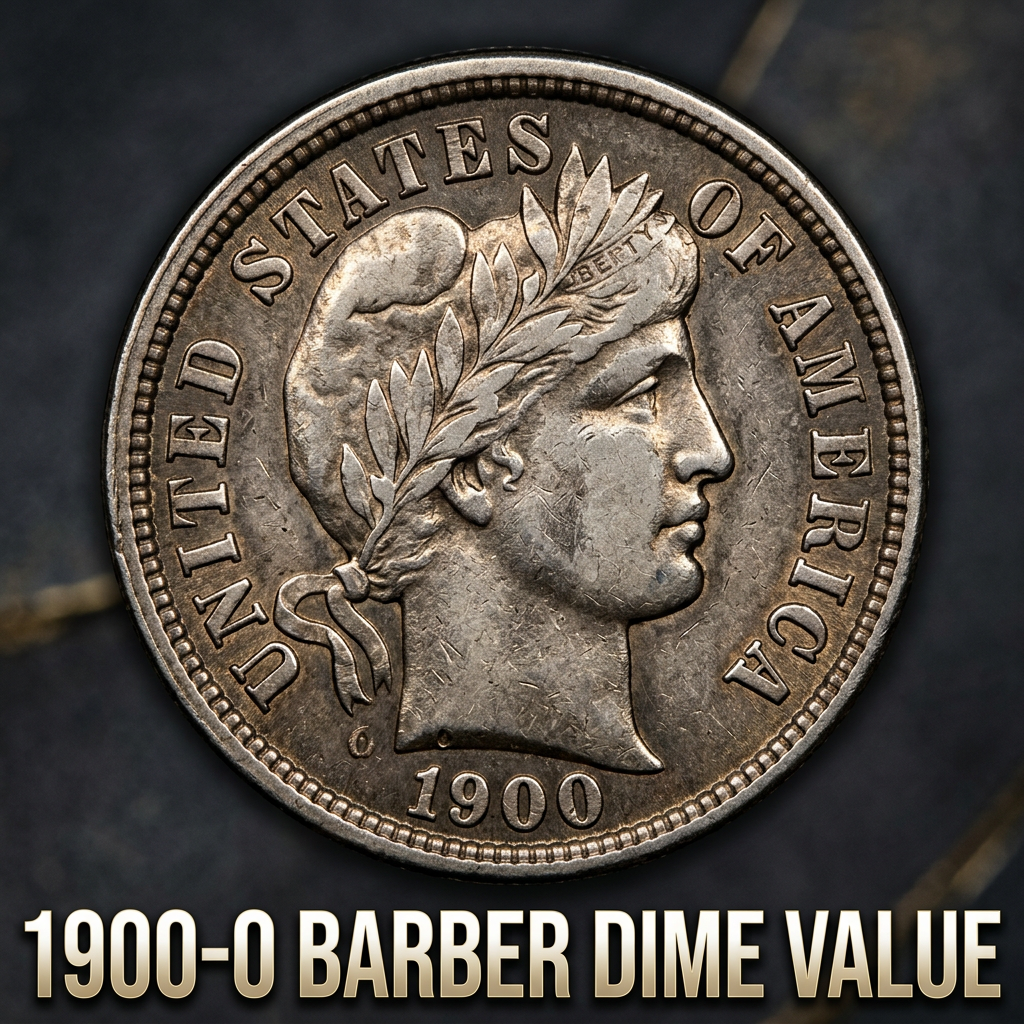
The 1900-O Barber Dime is worth anywhere from $5 in heavily worn condition to well over $200 in finer grades — and in rare high-mint-state examples, it can climb past $1,000. If you found one of these old silver dimes in a drawer, a coin jar, or a family collection, you may be sitting on something genuinely valuable. Read on to find out exactly what yours might be worth.
What Is the 1900-O Barber Dime?
The 1900-O Barber Dime was struck at the New Orleans Mint in 1900, part of the classic Barber coinage series designed by U.S. Mint Chief Engraver Charles E. Barber. The “O” mintmark on the reverse — just above the “E” in “ONE” — tells you it came from New Orleans, which operated as a U.S. Mint facility until 1909.
These dimes are made of 90% silver, giving them a melt value tied to the current silver spot price. But their numismatic (collector) value can far exceed that melt value depending on condition.
If you’re not sure what coin you’re holding or want a quick estimate without visiting a dealer, a coin identifier and value app can give you a solid starting point right from your phone.
The 1900-O had a mintage of 2,010,000 coins — respectable for the era but not enormous. That moderate mintage, combined with heavy circulation over more than a century, means well-preserved examples are genuinely scarce today.
How Much Is the 1900-O Barber Dime Worth by Grade?
Condition is everything in coin collecting. Most Barber Dimes that survived everyday use in 1900 are found in heavily worn (Good or Very Good) grades today. Only a lucky few made it to Mint State.
Here’s a general value guide based on grade:
| Grade | Description | Estimated Value |
|---|---|---|
| Good (G-4) | Heavily worn, date visible | $5 – $8 |
| Very Good (VG-8) | Moderate wear, some detail | $10 – $18 |
| Fine (F-12) | Even wear, clear legends | $22 – $35 |
| Very Fine (VF-20) | Light wear on high points | $45 – $75 |
| Extremely Fine (EF-40) | Slight wear, sharp design | $100 – $175 |
| About Uncirculated (AU-50) | Trace wear only | $200 – $300 |
| Mint State (MS-60+) | No wear, uncirculated | $500 – $1,500+ |
For a more detailed and regularly updated breakdown, check out this complete 1900 Barber Dime value guide that covers all mintmarks and grades in one place.
Key Things That Affect Your Coin’s Value
Beyond grade, a few other factors can move the needle on what your 1900-O Barber Dime is actually worth to a buyer.
Luster and eye appeal matter enormously in Mint State coins. A technically MS-62 coin with beautiful original luster may sell for more than an MS-63 with dull or cleaned surfaces. Cleaned coins — those that have been polished or washed — almost always sell for less, sometimes significantly so.
Strike quality is another factor. New Orleans Mint coins of this era were sometimes struck with slightly less sharpness than Philadelphia issues, so a sharply struck 1900-O is especially desirable.
Originality counts too. A coin with natural patina (called “original skin” by collectors) is generally preferred over one that has been artificially treated. Collectors and grading services can usually tell the difference.
If you want to check your coin’s condition and get an instant estimate on the go, CoinHix is a popular app among everyday collectors for quick photo-based coin identification and value lookups.
Is the 1900-O Barber Dime Rare?
In worn grades, the 1900-O Barber Dime is common enough that dealers and coin shops encounter them regularly. It’s not a key date like the 1895-O or 1894-S Barber Dime, which command enormous premiums.
However, the 1900-O becomes genuinely scarce in grades of Extremely Fine and above. Finding a true Mint State example with full luster and a sharp strike is a real challenge — and those coins attract serious collector interest.
In certified MS-65 or better, the 1900-O Barber Dime is rare enough that major auction houses treat them as significant offerings. Only a handful of such specimens are known to exist in top-tier grades.
So while your average circulated 1900-O is a nice find worth a few dollars above silver melt, a high-grade example could surprise you with its value. That’s why it always pays to look closely at what you have before spending or trading away old coins.
How to Find Out What Your 1900-O Dime Is Really Worth
The best first step is to examine the coin under good lighting and a magnifying glass. Look at the hair detail on Liberty’s portrait on the obverse and the eagle’s feathers on the reverse — the amount of detail remaining tells you a lot about grade.
Next, compare your coin to photos of graded examples available on major coin platforms. If you want an easier option, CoinHix lets you photograph your coin and get an AI-assisted identification and value estimate in seconds — no experience required.
For coins in Fine condition or better, getting a professional grade from PCGS or NGC is worth considering. A certified 1900-O Barber Dime is easier to sell and commands a premium over raw, ungraded examples.
—
FAQ About the 1900-O Barber Dime
Q: How do I find the mintmark on my 1900 Barber Dime?
A: Flip your dime over to the reverse side. Look just above the “E” in “ONE DIME” at the bottom of the coin. If you see a small “O,” your coin was made in New Orleans. No mintmark means it came from the Philadelphia Mint.
Q: Is a 1900-O Barber Dime made of real silver?
A: Yes. All Barber Dimes, including the 1900-O, are composed of 90% silver and 10% copper. Each coin contains approximately 0.0723 troy ounces of pure silver, giving it an intrinsic metal value tied to the current silver price.
Q: Should I clean my 1900-O Barber Dime before selling it?
A: No — never clean an old coin. Cleaning removes original surface patina and almost always reduces collector value significantly. Even light polishing can drop a coin’s grade and selling price. Leave it exactly as you found it.