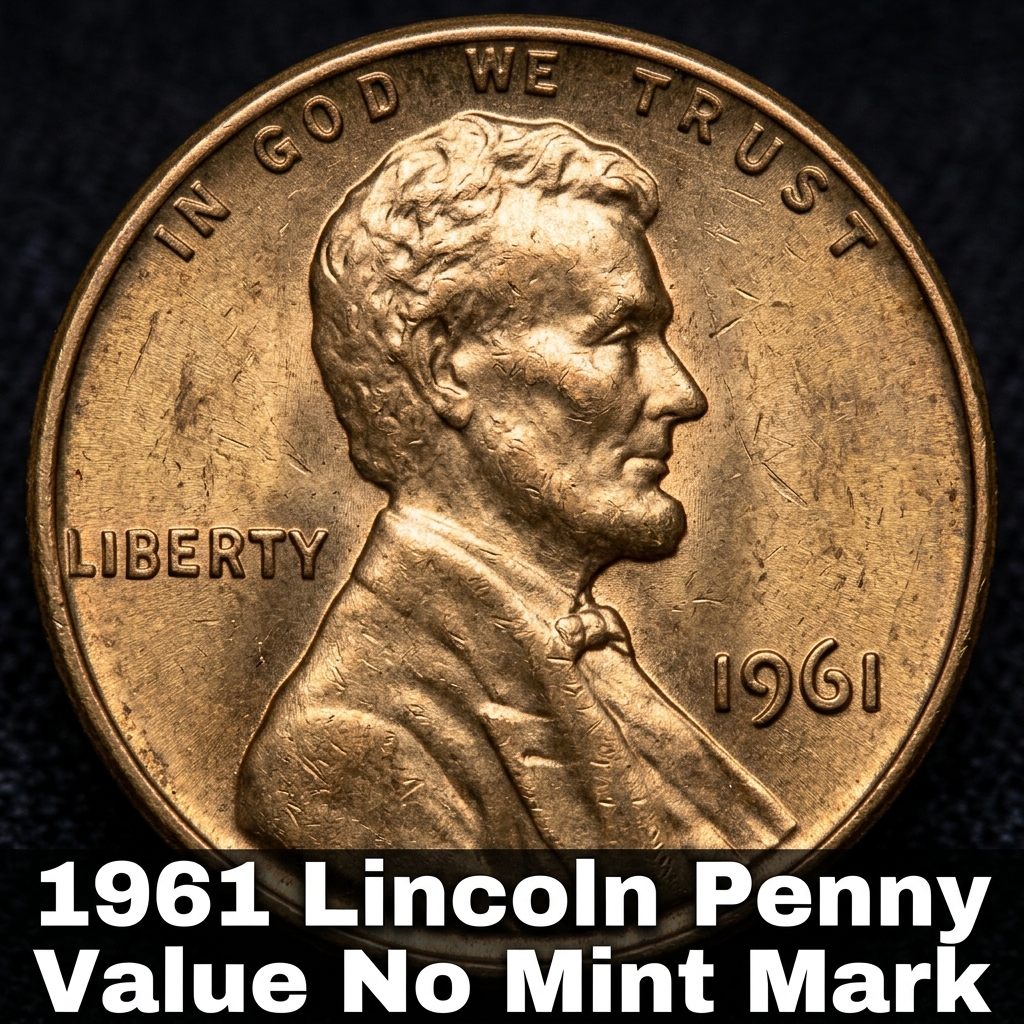
The 1961 Lincoln Penny with no mint mark is worth anywhere from a few cents in heavily worn condition to over $10 or more in certified mint state grades — and a handful of special examples have sold for much higher. If you found one of these coins rattling around in a jar or tucked in an old drawer, you’re in the right place to find out what it’s really worth.
What Does “No Mint Mark” Mean on a 1961 Penny?
When you flip a Lincoln penny over and look just below the date, you might notice a small letter — or nothing at all. That “nothing” is actually meaningful. A 1961 penny with no mint mark was struck at the Philadelphia Mint, which historically did not place a mint mark on its coins during this era.
Philadelphia was one of the most productive mints in the country, and 1961 was no exception. Over 753 million Lincoln cents were produced there that year. Because so many were made, most circulated examples are quite common.
That said, condition is everything in coin collecting. A heavily worn 1961 no mint mark penny might only be worth its face value of one cent, while a pristine, uncirculated example can fetch a surprising premium.
If you’re not sure what you’ve got, using a coin identifier and value app is one of the easiest ways to get a quick read on your coin’s grade and approximate value without needing to visit a coin shop.
How Much Is the 1961 Lincoln Penny Worth in Different Conditions?
Here’s where things get interesting. The value of a 1961 penny with no mint mark changes dramatically depending on its condition — what collectors call its “grade.”
A coin that’s been passed from hand to hand for decades will show heavy wear on Lincoln’s portrait and the wheat stalks (if you have the reverse side). These are worth face value to maybe a few cents at most.
Coins in “About Uncirculated” condition — meaning they show only slight wear from limited handling — start to be worth a few dollars. Fully uncirculated coins graded MS-63 or higher begin to attract real collector interest.
| Grade / Condition | Estimated Value |
|---|---|
| Good (G-4) – Heavy Wear | $0.01 – $0.05 |
| Fine (F-12) – Moderate Wear | $0.05 – $0.15 |
| Extremely Fine (EF-40) | $0.25 – $0.75 |
| About Uncirculated (AU-50) | $1.00 – $3.00 |
| Mint State MS-63 (Red-Brown) | $3.00 – $6.00 |
| Mint State MS-65 (Full Red) | $8.00 – $15.00 |
| MS-67 or Higher (Red) | $50.00+ |
For a more detailed breakdown, you can check out the 1961 Lincoln Penny MS Red price data on CoinHix, which tracks real auction results and certified coin values across multiple grades.
What Makes a 1961 Penny More Valuable?
Not all 1961 pennies are created equal, even among the Philadelphia issues. Several factors push value up significantly.
Color designation is a big one. Uncirculated copper coins are graded not just by sharpness, but by how much of their original red mint luster remains. A coin labeled “RD” (Red) commands the highest prices. “RB” (Red-Brown) is next, and “BN” (Brown) is the most common and least valuable among uncirculated examples.
Strike quality matters too. A sharply struck coin with crisp details on Lincoln’s cheekbone and the lettering will always outperform a weakly struck piece of the same technical grade.
Error coins are the big wild cards. Some 1961 pennies were struck with doubled dies, off-center strikes, or repunched dates. These anomalies can turn an otherwise ordinary cent into something worth hundreds of dollars. Always look closely at your coin under a magnifying glass before assuming it’s common.
CoinHix is a great tool to check current market values and see how error varieties of the 1961 penny have sold at recent auctions.
Should You Get Your 1961 Penny Graded?
For most circulated examples, professional grading isn’t worth the cost — the grading fee alone (typically $20–$40 per coin) would far exceed the coin’s value. But if your 1961 penny looks like it’s never been touched, has brilliant red luster, and shows no signs of cleaning or damage, it might be worth submitting to PCGS or NGC for certification.
A certified MS-67 or MS-67+ example in full red can sell for $100 or more, and top-population coins have gone even higher in major auction houses.
If you’re unsure whether your coin is worth grading, CoinHix can help you compare your coin’s visual appearance to graded examples and get a realistic sense of its potential market value before you invest in the certification process.
You can also explore a full guide to 1961 penny values by date and mint mark to compare the Philadelphia issue against the 1961-D (Denver) version and understand where your coin fits in the bigger picture.
—
FAQ
Q: Is a 1961 penny with no mint mark rare?
A: No, the 1961 Philadelphia penny is one of the more common Lincoln cents. Over 753 million were minted. However, high-grade examples — especially those graded MS-67 in full red — can still be scarce and valuable.
Q: How can I tell if my 1961 penny has been cleaned?
A: A cleaned coin often looks too bright or shiny in an unnatural way, with fine hairline scratches visible under magnification. Genuine mint luster has a cartwheel-like sheen when you tilt the coin in light. Cleaned coins are worth significantly less to collectors.
Q: Where is the best place to sell a valuable 1961 Lincoln penny?
A: For certified high-grade coins, major auction platforms like Heritage Auctions or Stack’s Bowers are excellent options. For more common examples, eBay or a local coin dealer works well. Always research recent sold prices before listing your coin.