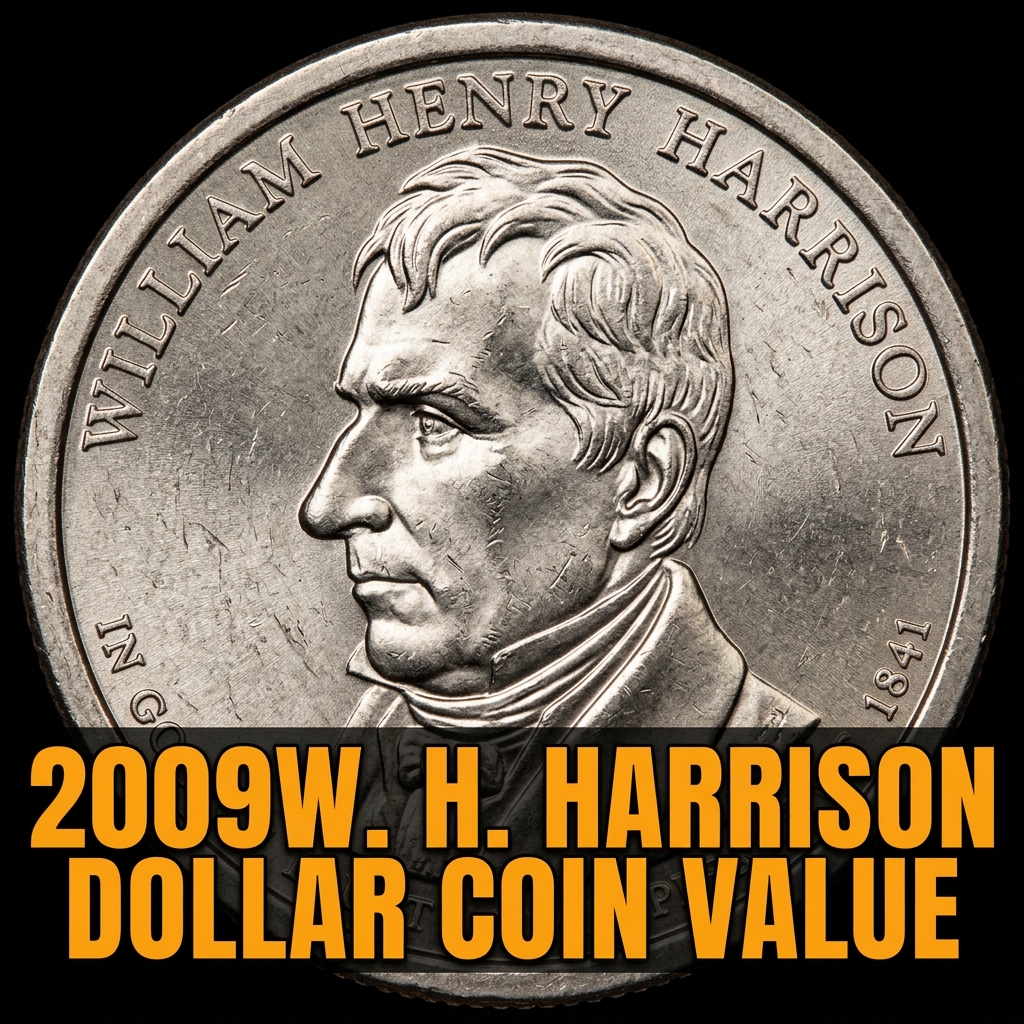
The 2009 William Henry Harrison Dollar coin is worth between $1.25 and $5 for most circulated examples, but uncirculated specimens in top condition can fetch $10 to $25 or more among collectors. If you recently found one of these golden dollar coins in your change or tucked away in a drawer, you’re in the right place to find out exactly what you’ve got.
What Is the 2009 W. H. Harrison Dollar Coin?
The 2009 William Henry Harrison Dollar is part of the Presidential Dollar series launched by the U.S. Mint in 2007. Each year, the Mint releases coins honoring former U.S. presidents in the order they served, and Harrison — the 9th president — made his appearance in 2009 alongside John Tyler, James K. Polk, and Zachary Taylor.
These coins are golden in color (though they contain no actual gold) thanks to a manganese-brass composition. They measure 26.5 mm in diameter and weigh 8.1 grams. The obverse features a detailed portrait of Harrison with his name, the years he served, and his order of presidency inscribed. The reverse displays the Statue of Liberty.
If you’re not sure which coin you’re holding, a coin identifier and value app can help you quickly confirm the year, mint mark, and series before you estimate its worth.
How Much Is the 2009 Harrison Dollar Worth Today
For most people who find one in everyday pocket change, the 2009 W. H. Harrison Dollar is worth its face value of $1 — or just a little more. Circulated coins in average condition typically trade for $1.25 to $2.00 in the collector market.
However, coins that have never been used — known as uncirculated or mint state coins — are where the value starts to climb. A coin graded MS65 by a professional grading service like PCGS or NGC can be worth $5 to $15. The rare high-grade MS67 examples can sell for $20 to $30 or more.
There’s also a special Proof version of this coin, struck at the San Francisco Mint with a mirror-like finish for collectors. Proof coins in PR69 or PR70 condition typically sell in the $10 to $30 range.
| Coin Type | Condition / Grade | Estimated Value |
|---|---|---|
| 2009-P Harrison Dollar | Circulated (Average) | $1.25 – $2.00 |
| 2009-P Harrison Dollar | Uncirculated MS63 | $3.00 – $5.00 |
| 2009-P Harrison Dollar | Uncirculated MS65 | $5.00 – $15.00 |
| 2009-D Harrison Dollar | Uncirculated MS65 | $5.00 – $15.00 |
| 2009-S Harrison Dollar (Proof) | PR69 | $12.00 – $20.00 |
| 2009-S Harrison Dollar (Proof) | PR70 | $25.00 – $35.00 |
Mint Marks and Mintage Numbers
The 2009 Harrison Dollar was produced at two main mints: Philadelphia (P) and Denver (D). The Philadelphia Mint struck approximately 43.3 million coins, while Denver produced around 55.16 million. Because mintage numbers were relatively high, these coins aren’t rare in the traditional sense.
However, production of Presidential Dollars for general circulation was actually discontinued after 2011, making earlier-date examples like the 2009 issues slightly more interesting to collectors over time.
The San Francisco Mint produced a smaller number of Proof coins exclusively for collector sets — these are the ones worth keeping an eye on. Mintage for the 2009-S Proof Harrison Dollar was approximately 2.8 million, which is modest by modern standards.
If you’re curious how presidential dollar values compare to other collectible coins — such as rare Eisenhower dollar values and key dates — you’ll find that series history and condition play a huge role in pricing.
What Makes a 2009 Harrison Dollar More Valuable
Most of these coins are common, but a few factors can push the value higher. First, look for coins that appear bright, fully lustrous, and free of scratches or bag marks — these are signs of a high-grade uncirculated coin.
Second, check whether your coin has any errors. Known error types on Presidential Dollars include edge lettering errors (where the date, mint mark, and motto “E PLURIBUS UNUM” are stamped on the edge). Some coins were released missing the edge lettering entirely — these are called “Smooth Edge” or “Missing Edge Lettering” errors, and they can be worth $50 to $200 depending on the mint and grade.
Third, consider getting your coin professionally graded if you believe it’s in exceptional condition. Slabbed coins (graded by PCGS or NGC) generally sell for more at auction than raw, ungraded coins.
You can use CoinHix to quickly research recent sale prices for Presidential Dollars before deciding whether to get yours graded or sell it. CoinHix tracks live market data so you’re never guessing when it comes to what buyers are actually paying.
For broader dollar coin pricing data, you can also browse current dollar coin price trends and market values to better understand how the collector market is moving.
Should You Keep or Sell Your 2009 Harrison Dollar
If your coin is just a worn, circulated example, it’s worth holding onto as a fun piece of American history but probably not worth selling individually. On the other hand, if your coin is bright, uncirculated, or shows a possible error, it could be worth more than you think.
The best approach is to examine the coin under good lighting, compare it to grading photos online, and use a tool like CoinHix to check current sold listings. That way, you’ll have real data before making any decision.
Presidential Dollars are still underappreciated by many collectors, which means there’s still room for good deals — both for buyers and sellers — in this series.
FAQ About the 2009 W. H. Harrison Dollar
Q: Is the 2009 W. H. Harrison Dollar made of gold?
A: No. Despite its golden appearance, the coin is made from a manganese-brass alloy. It contains no gold and has a face value of $1.
Q: How do I know if my 2009 Harrison Dollar has a missing edge lettering error?
A: Roll the coin on its edge and look for the inscribed text that should include the year, mint mark, and motto. If the edge is completely smooth and blank, you may have a valuable error coin worth getting professionally examined.
Q: Where is the best place to sell a 2009 Harrison Dollar?
A: eBay is the most popular platform for selling individual collector coins. For graded or higher-value specimens, Heritage Auctions or PCGS CoinFacts are also good options. Always check recent sold prices before listing.