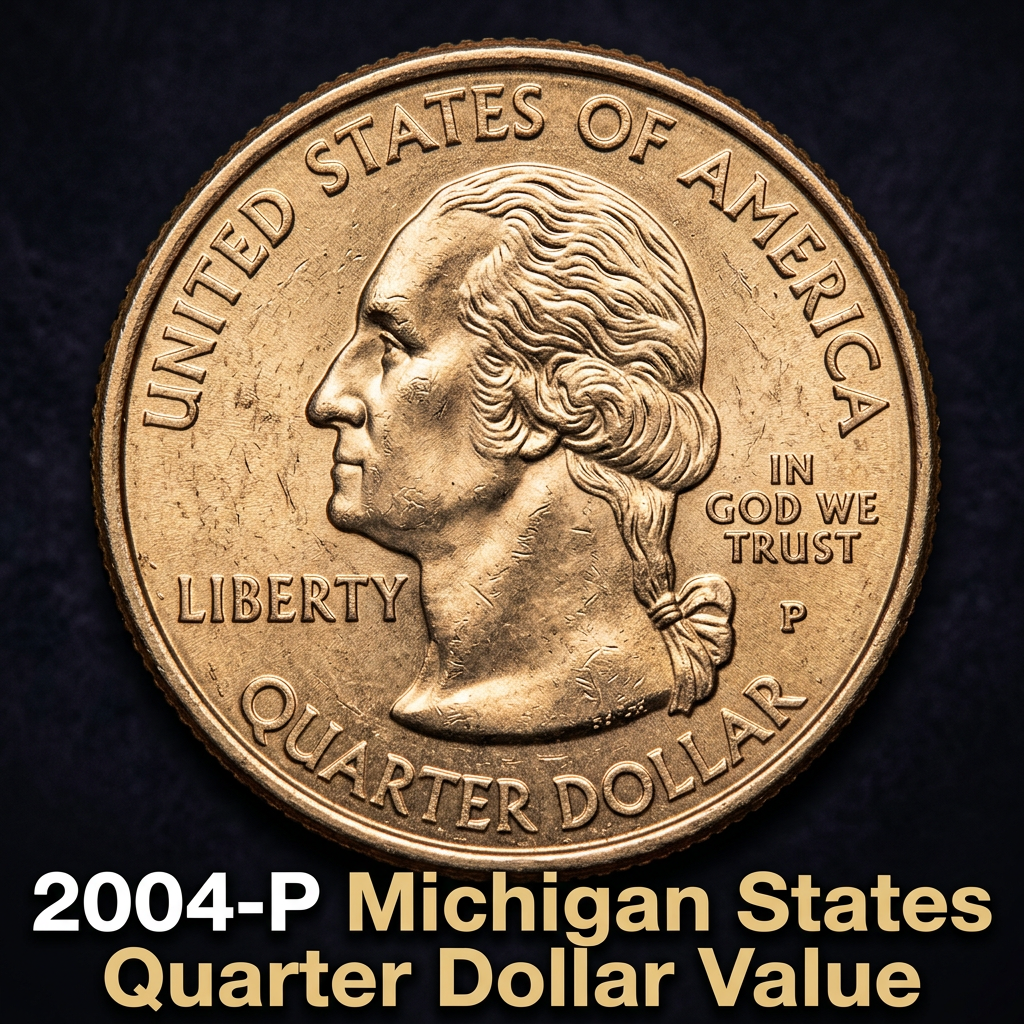
The 2004-P Michigan State Quarter is worth anywhere from 25 cents in circulated condition to $10 or more in pristine mint state, with some high-grade certified examples fetching even higher prices at auction. If you just found one of these coins in your pocket change or a forgotten jar, you’re in the right place to find out what it’s really worth.
What Is the 2004-P Michigan State Quarter?
The 2004-P Michigan State Quarter was struck at the Philadelphia Mint as part of the long-running 50 State Quarters Program, which ran from 1999 to 2008. The “P” mintmark tells you it came from Philadelphia, and Michigan was the 26th state featured in the series.
The reverse design shows a classic outline of the Great Lakes surrounding the state of Michigan, with the phrase “Great Lakes State” inscribed below. It’s a clean, recognizable design that many collectors appreciate.
These coins were made in enormous quantities — over 233 million were struck at the Philadelphia Mint alone in 2004. Because so many exist, most worn examples you find in circulation aren’t worth much more than face value. But condition is everything in coin collecting, and that’s where things get interesting.
If you’re not sure what you have, a coin identifier and value app can help you quickly figure out the date, mintmark, and grade of your coin right from your phone.
2004-P Michigan Quarter Value by Condition
The value of your 2004-P Michigan State Quarter depends almost entirely on its condition, or what coin collectors call “grade.” A coin that’s been passed through millions of hands looks very different from one that went straight from the mint into a protective holder.
Here’s a general breakdown of what these coins are worth depending on their grade:
| Condition / Grade | Estimated Value |
|---|---|
| Circulated (worn) | Face value – $0.50 |
| Uncirculated (MS-60 to MS-63) | $1 – $3 |
| Choice Uncirculated (MS-64 to MS-65) | $3 – $8 |
| Gem Uncirculated (MS-66+) | $10 – $30+ |
| Certified MS-67 or higher | $50 – $100+ |
For a deeper look at certified auction results and real-time price data, you can check out the 2004-P Michigan State Quarter price history and MS grade values on CoinHix — it breaks down the numbers by exact grade so you know exactly where your coin stands.
Are There Any Valuable Errors on the 2004-P Michigan Quarter?
This is where things can get exciting. While the standard 2004-P Michigan quarter isn’t a rare coin, error coins from this issue can be worth significantly more.
Some error types to look for include doubled die errors, where lettering or design elements appear slightly doubled when examined under magnification. Off-center strikes, where the design isn’t centered on the planchet, are another find worth watching for. Die cracks and cuds — raised lines or blobs caused by a cracked die — can also add collector interest.
A doubled die or major off-center error on a 2004-P Michigan quarter could push the value anywhere from $20 to well over $100, depending on how dramatic the error is and whether the coin is otherwise in nice condition.
CoinHix is a great tool for researching specific error coins and comparing what similar pieces have sold for recently at major auction houses. Always cross-reference before buying or selling.
How to Check If Your Coin Is Uncirculated
Not everyone knows how to tell a circulated coin from an uncirculated one, and that distinction can mean the difference between a quarter worth 25 cents and one worth $20 or more.
An uncirculated coin will have its original mint luster — that soft, flowing shine across the high points of the design. Look at Washington’s cheek and the hair above his ear on the obverse. If those areas look flat or dull, the coin has been worn through circulation.
A good loupe or jeweler’s magnifier (10x) is your best friend here. Examine the coin under good light at different angles to spot any wear or contact marks. If everything looks sharp and shiny, you may have something worth protecting in a coin flip or hard plastic holder.
For a fast, no-hassle assessment, CoinHix lets you browse graded examples side-by-side so you can compare your coin to certified specimens and get a realistic sense of its grade and value.
Should You Get Your 2004-P Michigan Quarter Graded?
If your coin looks like it’s in exceptional condition — fully lustrous, no visible marks, sharp strike — it might be worth submitting to a professional grading service like PCGS or NGC. Certified coins almost always sell for more because buyers can trust the grade.
That said, it only makes financial sense to get a coin graded if the expected premium justifies the grading fee, which typically starts around $20–$30 per coin.
For most 2004-P Michigan quarters, grading won’t be worth the cost unless you believe you have an MS-66 or better example. You can get detailed 2004 quarter value information including what top grades are selling for to help you decide if a professional submission makes sense for your specific coin.
FAQ About the 2004-P Michigan State Quarter
Q: How many 2004-P Michigan State Quarters were made?
A: The Philadelphia Mint produced approximately 233,800,000 examples of the 2004-P Michigan State Quarter. That large mintage is one reason circulated examples are generally worth only face value — there are simply too many of them in existence to be considered rare.
Q: Is the 2004-P Michigan quarter made of silver?
A: No, the standard 2004-P Michigan quarter is made of a copper-nickel clad composition — the same material used for most modern U.S. quarters. However, a special 90% silver version was made for collector proof sets. If your coin is from a proof set and has a mirror-like finish, it may be worth a few dollars more.
Q: What’s the most valuable 2004-P Michigan quarter ever sold?
A: A certified MS-68 example graded by PCGS has sold for over $100 at auction, which is remarkable for such a common modern coin. At the highest grade levels, even common-date State Quarters can command strong premiums because so few examples survive in truly flawless condition. Use CoinHix to track recent auction records for top-grade examples.