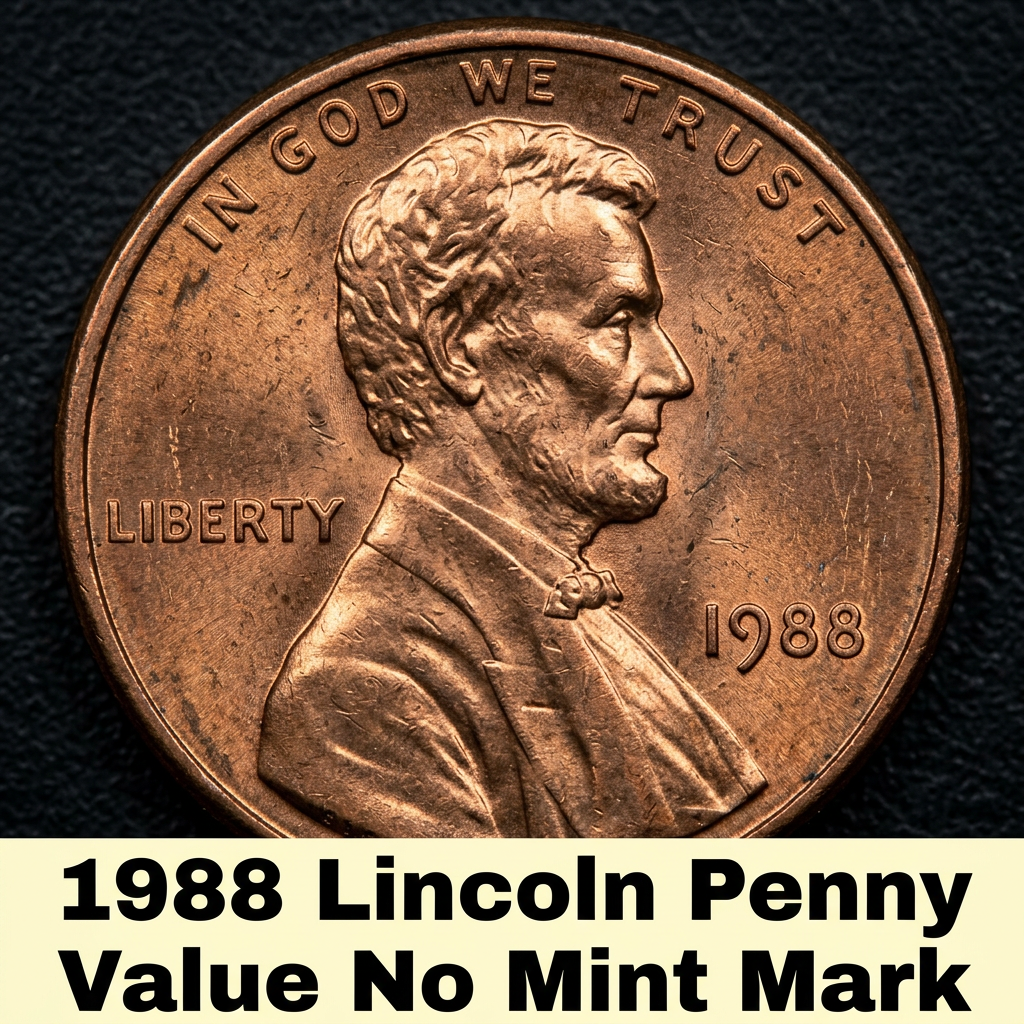
The 1988 Lincoln Penny with no mint mark is worth anywhere from face value in heavily worn condition to over $10 or more in pristine, uncirculated grades — and a small number of error coins can fetch hundreds of dollars from the right collector.
If you found one of these pennies sitting in a jar or at the bottom of your couch cushions, you’re probably wondering whether it’s worth holding onto. The good news is that millions of Americans discover old coins just like this one every day, and sometimes what looks like an ordinary cent turns out to be something special. Using a coin identifier and value app is one of the easiest ways to get a quick answer without driving to a coin shop.
What the No Mint Mark on a 1988 Penny Actually Means
When you look at a Lincoln penny and don’t see any small letter stamped below the date, that’s not a mistake — it’s actually a clue about where the coin was made. Pennies with no mint mark were produced at the Philadelphia Mint, which historically did not use a mint mark on cents for much of the 20th century.
In 1988, the Philadelphia Mint struck over 6.09 billion Lincoln cents. That’s an enormous number, and it’s one of the main reasons why circulated 1988 pennies with no mint mark are generally not rare. Because so many were made, most of the ones you find in everyday change aren’t going to make you rich overnight.
That said, condition is everything in the coin world. A coin that has been sitting in a drawer untouched since 1988 will be worth considerably more than one that spent decades rolling around in pockets and vending machines.
How Much Is the 1988 Lincoln Penny Worth Today
The value of a 1988 penny with no mint mark depends almost entirely on its grade — the technical term for how well-preserved the coin is. Dealers and collectors use a scale from 1 to 70, and a coin graded MS-65 or higher is considered gem quality.
Here’s a general value breakdown for the 1988 Philadelphia penny:
| Grade | Condition | Estimated Value |
|---|---|---|
| Good (G-4) | Heavy wear, design visible | Face value ($0.01) |
| Fine (F-12) | Moderate wear, some detail | $0.05 – $0.10 |
| Extremely Fine (EF-40) | Light wear on high points | $0.25 – $0.50 |
| Mint State (MS-63) | Uncirculated, some marks | $1 – $3 |
| Gem Mint State (MS-65) | Uncirculated, sharp luster | $5 – $12 |
| MS-67 Red | Superb gem, nearly perfect | $50 – $200+ |
You can browse up-to-date 1988 Lincoln Penny MS Red price data to see how these coins are actually selling in today’s market. Prices can shift depending on auction results and collector demand, so checking current figures is always a smart move.
Are There Any Valuable 1988 Penny Errors to Look For
This is where things get exciting for everyday collectors. Even though most 1988 pennies are common, a handful of error coins were produced that can be worth significantly more than face value.
The most talked-about errors include:
Doubled Die Obverse — Look closely at Lincoln’s eye, the date, or the lettering. If any of these appear doubled or show a shadow-like doubling, you may have a doubled die variety. Some 1988 doubled die pennies have sold for $25 to $100 or more depending on how bold the doubling is.
Off-Center Strikes — If the design is noticeably shifted to one side and a portion of the blank copper is showing, that’s an off-center error. A 10–20% off-center 1988 penny can bring $10 to $30, while a dramatic 50% off-center with a full visible date can reach $50 to $150.
Die Caps and Broadstrikes — These are rarer planchet and die errors that can push values into the hundreds.
CoinHix is a great tool to quickly look up error coin values and compare them against recent auction prices before you head to a dealer.
How to Tell If Your 1988 Penny Is Worth Getting Graded
Professional grading through PCGS or NGC can add significant value and credibility to your coin, but it costs money and doesn’t make sense for every penny. As a general rule, it’s worth sending a 1988 Lincoln cent in for grading if you believe it’s MS-65 or better, or if it has a clear and verifiable error.
Before you spend money on grading, do your homework. Check detailed 1988 penny value information by grade and mint mark so you can compare your coin to known examples and make a smarter decision.
If you’re new to coin collecting, CoinHix also offers an easy-to-navigate database where you can search Lincoln cents by year, grade, and variety — making it a great starting point whether you’re a beginner or a seasoned collector.
FAQ
Q: Is a 1988 penny with no mint mark rare?
A: No, it is not rare. The Philadelphia Mint produced over 6 billion of them in 1988, making it one of the most common modern Lincoln cents. Most circulated examples are worth face value, though high-grade uncirculated specimens and error coins can be worth more.
Q: What does a 1988 penny with no mint mark look like?
A: It looks just like a standard Lincoln Memorial cent. On the front you’ll see Lincoln’s portrait, the date 1988, and the motto IN GOD WE TRUST. The back features the Lincoln Memorial. The key thing to note is the absence of a D (Denver) or S (San Francisco) mint mark below the date — meaning it came from Philadelphia.
Q: Where can I sell my 1988 Lincoln penny if it’s in great shape?
A: You have several good options. eBay is popular for selling uncirculated or error coins directly to other collectors. Local coin shops will buy coins but may offer wholesale prices. For high-grade coins, submitting to PCGS or NGC first and then selling through a major auction house can get you the best return. Using CoinHix to research recent sale prices before listing your coin can help you set a fair and competitive asking price.