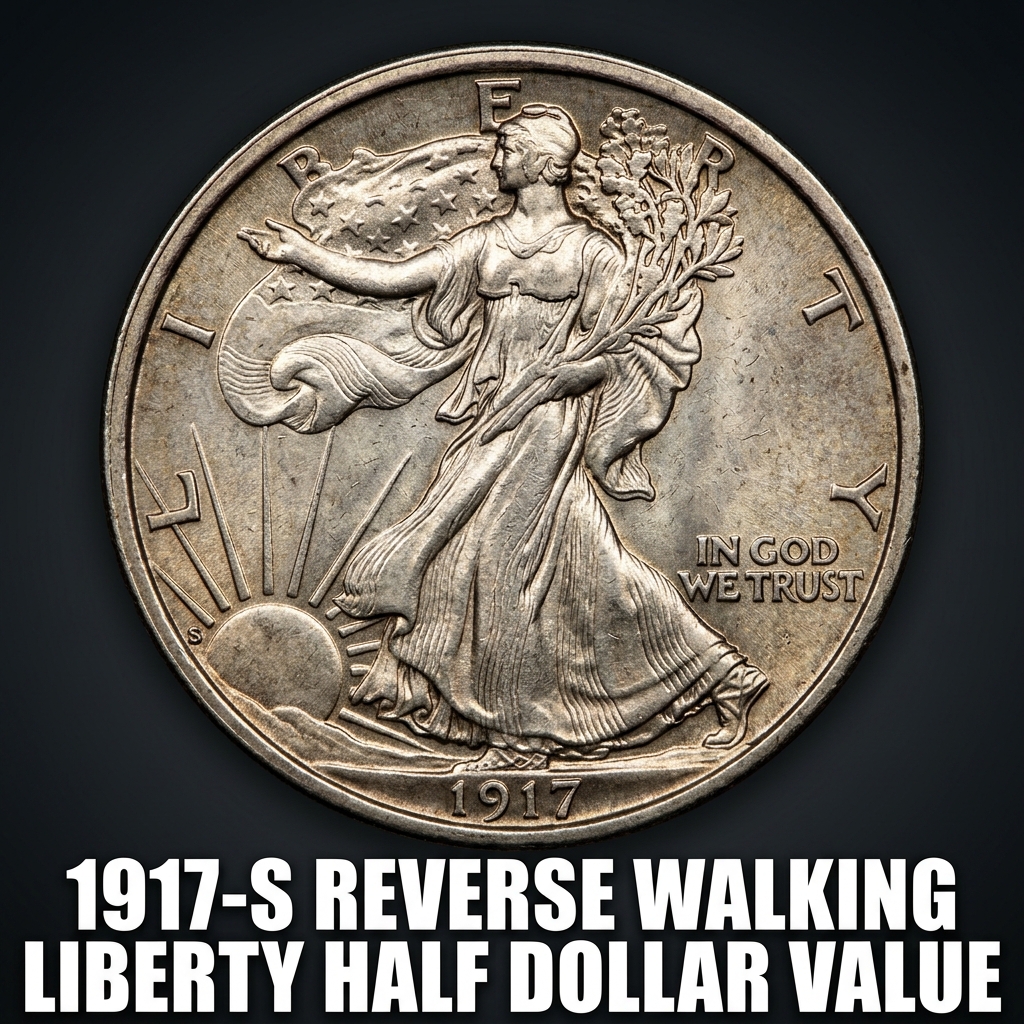
The 1917-S Reverse Walking Liberty Half Dollar is worth anywhere from $25 in heavily worn condition to well over $1,500 or more in higher mint state grades. If you’ve stumbled across one of these beautiful old coins, you may be sitting on something genuinely valuable — and this guide will help you figure out exactly what you’ve got.
What Makes the 1917-S Reverse So Special?
The year 1917 was a transitional one for the Walking Liberty Half Dollar. The Philadelphia Mint had been placing the mintmark on the obverse (front) of the coin, but mid-year, both the San Francisco and Denver Mints switched to placing the “S” or “D” mintmark on the reverse (back), just below the eagle’s tail feathers. This is why collectors distinguish between the 1917-S Obverse and the 1917-S Reverse — they are considered two separate coins entirely.
The 1917-S Reverse had a mintage of 5,554,000 pieces, which is reasonably large by early Walking Liberty standards. However, most of these coins were heavily circulated, making well-preserved examples genuinely scarce today.
If you’re trying to identify which version you have, a coin identifier and value app can help you pinpoint the mintmark location quickly and accurately — even from a photo taken on your phone.
How to Find the Mintmark and Confirm What You Have
Locating the mintmark is your first step. On the 1917-S Reverse, flip the coin over to the reverse side — the side showing an eagle in flight. Look at the lower left area, just below the pine branch and above the motto “E PLURIBUS UNUM.” You should see a small “S” there.
If the “S” is instead on the front of the coin, near Lady Liberty’s hand, then you have the 1917-S Obverse variety, which carries different values entirely. Getting this right matters a lot when you’re trying to price your coin accurately.
Once you’ve confirmed the mintmark location, check the overall condition. Worn, smooth coins with little detail remaining are worth far less than coins that still show feather detail on the eagle or the fine lines in Liberty’s gown. Condition — what coin collectors call “grade” — is the single biggest factor driving value.
1917-S Reverse Walking Liberty Half Dollar Value by Grade
Here’s a general breakdown of what this coin is worth depending on its condition:
| Grade / Condition | Estimated Value |
|---|---|
| Good (G-4) – heavily worn | $25 – $35 |
| Very Good (VG-8) | $35 – $55 |
| Fine (F-12) | $55 – $90 |
| Very Fine (VF-20) | $90 – $160 |
| Extremely Fine (EF-40) | $160 – $275 |
| About Uncirculated (AU-50) | $275 – $500 |
| Mint State (MS-63) | $700 – $1,200 |
| Mint State (MS-65) | $1,500 – $3,000+ |
For the most current auction data and retail pricing on this specific coin, you can check detailed 1917 Walking Liberty Half Dollar price records by grade to see real sale results from recent markets.
Silver Content and Melt Value
Even if your coin is heavily worn and doesn’t command a big collector premium, it’s still made of 90% silver. Each Walking Liberty Half Dollar contains 0.3617 troy ounces of pure silver. With silver prices fluctuating, this means even the most beat-up example has a base melt value that generally falls in the $8 to $12 range or higher depending on the current spot price.
This is important to know because it sets a floor — no one should be selling a genuine 1917-S Reverse for less than its silver melt value, no matter the condition.
CoinHix is a great free tool that automatically updates silver melt values for common U.S. coins, so you always know what the metal alone is worth before you even consider collector value.
How to Get the Best Price for Your Coin
If you think you have a higher-grade example, consider having it professionally graded by PCGS or NGC. Slabbed (certified) coins typically sell for significantly more than raw, ungraded coins because buyers trust the grade. For lower-grade coins, selling to a local coin dealer or through online platforms like eBay is usually straightforward.
For a quick and easy reference, this detailed 1917 Half Dollar value guide breaks down pricing across all grades and mint varieties, making it simple to understand what a fair offer looks like.
CoinHix also lets you scan your coin and get an instant estimated value range, which is handy if you’re at a coin show or flea market and need to make a quick decision.
FAQ
Q: How do I tell the 1917-S Reverse apart from the 1917-S Obverse?
A: Look at both sides of the coin. On the Reverse variety, the “S” mintmark is found on the back of the coin, below the eagle near the lower left. On the Obverse variety, the mintmark is on the front, near Lady Liberty’s left hand at the bottom of the design.
Q: Is the 1917-S Reverse Walking Liberty Half Dollar rare?
A: It’s not considered rare in worn grades, since nearly 5.6 million were minted. However, finding one in Extremely Fine or Mint State condition is genuinely difficult, and those examples can be worth several hundred to several thousand dollars.
Q: Should I clean my 1917-S Reverse Walking Liberty Half Dollar before selling it?
A: Absolutely not. Cleaning a coin — even with gentle polishing — permanently damages its surface and dramatically reduces its collector value. A naturally toned, uncleaned coin is always worth more to serious buyers than a cleaned one.