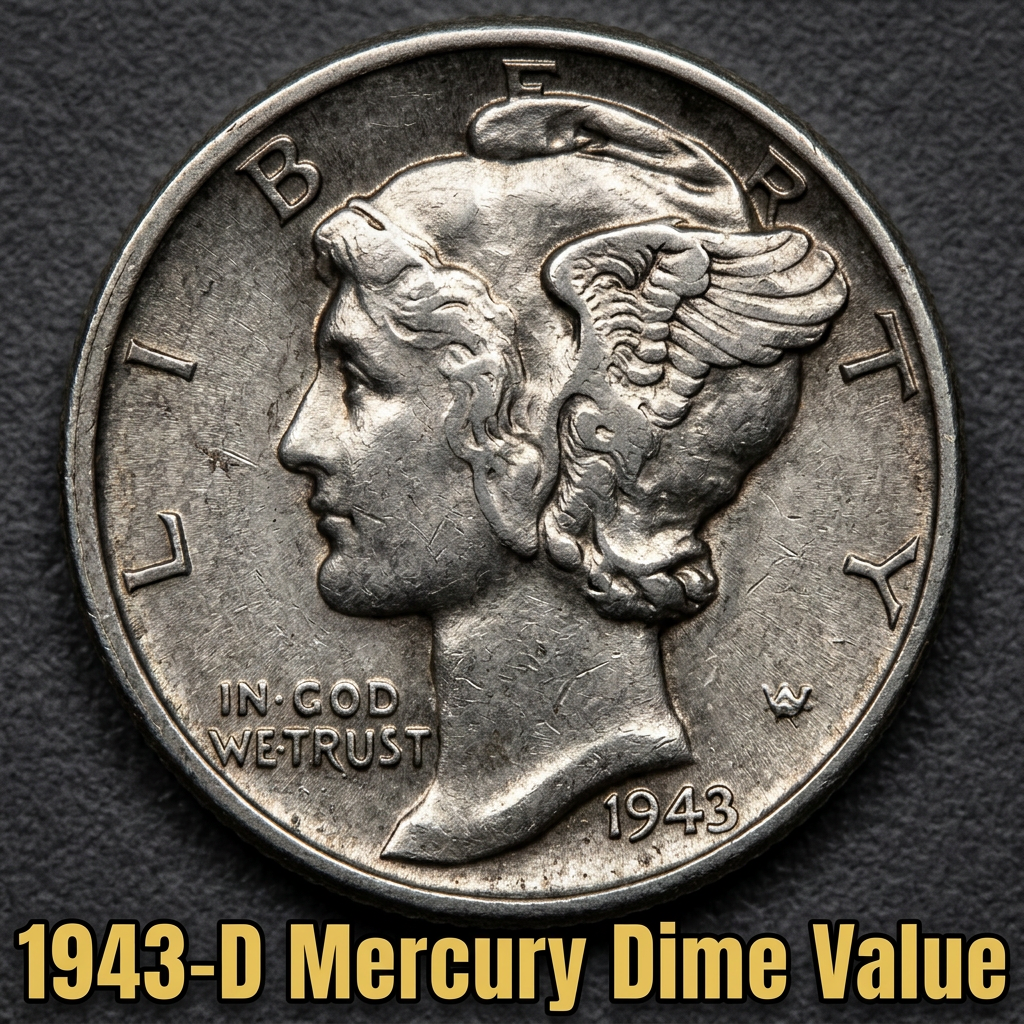
The 1943-D Mercury Dime is worth anywhere from $3 to $5 in heavily worn condition to well over $30 in uncirculated grades — and in top mint state examples, it can fetch hundreds of dollars at auction. If you’ve found one of these small silver coins from Denver, you’re in luck, because even in average shape, it’s worth more than face value.
coin identifier and value app tools can help you quickly identify what you have and get a ballpark value before you head to a dealer or auction site.
What Is the 1943-D Mercury Dime?
The 1943-D Mercury Dime is a 10-cent coin struck at the Denver Mint during World War II. The “D” mintmark appears on the reverse side of the coin, just to the right of the fasces bundle — the bundle of rods with an axe head. It was a high-production year, with over 71 million of these dimes made, which is why circulated examples are relatively easy to find.
The coin features a design by Adolph Weinman that many collectors consider one of the most beautiful in American numismatic history. The obverse shows a young Liberty wearing a winged cap — often mistaken for the Roman god Mercury, which is how the coin got its nickname. The reverse displays a Roman fasces, symbolizing strength through unity, which had deep meaning during wartime.
The coin is made of 90% silver and 10% copper. That silver content alone gives it a base melt value of roughly $2 to $2.50 depending on current silver spot prices, meaning even the most worn examples have real intrinsic value.
1943-D Mercury Dime Value by Grade
Coin values depend heavily on condition, or “grade.” Dealers and collectors use a scale from 1 (barely identifiable) to 70 (perfect). Here’s a general breakdown of what a 1943-D Mercury Dime is worth at different grades:
| Grade | Condition Description | Estimated Value |
|---|---|---|
| G-4 (Good) | Heavy wear, outlines visible | $3 – $4 |
| VF-20 (Very Fine) | Moderate wear, decent detail | $5 – $8 |
| EF-40 (Extremely Fine) | Light wear on high points | $10 – $15 |
| MS-63 (Choice Uncirculated) | No wear, minor blemishes | $30 – $50 |
| MS-65 (Gem Uncirculated) | Sharp strike, strong luster | $60 – $100+ |
| MS-67 (Superb Gem) | Near perfect, rare at this level | $300 – $800+ |
For up-to-date certified coin prices across auction records, you can browse 1943 Mercury Dime MS grade price data to see how recent sales are trending.
What Makes Some 1943-D Dimes Worth More?
Not all 1943-D Mercury Dimes are created equal. A few factors can push value significantly higher than the typical range.
The most important factor beyond grade is the Full Bands (FB) designation on the reverse. This refers to the horizontal bands crossing the middle of the fasces on the reverse. When these bands are fully struck and separated, the coin earns an FB designation from grading services like PCGS or NGC — and that can double or even triple the coin’s value at higher grades.
Strike quality varied by die and planchet batch at the Denver Mint in 1943, so finding a sharply struck coin with strong luster and minimal contact marks is genuinely special. Collectors pay serious premiums for these coins because they’re hard to find compared to the overall mintage.
Eye appeal also matters. A coin with original, undisturbed mint luster will always attract more buyer interest than one that’s been cleaned. Never clean your old coins — it permanently damages the surface and kills the numismatic value.
How to Check If Your 1943-D Mercury Dime Is the Real Deal
First, look for the “D” mintmark on the reverse, just above the word “ONE” and next to the base of the fasces. It should be a small letter D, clearly struck into the metal.
Next, check the date on the obverse — it should read 1943. Then look at the edge of the coin. A genuine Mercury Dime will have a reeded (ridged) edge. If the edge looks smooth or the coin seems thicker or heavier than normal, it could be a counterfeit or a different coin entirely.
You can also use CoinHix to scan and identify the coin instantly. The app reads mintmarks, dates, and condition clues to give you a fast, reliable starting point for valuation — which is perfect if you’re sorting through a jar of old coins and want quick answers.
If you want a more detailed breakdown of how the 1943 dime compares across different mint marks and conditions, this 1943 dime value guide with full condition details walks through everything clearly.
Should You Sell, Hold, or Get It Graded?
If your 1943-D Mercury Dime shows heavy wear, selling it for its silver melt value or a slight premium to a local dealer is probably your best move. It’s a common date and won’t command large premiums in low grades.
However, if the coin looks bright, has minimal scratches, and the bands on the reverse look sharp and separated, it may be worth submitting to PCGS or NGC for professional grading. The cost of grading (typically $30–$50 per coin) is worth it when a coin has a real shot at MS-65 or higher with Full Bands — those coins regularly sell for $100 to several hundred dollars.
CoinHix makes this decision easier. Before you spend money on grading, use the app to assess whether your coin’s details suggest it’s in a grade worth the submission cost. It’s a smart first step that saves both time and money.
Frequently Asked Questions
Q: How much silver is in a 1943-D Mercury Dime?
A: The 1943-D Mercury Dime contains 0.07234 troy ounces of pure silver. With silver spot prices typically between $25 and $30 per ounce, the melt value is roughly $1.80 to $2.20. This is the absolute floor value for any Mercury Dime in any condition.
Q: Is the 1943-D Mercury Dime rare?
A: Not particularly, no. The Denver Mint struck over 71 million Mercury Dimes in 1943, making it one of the higher-mintage years for the series. Common circulated examples are easy to find. However, gem uncirculated examples with Full Bands are genuinely scarce and can be quite valuable to collectors.
Q: What does “Full Bands” mean on a Mercury Dime?
A: Full Bands (FB) refers to the two sets of horizontal bands on the fasces on the reverse of the coin. When the coin was struck with enough pressure and a fresh die, these bands appear fully separated and well-defined. Coins with this designation are harder to find and command premium prices, especially in higher mint state grades.