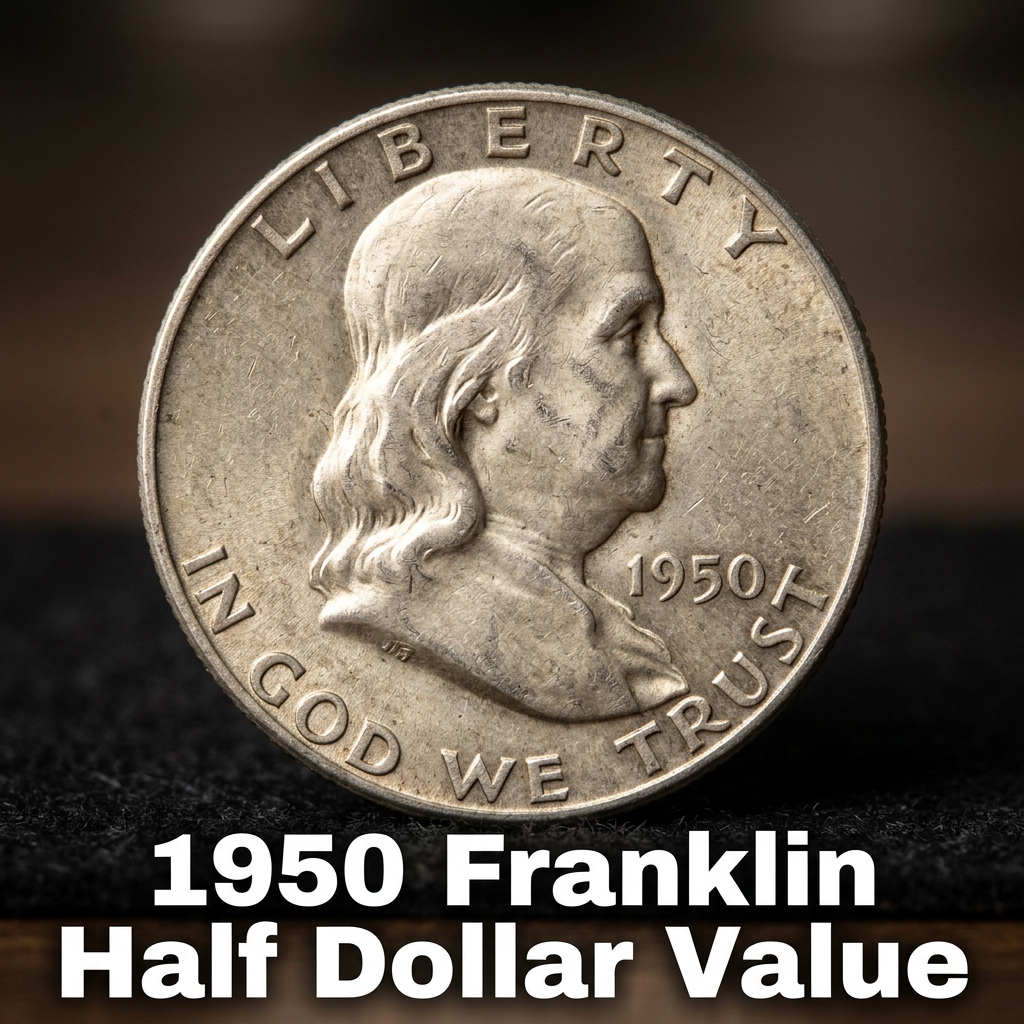
The 1950 Franklin Half Dollar is worth anywhere from $10 in heavily worn condition to well over $500 or more in high-grade mint state — and certain mint mark varieties can push that number even higher. If you’ve found one of these classic silver coins in a drawer, an old collection, or an estate sale, you’re in the right place to find out exactly what you’ve got.
What Makes the 1950 Franklin Half Dollar Special
The Franklin Half Dollar series ran from 1948 to 1963, and the 1950 issue is one of the more interesting dates in the entire series. Designed by John R. Sinnock, the obverse features a portrait of Benjamin Franklin, while the reverse shows the Liberty Bell — a distinctly American design that collectors still love today.
One thing that sets the 1950 half dollar apart is its relatively low mintage compared to later dates in the series. The Philadelphia Mint struck just over 7.7 million coins, while the Denver Mint produced about 3.6 million. Lower mintage generally means greater collector interest, and that’s especially true for well-preserved examples.
If you’re not sure whether your coin has a mint mark or want help identifying exactly what you have, a coin identifier and value app can walk you through it step by step using just your phone’s camera.
1950 Franklin Half Dollar Value by Mint Mark and Grade
The value of a 1950 Franklin Half Dollar depends heavily on two things: where it was minted and what condition it’s in. Coins from Philadelphia carry no mint mark, while Denver coins show a small “D” on the reverse, above the Liberty Bell.
Here’s a general value guide based on condition:
| Variety | Good (G-4) | Fine (F-12) | XF-40 | MS-63 | MS-65 |
|---|---|---|---|---|---|
| 1950 (Philadelphia) | $10–$12 | $12–$15 | $18–$25 | $60–$100 | $300–$600+ |
| 1950-D (Denver) | $10–$12 | $12–$15 | $18–$28 | $65–$110 | $350–$700+ |
For the most current market pricing, you can check 1950 Franklin Half Dollar mint state price data on CoinHix — it’s updated regularly to reflect real auction results.
How Condition Affects What You’ll Actually Get Paid
Condition — or “grade” in collector language — is the single biggest factor affecting what your 1950 Franklin Half Dollar is actually worth. A coin that looks shiny and sharp under magnification is worth dramatically more than one that’s been rattled around in a pocket or purse for decades.
Coin graders look at things like the sharpness of Franklin’s hair above his ear, the clarity of the lettering, and whether the Liberty Bell shows full bell lines on the reverse. A coin graded MS-65 Full Bell Lines (FBL) is considered a premium example and can sell for significantly more than a standard MS-65.
Most coins found in old collections or family estates fall somewhere in the Fine to Extremely Fine range. That still puts them at solid silver value plus a small collector premium — not bad for something sitting in a sock drawer.
CoinHix makes it easy to look up real-world sale prices for graded Franklin Half Dollars so you’re not just guessing at what someone might pay.
Silver Content and Melt Value
Even a heavily worn 1950 Franklin Half Dollar has real intrinsic value because it’s made of 90% silver. Each coin contains approximately 0.3617 troy ounces of pure silver. With silver prices fluctuating around $27–$30 per troy ounce at the time of writing, that puts the melt value of any 1950 Franklin Half Dollar at roughly $9.75 to $10.85.
That means even the most beat-up example is worth keeping — it’s essentially a small silver investment. And if silver prices rise, so does the floor value of every Franklin Half Dollar in your collection.
For a full breakdown of 1950 half dollar value including silver melt and collector premiums, it’s worth reviewing a dedicated coin value resource before selling or trading.
Tips for Selling Your 1950 Franklin Half Dollar
If you’ve decided you want to sell, knowing your options can make a real difference in what you walk away with. Coin dealers will typically offer 60–80% of retail value. Online platforms like eBay can get you closer to full market price, but require more effort. Coin shows are great for connecting with serious collectors willing to pay a fair price.
Before you sell anything, it’s smart to get a second opinion on condition and value. The CoinHix app lets you scan your coin and get an instant estimated grade and value range — no expertise required. It’s one of the simplest ways everyday people can avoid leaving money on the table.
Never clean your coins before selling. Even gentle cleaning can scratch the surface under magnification and drop a coin’s grade — and its value — significantly.
—
Frequently Asked Questions
Q: How much is a 1950 Franklin Half Dollar worth with no mint mark?
A: A 1950 Philadelphia coin (no mint mark) is worth $10–$15 in worn condition and $60–$600+ in uncirculated grades. High-grade examples with Full Bell Lines are the most valuable.
Q: What’s the difference between the 1950 and 1950-D Franklin Half Dollar?
A: The 1950-D was minted in Denver and carries a “D” mint mark on the reverse above the Liberty Bell. Both have similar values, though certain high-grade 1950-D examples with strong strike quality can command premiums.
Q: Should I get my 1950 Franklin Half Dollar graded professionally?
A: If your coin looks uncirculated or close to it, professional grading by PCGS or NGC can significantly increase its value and buyer confidence. For worn coins, the grading cost likely isn’t worth it — the silver melt value and a small collector premium are what you’re working with.