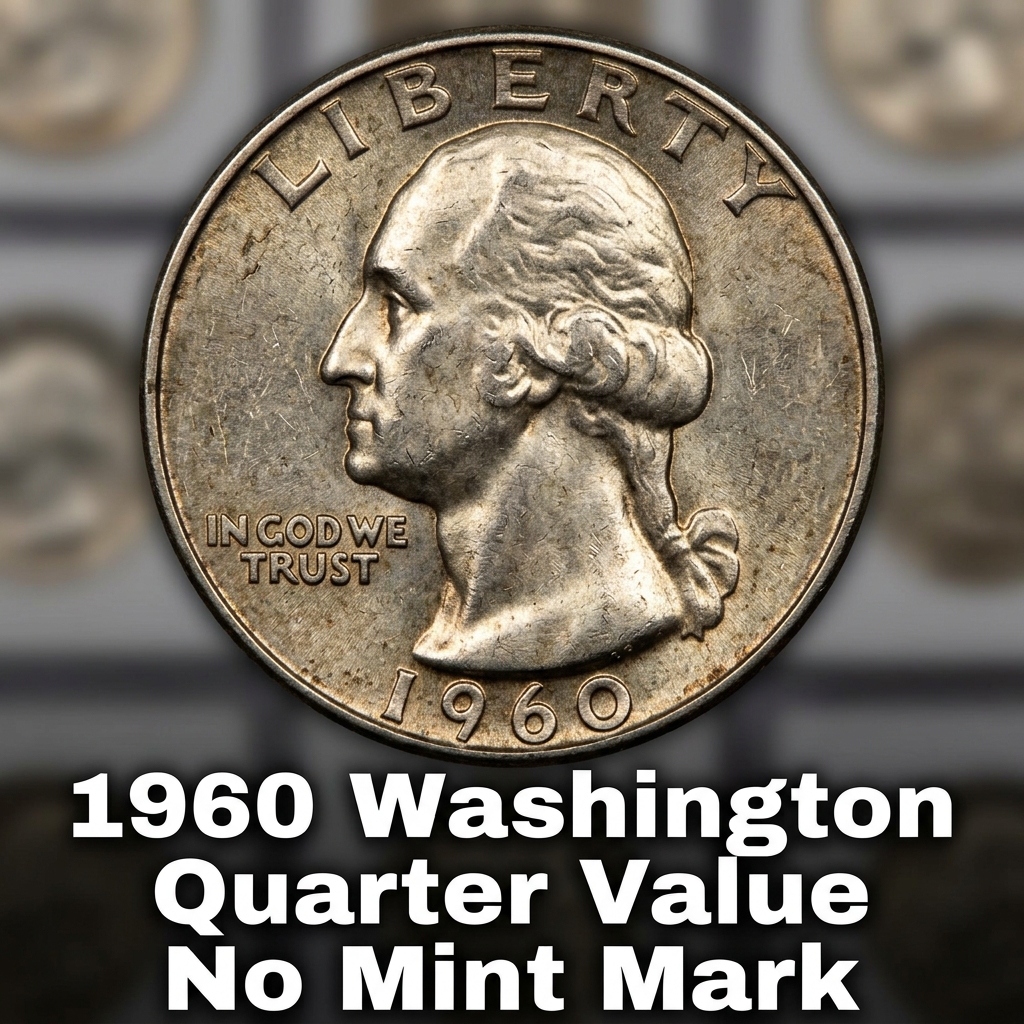
The 1960 Washington Quarter with no mint mark is worth anywhere from $5 in circulated condition to over $200 or more in top mint state grades. If you found one in an old coin jar or inherited a collection, you’re in the right place — let’s break down exactly what this coin is worth and why.
What the No Mint Mark Means on a 1960 Quarter
When you flip over a 1960 Washington Quarter and see no mint mark, that tells you it was made at the Philadelphia Mint. Back in 1960, the Philadelphia Mint didn’t stamp a “P” on its coins — that practice didn’t start until much later. So the absence of a mint mark isn’t a mistake or a rarity; it simply means Philadelphia made it.
The Philadelphia Mint struck over 29 million of these quarters in 1960, making them relatively common. But “common” doesn’t mean worthless, especially when condition matters so much in the coin world.
If you’re not sure where to start identifying what you have, a coin identifier and value app can make the whole process a lot faster and easier — just snap a photo and get instant results.
How Much Is a 1960 Washington Quarter Worth
The value of a 1960 Washington Quarter no mint mark depends almost entirely on its condition, also called “grade” by collectors. A heavily worn coin might only fetch melt value — around $4 to $6 in silver content alone, since these quarters are 90% silver.
But a lightly circulated example jumps up to $7–$15, and an uncirculated coin can bring $20 to $50 or more depending on its luster and eye appeal.
Here’s a quick value table to help you figure out what yours might be worth:
| Grade / Condition | Description | Estimated Value |
|---|---|---|
| Good (G-4) | Heavy wear, design visible | $5 – $6 |
| Fine (F-12) | Moderate wear, details clear | $6 – $8 |
| Extremely Fine (EF-40) | Light wear on high points | $8 – $15 |
| About Uncirculated (AU-55) | Slight wear, strong luster | $15 – $25 |
| Mint State (MS-63) | No wear, some bag marks | $25 – $50 |
| Gem Mint State (MS-65+) | Sharp strike, full luster | $100 – $250+ |
For more detailed 1960 Washington Quarter price data across all mint state grades, you can explore certified auction records to see what collectors are actually paying right now.
The Silver Content Factor
One thing many everyday coin finders don’t realize is that pre-1965 Washington Quarters are made of 90% silver. That alone gives the 1960 quarter a base value tied directly to the silver market.
At current silver prices (typically around $28–$30 per troy ounce), each 1960 quarter contains roughly 0.1808 troy ounces of silver — which works out to about $5 to $6 in silver melt value.
This means even the most beat-up 1960 quarter you find is worth keeping. It’s real silver sitting in your hands, and that’s something no clad modern quarter can say.
CoinHix is a great tool for tracking silver melt values in real time alongside collector premiums — all in one place.
Proof Versions and Special Strikes
The Philadelphia Mint also produced Proof versions of the 1960 Washington Quarter for collectors. These were specially struck coins with mirror-like fields and sharp designs, sold in proof sets directly to collectors — not meant for everyday circulation.
A 1960 Proof quarter (designated PR or PF) is worth considerably more than a regular business strike. In PR-65 condition, expect values of $15 to $30, with cameo and deep cameo versions bringing $50 to $150 or higher.
If your coin looks unusually sharp, shiny, and almost mirror-like on the flat surfaces, it may be a proof. Compare it carefully or use CoinHix to scan and identify it instantly.
You can also explore a full breakdown of 1960 quarter values including proof and circulation strike comparisons to understand exactly where your coin stands.
Tips for Getting the Most From Your 1960 Quarter
Before you try to sell or get your coin graded, here are a few practical tips:
Never clean your coin. Cleaning destroys the original surface and dramatically reduces collector value — even if it makes the coin look shinier to you.
Hold the coin by its edges only. Fingerprints on the faces can leave oils that affect grading.
If you believe your coin is in uncirculated condition, consider submitting it to PCGS or NGC for professional grading. A certified MS-65 or MS-66 coin can sell for a significant premium over a raw, ungraded example.
For casual identification and a quick value estimate, CoinHix is a convenient starting point before you invest in professional grading fees.
FAQ
Q: Is a 1960 Washington Quarter with no mint mark rare?
A: No, it’s not rare — Philadelphia minted over 29 million of them. But condition makes a huge difference. High-grade examples are harder to find and worth real money to collectors.
Q: How do I know if my 1960 quarter is silver?
A: If it was made before 1965, it’s silver. The 1960 Washington Quarter is 90% silver by composition. You can also check the edge — a silver quarter will have a solid silver-colored edge with no copper stripe visible.
Q: What’s the best way to find out the exact value of my 1960 quarter?
A: Start by evaluating the condition honestly under good light. Use the grade table above as a guide. For a more precise answer, a coin identifier app like CoinHix can give you a fast estimate, and professional grading from PCGS or NGC is the gold standard if you think you have a high-grade example.