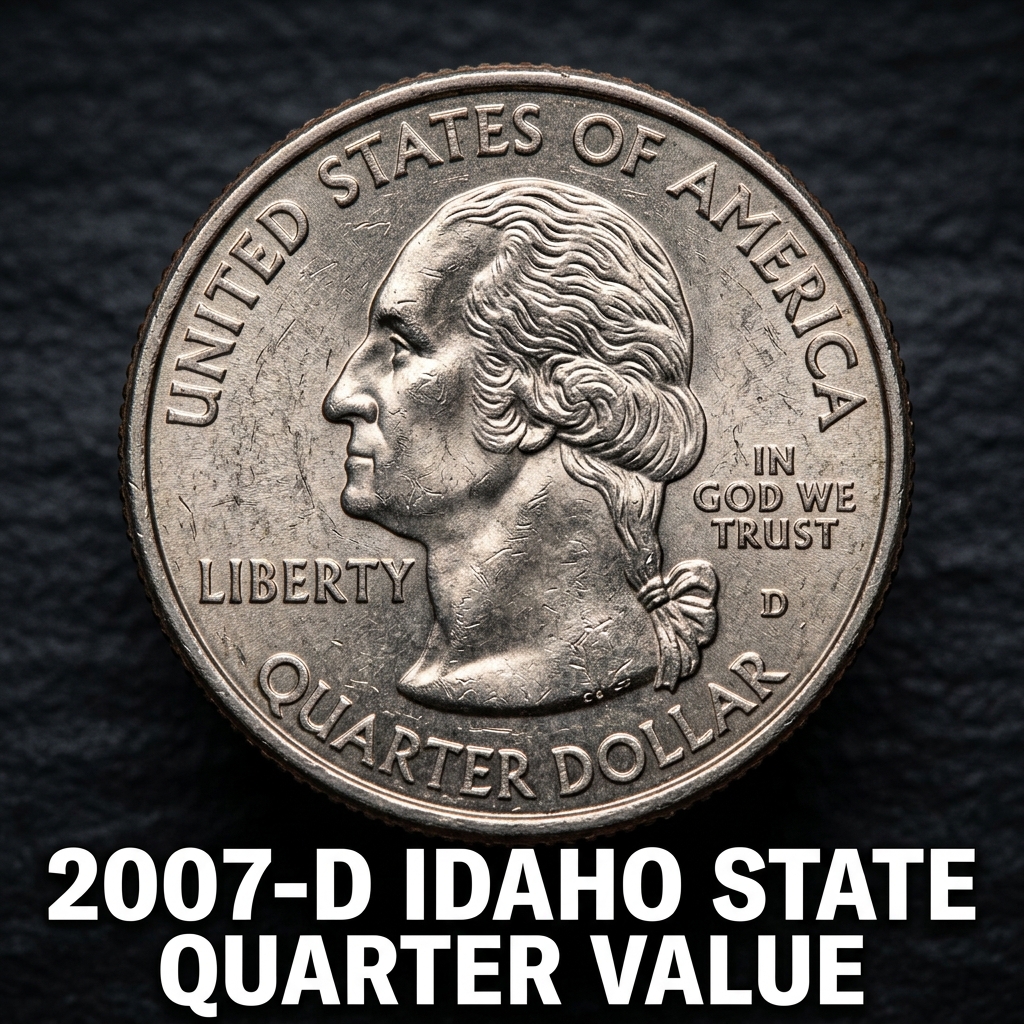
The 2007-D Idaho State Quarter is worth anywhere from 25 cents in heavily circulated condition to $5 or more in mint state, with certified high-grade examples occasionally reaching $15 to $20. If you found one of these in your change jar or inherited a collection, you’re in the right place to find out exactly what it’s worth.
—
What Makes the 2007-D Idaho Quarter Special
The 2007-D Idaho State Quarter was struck at the Denver Mint as part of the United States Mint’s popular 50 State Quarters Program, which ran from 1999 to 2008. The “D” mintmark on the reverse indicates Denver production, and the coin features a peregrine falcon in flight over the outline of Idaho, with the state’s famous motto “Esto Perpetua” — Latin for “Let it be perpetual.”
Over 286 million of these coins were minted in Denver, which means they’re not rare in everyday circulation. But condition is everything when it comes to value. A coin pulled from pocket change will show wear on the high points of the design, while an uncirculated example fresh from a mint set will have full luster and sharp detail.
If you’re not sure how to grade your coin or identify its condition, a coin identifier and value app can help you get a quick and reliable read without needing to visit a dealer.
—
2007-D Idaho Quarter Value by Condition
The value of your 2007-D Idaho State Quarter depends almost entirely on its grade. Here’s a simple breakdown of what collectors and dealers typically pay:
| Condition / Grade | Estimated Value |
|---|---|
| Circulated (worn) | Face value ($0.25) |
| Extremely Fine (EF-45) | $0.50 – $1.00 |
| Mint State 63 (MS-63) | $1.00 – $3.00 |
| Mint State 65 (MS-65) | $3.00 – $6.00 |
| Mint State 67 (MS-67) | $10.00 – $20.00+ |
| Satin Finish (SMS) | $2.00 – $8.00 |
Most coins you find in circulation will grade somewhere between Good and Extremely Fine, meaning their real-world value is pretty close to face value. But if you’ve got a coin with no scratches, full original luster, and sharp design details, it could be worth holding onto. You can check current 2007 quarter values broken down by grade and mintmark to compare your coin against recent market data.
—
How the Denver Mint Compares to Philadelphia for This Issue
Coin collectors often wonder whether the Denver or Philadelphia version of a State Quarter is worth more. For the 2007 Idaho Quarter, both the D and P mint versions are common, but there can be slight differences in populations at high grades.
The 2007-P Idaho Quarter (Philadelphia) had a mintage of around 294 million — slightly higher than Denver’s 286 million. When two coins are this close in mintage, value differences are usually minimal.
However, at the top of the grading scale — MS-67 and above — populations get thin fast, and that’s where scarcity kicks in. If a grading service like PCGS or NGC has certified only a handful of MS-68 examples, those coins can fetch serious premiums at auction.
For a deeper look at how the 2007-D compares to the P-mint version in graded population data, check out live market pricing for 2007 State Quarters across mint state grades — it’s a great reference if you’re trying to make a smart buying or selling decision.
—
Error Coins and What to Look For
Like any coin in the State Quarter series, the 2007-D Idaho Quarter can occasionally turn up with mint errors, and those are a completely different ballgame in terms of value.
Common errors to look for include:
Double Die Obverse or Reverse — Look closely at the lettering and design elements under magnification. If you see doubling in the text or falcon feathers, that’s potentially a die error worth investigating.
Off-Center Strikes — If the design isn’t centered on the coin and part of the design is missing, that’s an off-center strike. Depending on severity, these can be worth $10 to $100 or more.
Clipped Planchets — A coin with a small curved section missing from the edge had a planchet error at the mint.
Wrong Planchet Errors — These are rare but extremely valuable. A quarter design struck on a dime or nickel planchet can be worth hundreds of dollars.
If you think you might have an error coin, the CoinHix app is a handy tool to help you identify unusual features and compare your coin to known error varieties before you pay for professional grading.
—
Is the 2007-D Idaho Quarter Worth Keeping?
Honestly, for most people, the 2007-D Idaho Quarter found in change is worth exactly 25 cents. It’s a common coin with a high mintage, and unless it’s in pristine uncirculated condition or has a mint error, it won’t pay for dinner.
That said, if you enjoy collecting, completing a set of all 50 State Quarters is a fun and affordable hobby. A full circulated set can be put together for just a few dollars, and upgrading to mint state examples is a rewarding challenge.
CoinHix makes it easy to track which State Quarters you have and which ones you still need, with up-to-date pricing that reflects what coins are actually selling for — not just catalog estimates from years ago.
Whether you’re a first-time finder or a seasoned collector, knowing your coin’s true value is always the smart first step.
—
FAQ
Q: How many 2007-D Idaho Quarters were made?
A: The Denver Mint produced approximately 286,800,000 examples of the 2007-D Idaho State Quarter. Because of this high mintage, the coin is common in circulation and generally worth face value in worn condition.
Q: What is the most valuable 2007-D Idaho Quarter ever sold?
A: High-grade certified examples in MS-67 or MS-68 can sell for $15 to $30 or more through major coin auction houses. Error coins with significant mint mistakes can occasionally exceed $100 depending on the type and severity of the error.
Q: Should I get my 2007-D Idaho Quarter professionally graded?
A: Professional grading through PCGS or NGC is generally only worth the cost if your coin appears to be in MS-65 condition or better, or if you suspect a mint error. Grading fees typically start around $20 to $30 per coin, so make sure the potential value justifies the expense. Apps like CoinHix can help you assess your coin before committing to professional grading.