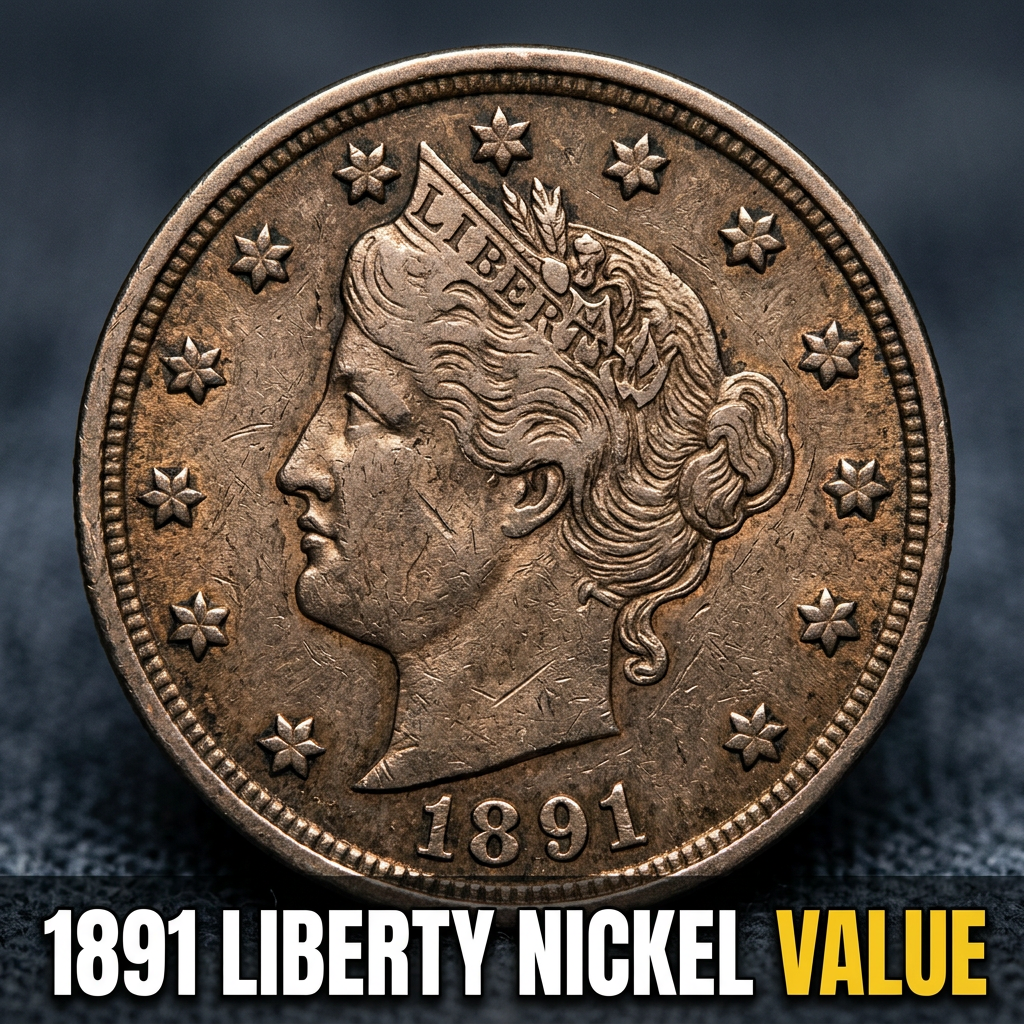
The 1891 Liberty Nickel is worth anywhere from $2 to $5 in heavily worn condition, but can fetch $30 to $80 in fine to extremely fine grades — and well-preserved examples in mint state can command $150 or more depending on the strike and luster.
If you found one of these coins in an old jar, a drawer, or a family collection, you’re in the right place. This guide breaks down exactly what the 1891 Liberty Nickel is worth, what makes certain examples more valuable than others, and how to tell if yours is something special.
What Is the 1891 Liberty Nickel?
The Liberty Nickel — also called the “V Nickel” because of the large Roman numeral V on the reverse — was minted from 1883 to 1912. The 1891 version was struck at the Philadelphia Mint, the only mint producing this coin that year.
It’s made of 75% copper and 25% nickel, so don’t let the name fool you — there’s no silver inside. The obverse features Lady Liberty with a coronet inscribed “LIBERTY,” surrounded by 13 stars. The reverse displays a large V with “E PLURIBUS UNUM” above and “CENTS” below.
If you want to quickly identify and value coins like this one, a reliable coin identifier and value app can save you a lot of guesswork. Tools like CoinHix are especially handy for beginners who aren’t sure what they’re holding.
1891 Liberty Nickel Value by Grade
Coin grading is everything when it comes to value. A coin graded Good (G-4) has been heavily circulated — the design is visible but very flat. Fine (F-12) coins show moderate wear but most details are clear. Extremely Fine (EF-40) coins have light wear only on the high points. Mint State (MS) coins were never circulated and show original luster.
Here’s a general value breakdown for the 1891 Liberty Nickel:
| Grade | Estimated Value |
|---|---|
| Good (G-4) | $2 – $5 |
| Very Good (VG-8) | $6 – $12 |
| Fine (F-12) | $14 – $22 |
| Very Fine (VF-20) | $25 – $40 |
| Extremely Fine (EF-40) | $45 – $80 |
| About Uncirculated (AU-50) | $90 – $130 |
| Mint State (MS-60 to MS-65) | $150 – $500+ |
For a closer look at certified auction results and up-to-date 1891 Liberty Nickel prices in mint state grades, professional databases can give you a more precise picture of what buyers are actually paying right now.
What Makes Some 1891 Liberty Nickels More Valuable?
Not every 1891 Liberty Nickel is the same. Even two coins with identical grades can differ in value based on a few important factors.
Strike quality matters — a sharply struck coin shows crisp detail in Liberty’s hair and the eagle feathers on the reverse, while a weakly struck coin looks soft and flat even without wear. Collectors pay a premium for well-struck examples.
Luster and eye appeal also play a big role. Mint state coins that still show original cartwheel luster — the shimmering reflection you see when you tilt the coin — are far more desirable than dull or cleaned specimens.
Color and surface preservation round out the picture. Coins that have been polished, cleaned, or artificially toned are generally worth less than naturally toned originals. If your coin looks “too shiny,” it may have been cleaned at some point, which reduces its numismatic value.
How to Tell If Your 1891 Nickel Is the Real Deal
The 1891 Liberty Nickel is not a rare date — the Philadelphia Mint produced roughly 16.8 million of them. That said, it’s still a 130-year-old coin, and even worn examples are worth keeping.
Check the date carefully. The numerals should be clear and well-defined even on a worn coin. Look for the word “CENTS” on the reverse — this distinguishes the Liberty Nickel from the infamous 1883 “Racketeer Nickel” that lacked the word “CENTS” and was sometimes gold-plated to pass as a $5 gold coin.
Also, if you’re comparing values across different coin types from the same era, it helps to see how similar coins are priced. For example, you can explore detailed 1891 silver dollar value information to see how collector demand varied for different denominations minted in the same year.
Tools like CoinHix are perfect for this kind of cross-comparison — the app lets you look up multiple coins quickly and see real market data without needing a price guide book.
Should You Sell, Hold, or Get It Graded?
If your coin is in Good to Fine condition, it’s a modest find worth a few dollars to maybe $20. Enjoyable to own, but probably not worth professional grading fees.
If your coin looks sharp, shows minimal wear, and still has some shine to it, you might be sitting on something worth $100 or more. In that case, submitting it to a professional grading service like PCGS or NGC is worth considering — a certified grade can significantly increase what a buyer will pay.
When in doubt, use CoinHix to scan your coin and get an instant valuation before deciding your next step. It’s one of the easiest ways for everyday collectors to get a realistic sense of what their coins are worth.
FAQ
Q: Is the 1891 Liberty Nickel made of silver?
A: No. Despite being called a “nickel,” the 1891 Liberty Nickel contains no silver. It’s made of 75% copper and 25% nickel. The similar-looking 1891 Morgan Silver Dollar is the silver coin from that year.
Q: How do I know if my 1891 Liberty Nickel has been cleaned?
A: A cleaned coin often looks unnaturally bright or has fine hairline scratches visible under magnification. Original, uncleaned coins tend to have an even, mellow tone. Cleaning reduces collector value, even if the coin looks nicer to the untrained eye.
Q: Where is the best place to sell a 1891 Liberty Nickel?
A: eBay, Heritage Auctions, and local coin shops are common options. For higher-grade coins, getting it professionally graded first will usually result in a better sale price. Apps like CoinHix can also help you track current market values before you sell.