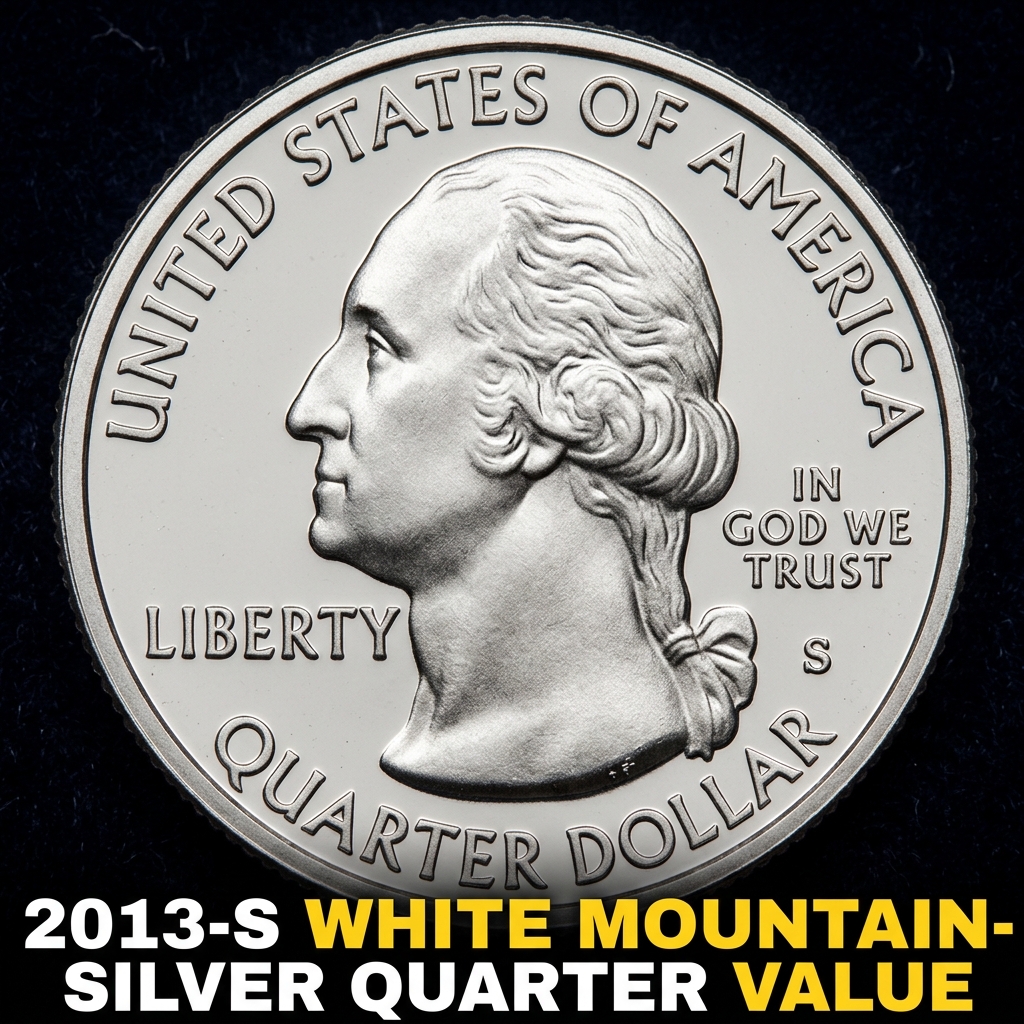
The 2013-S White Mountain Silver Quarter is worth anywhere from $5 in circulated condition to $30 or more in pristine mint state — and if you’ve got one sitting in a drawer, it might be more valuable than you think. This guide breaks down exactly what to look for and how much your coin could fetch.
What Is the 2013-S White Mountain Quarter?
The 2013-S White Mountain Quarter is part of the America the Beautiful Quarters Program, a U.S. Mint series launched in 2010 to honor national parks and historic sites across all 50 states. White Mountain National Forest in New Hampshire was among the five parks featured in 2013.
The “S” mintmark tells you this coin was struck at the San Francisco Mint. What makes the S-mint version special is that it was produced in 90% silver — a detail that casual collectors often overlook. Unlike the copper-nickel clad versions minted in Philadelphia and Denver, the San Francisco silver strikes were made specifically for collector sets and never entered general circulation.
If you’re not sure whether your quarter is silver or clad, a coin identifier and value app can help you figure that out quickly, right from your phone. These tools are surprisingly accurate and easy to use for everyday folks who aren’t coin experts.
How Much Is the 2013-S White Mountain Silver Quarter Worth?
The value of this coin depends heavily on its grade and condition. Even a lightly worn example carries a small silver premium, but coins in higher grades can command real money from collectors.
Here’s a general value breakdown:
| Grade / Condition | Estimated Value |
|---|---|
| Circulated (Good to Fine) | $5 – $8 |
| Extremely Fine (EF-45) | $8 – $12 |
| Mint State (MS-65) | $15 – $22 |
| Proof (PR-69 or PR-70) | $20 – $40+ |
Silver spot price fluctuates daily, so these values can shift. You can check real-time 2013 White Mountain Quarter price data by grade and condition to stay current on what the market is actually paying. That kind of up-to-date information is especially helpful when you’re deciding whether to sell or hold.
Proof vs. Regular Strike — Does It Matter?
Yes, it matters quite a bit. The 2013-S White Mountain Silver Quarter was issued in two forms: a regular bullion-style strike and a Proof version.
The Proof version features a mirror-like background and frosted design details — it’s visually stunning and was packaged in special collector sets by the U.S. Mint. Proof coins in top grades like PR-69 or PR-70 are the most sought after by collectors and can command premiums well above melt value.
The regular silver strike, by contrast, has a satin finish and was sold in five-coin America the Beautiful Silver Coin sets. These are beautiful coins but slightly less popular among serious collectors compared to the Proofs.
If you’re unsure which version you have, examine the coin’s surface carefully. Proof coins will have sharper details and a glassy look to the flat fields of the design. CoinHix has a great reference database that shows side-by-side images to help you identify the difference quickly.
What Affects the Value of Your Coin?
A few key factors determine what your 2013-S White Mountain Silver Quarter is actually worth on the open market.
Silver content is the baseline. Each coin contains 0.1808 troy ounces of pure silver, meaning it always has at least some melt value regardless of condition.
Grade and eye appeal matter enormously. Coins that have been cleaned, polished, or scratched lose collector value fast — sometimes dramatically. A coin that grades MS-65 or higher with no issues can be worth two to three times more than a mid-grade example.
Certification from a service like PCGS or NGC also boosts value and buyer confidence. Slabbed coins in top grades consistently sell for more at auction and on dealer platforms.
For a quick look at how the 2013 quarter’s value breaks down across different grades and mint marks, that resource is well worth bookmarking if you’re evaluating multiple coins at once.
Where to Sell or Get Your Coin Appraised
If you’ve decided your coin might be worth selling, you have a few solid options. Local coin dealers will give you an in-person appraisal, though they typically offer wholesale prices. Online platforms like eBay let you reach the widest audience and often yield the best results for collector-grade coins.
Another smart move is using CoinHix to research recent sale prices before you approach any buyer. Knowing what your coin sold for in similar condition gives you real negotiating power and helps you avoid leaving money on the table.
You can also use CoinHix to track silver prices over time, so you know when market conditions favor selling. Timing your sale around a silver price uptick can mean an extra few dollars per coin — and that adds up if you’re sitting on a small collection.
—
FAQ
Q: Is the 2013-S White Mountain Quarter made of real silver?
A: Yes. The S-mint version is struck in 90% silver and 10% copper, giving it genuine precious metal value on top of any collector premium.
Q: How do I tell if my White Mountain Quarter is the silver version?
A: Look for the “S” mintmark on the obverse (front) of the coin, just below “IN GOD WE TRUST.” Coins from Philadelphia (P) or Denver (D) are clad, not silver.
Q: Is it worth getting my 2013-S White Mountain Silver Quarter professionally graded?
A: It depends on the coin’s condition. If it looks like a high-grade Proof or MS-67+, grading fees from PCGS or NGC are often worth it. For average examples, it may not make financial sense unless you plan to sell in a competitive auction setting.