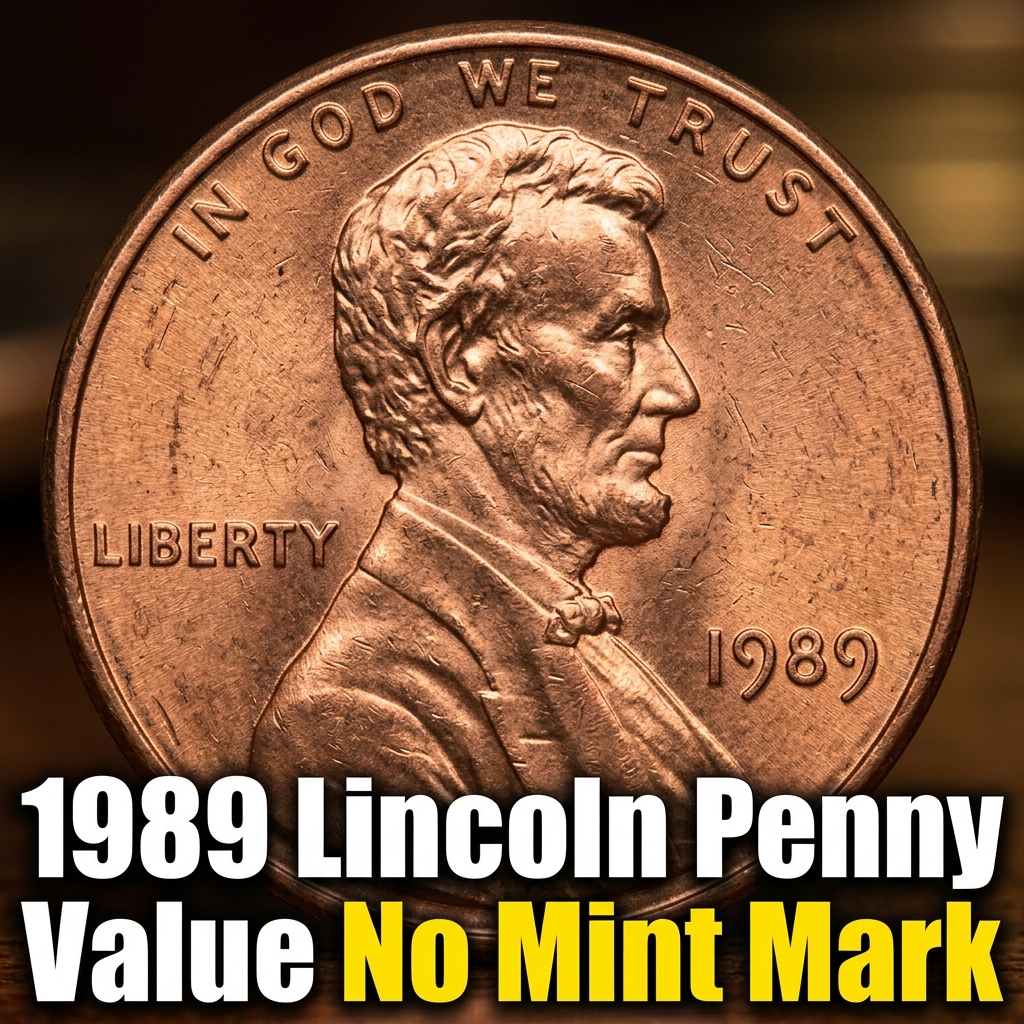
The 1989 Lincoln penny with no mint mark is worth anywhere from a few cents in circulated condition to around $5 to $10 or more in pristine uncirculated grades — and a rare few have sold for much higher at auction. If you just found one of these copper-colored cents in your change jar or an old coin collection, you’re in the right place to find out exactly what it’s worth.
What the No Mint Mark Means on a 1989 Penny
When you look at a 1989 Lincoln penny and don’t see any small letter beneath the date, that means it was struck at the Philadelphia Mint. Philadelphia has historically been the main U.S. coin production facility, and for most of its history, coins made there carried no mint mark at all.
This is completely normal and doesn’t make the coin rare on its own. In fact, the Philadelphia Mint struck over 7.5 billion Lincoln cents in 1989 — one of the highest mintage years in history. With that kind of production volume, the vast majority of these coins are common and hold only face value in everyday circulated condition.
That said, coin condition and special varieties can change the story dramatically. If you’re unsure whether your coin has any special characteristics worth noting, using a coin identifier and value app can help you quickly scan and evaluate your coin right from your phone.
1989 Lincoln Penny Value by Grade
The value of a 1989 Lincoln penny depends almost entirely on its condition, also known as its grade. Coins that have been passed through many hands are typically worn, while coins that were never circulated can show original luster and sharp details.
Here’s a general breakdown of what the 1989 Lincoln penny (no mint mark) is worth across different grades:
| Grade | Condition Description | Estimated Value |
|---|---|---|
| Good (G-4) | Heavy wear, outlines visible | Face value ($0.01) |
| Fine (F-12) | Moderate wear, details clear | Face value ($0.01) |
| Extremely Fine (EF-40) | Light wear on high points | $0.05 – $0.25 |
| Mint State (MS-63) | Uncirculated, some contact marks | $0.50 – $2.00 |
| Mint State (MS-65) | Gem uncirculated, strong luster | $2.00 – $6.00 |
| Mint State (MS-67+) | Superb gem, virtually flawless | $50 – $200+ |
For a deeper look at 1989 Lincoln penny prices across MS grades with real auction data, it’s worth checking current market records before making any buying or selling decisions.
Are Any 1989 No Mint Mark Pennies Worth Big Money?
Most 1989 pennies will never be worth more than a few cents, but there are exceptions. Coins graded MS-67 Red or higher by professional grading services like PCGS or NGC have sold for significant sums because they are genuinely rare in that level of preservation.
The color designation also matters. Lincoln cents struck after 1982 are made of zinc with a thin copper coating. A coin graded “Red” (RD) means it has retained nearly all of its original copper-colored surface, which is harder to preserve than you’d think. A coin that grades MS-67 RD can fetch $100 to $200 or more, while an MS-68 example — if one exists — could be worth considerably more.
Error coins are another way a 1989 penny can surprise you. Double die errors, off-center strikes, and die cap errors have all been documented on Lincoln cents from this era. If something looks “off” about your coin, it’s worth investigating further. CoinHix is a great resource to look up specific error varieties and see if your coin matches known examples.
How to Check the Value of Your 1989 Penny Today
You don’t need to be an expert to get a rough sense of what your coin is worth. Start by examining it under good light and looking for sharp details, original luster, and any unusual marks or doubling in the design. Then compare your coin to graded examples online.
For a reliable and easy-to-use reference, you can check out detailed 1989 penny value information including all mint marks and grades to see how your coin stacks up against current market prices.
If you think you might have a high-grade or error coin, consider submitting it to PCGS or NGC for official grading. The cost of grading might be worth it if your coin shows strong luster and no visible damage. And if you want to explore coins beyond just pennies, CoinHix offers a comprehensive database of U.S. coin values that’s useful for collectors at any level.
Tips for Storing and Selling Your 1989 Lincoln Penny
If your coin looks uncirculated or better, handle it by the edges only and store it in a protective coin flip or airtight holder. Fingerprints and scratches can significantly reduce a coin’s grade and value, so it’s better to be careful from the start.
When it comes time to sell, you have several good options. Online auction platforms like eBay allow you to reach collectors nationwide. Local coin shops will offer quick cash but typically at wholesale prices. Coin shows are a great middle ground where you can meet multiple buyers and get competing offers.
Whether you’re looking to sell or simply satisfy your curiosity, CoinHix makes it easy to research recent sale prices and understand what the current market looks like for any Lincoln cent, including the 1989 no mint mark issue.
FAQ About the 1989 Lincoln Penny No Mint Mark
Q: Is a 1989 penny with no mint mark rare?
A: No, it is not rare. The Philadelphia Mint produced over 7.5 billion Lincoln cents in 1989, making this one of the most common modern pennies in existence. Most examples are only worth face value unless they are in exceptional uncirculated condition.
Q: What makes a 1989 penny valuable?
A: The main factors are grade, color, and any error varieties. A coin graded MS-67 Red or higher by PCGS or NGC can be worth $50 to $200 or more. Error coins with doubling, off-center strikes, or other mint mistakes can also carry a premium depending on the type and severity of the error.
Q: How can I tell if my 1989 penny is uncirculated?
A: An uncirculated coin will show original mint luster — a shiny, slightly cartwheel-like reflective quality when tilted under light. There should be no flat, worn spots on Lincoln’s cheekbone or the high points of the reverse design. If the coin looks dull and flat in those areas, it has likely been circulated and is worth face value.