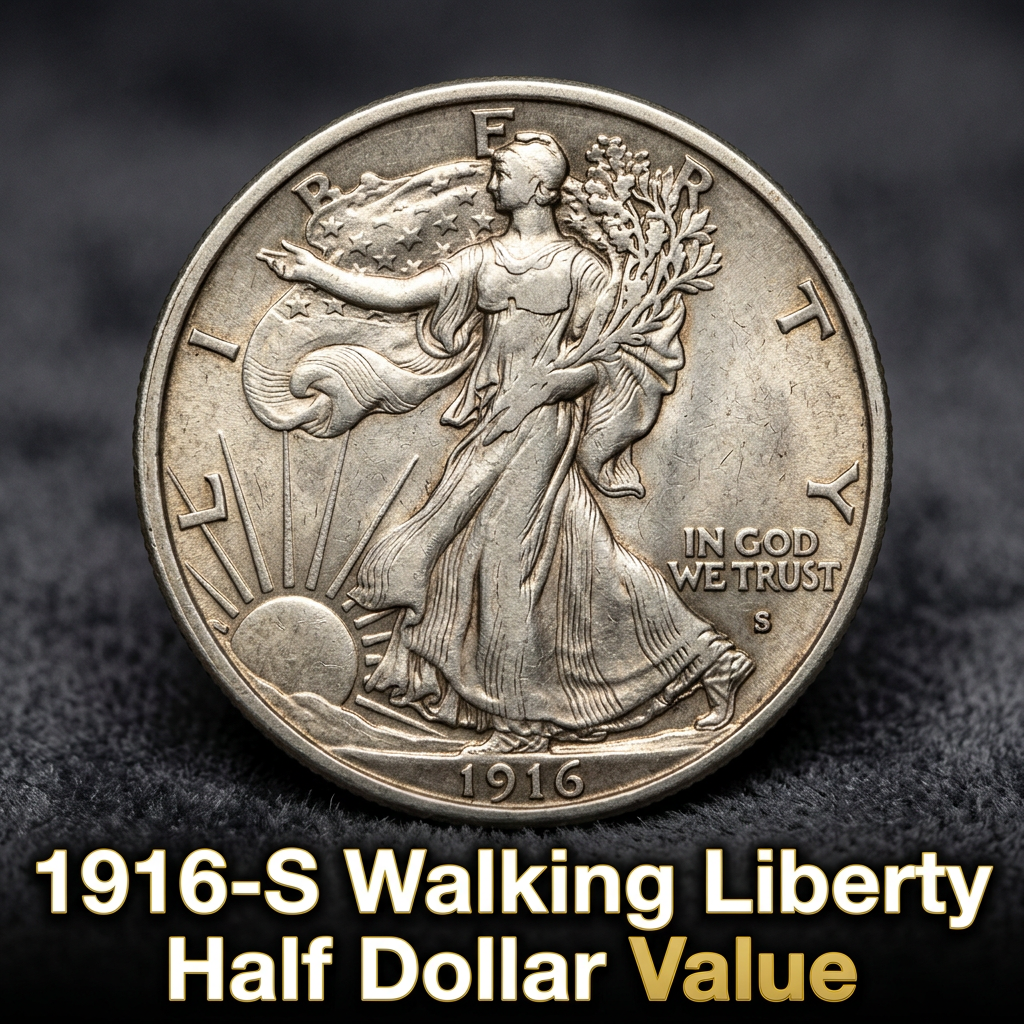
The 1916-S Walking Liberty Half Dollar is worth anywhere from $30 in heavily worn condition to well over $2,000 or more in top mint state grades — and if you happen to have a high-grade example sitting in an old coin collection, it could be worth serious money. This is one of the most beloved American silver coins ever made, and collectors are actively searching for it.
A Quick Look at the 1916-S Walking Liberty Half Dollar
The Walking Liberty Half Dollar series ran from 1916 to 1947, and the very first year of issue — 1916 — is already special. But the 1916-S, struck at the San Francisco Mint, is particularly sought after. Only 508,000 were produced, making it one of the lower-mintage dates in the entire series.
That mintmark “S” on the obverse (front) of the coin near the date sets it apart from the 1916 Philadelphia issue. Don’t confuse the two — the mintmark location matters and can significantly change the value of your coin.
The coin features Adolph Weinman’s iconic design of Lady Liberty draped in an American flag, striding toward the sunrise. It’s widely considered one of the most beautiful coins the U.S. Mint has ever produced. That beauty, combined with its low mintage, drives strong collector demand.
1916-S Walking Liberty Half Dollar Value by Grade
The condition of your coin — called its “grade” — is the single biggest factor in determining value. A coin that looks worn and scratched is worth far less than one that’s well-preserved with sharp details.
Here’s a general value breakdown based on current market trends. You can also check out detailed 1916-S Walking Liberty Half Dollar price data by grade for the most up-to-date auction results.
| Grade | Description | Estimated Value |
|---|---|---|
| Good (G-4) | Heavy wear, outline visible | $30 – $50 |
| Very Good (VG-8) | Moderate wear, some detail | $55 – $100 |
| Fine (F-12) | Even wear, clear lettering | $100 – $200 |
| Very Fine (VF-20) | Light wear on high points | $200 – $400 |
| Extremely Fine (EF-40) | Slight wear, good detail | $500 – $900 |
| About Uncirculated (AU-50) | Trace wear only | $900 – $1,400 |
| Mint State (MS-60+) | No wear, uncirculated | $1,500 – $3,500+ |
Note that silver content adds a floor to the value. Each Walking Liberty Half Dollar contains 0.3617 troy ounces of pure silver, so even a heavily worn example is worth more than just face value.
How to Identify Your 1916-S Half Dollar
First, look at the date on the front of the coin. It should clearly read “1916.” Then look for the “S” mintmark — on 1916-S coins, it appears on the obverse near the bottom left, just above “HALF DOLLAR.” This is actually different from later years when the mintmark moved to the reverse.
If you’re not sure what you have, using a coin identifier and value app can help you quickly confirm the date, mintmark, and get an instant estimate. It’s a fast, beginner-friendly way to start before taking your coin to a dealer.
You can also try CoinHix, a free app that lets you scan your coin and get real market value estimates in seconds. It’s especially helpful if you’ve found multiple old coins and want to sort through them quickly without spending hours doing research.
What Makes This Coin So Valuable to Collectors
The 1916-S is a key date coin, meaning it’s one of the harder dates to find in the Walking Liberty series. With just over half a million minted — compared to millions in later years — it simply doesn’t come up for sale very often, especially in nicer grades.
Collectors working on a complete set of Walking Liberty Half Dollars almost always need the 1916-S, and that steady demand keeps prices strong. Even in well-worn grades, this coin sells reliably because it fills a critical slot in the collection.
If your coin shows strong detail in Liberty’s hand, clear feathers on the eagle’s wing on the reverse, and a readable mintmark, it could grade out higher than you expect. Small differences in grade can mean hundreds of dollars in price difference, so it’s worth getting it looked at carefully.
For a full breakdown of 1916 Walking Liberty Half Dollar values across all mint marks and grades, comparing the Philadelphia, Denver, and San Francisco issues side by side can help you understand exactly where your coin fits in the market.
Should You Sell, Hold, or Get It Graded?
If your 1916-S appears to be in Very Fine condition or better, it’s probably worth getting it professionally graded by PCGS or NGC. A certified coin in a holder typically sells for more than a raw (ungraded) coin, because buyers trust the official grade.
For coins in lower circulated grades, selling to a local dealer or listing on an online marketplace is usually straightforward. Just be sure to do your homework on current prices first.
CoinHix is a great tool to check live market values before you negotiate. It pulls real auction data so you’ll know if an offer is fair — something every coin seller should do before walking into a shop.
Frequently Asked Questions
Q: How do I know if my coin is the 1916-S and not just the 1916 Philadelphia issue?
A: Look for the “S” mintmark on the obverse (front) of the coin, located near the bottom left above the words “HALF DOLLAR.” If there’s no mintmark, it was struck at the Philadelphia Mint. The 1916-S is generally worth more due to its lower mintage.
Q: Is the 1916-S Walking Liberty Half Dollar made of real silver?
A: Yes. Like all Walking Liberty Half Dollars, the 1916-S is composed of 90% silver and 10% copper, containing approximately 0.3617 troy ounces of pure silver. Even in poor condition, it holds melt value based on the current silver price.
Q: What’s the best way to find out what my 1916-S Walking Liberty Half Dollar is worth today?
A: Start by examining the condition of your coin carefully, then compare it to a grading guide. You can use CoinHix to scan your coin and get current market pricing fast. For a more precise valuation, consider submitting it to a professional grading service like PCGS or NGC, especially if it appears to be in uncirculated or near-uncirculated condition.