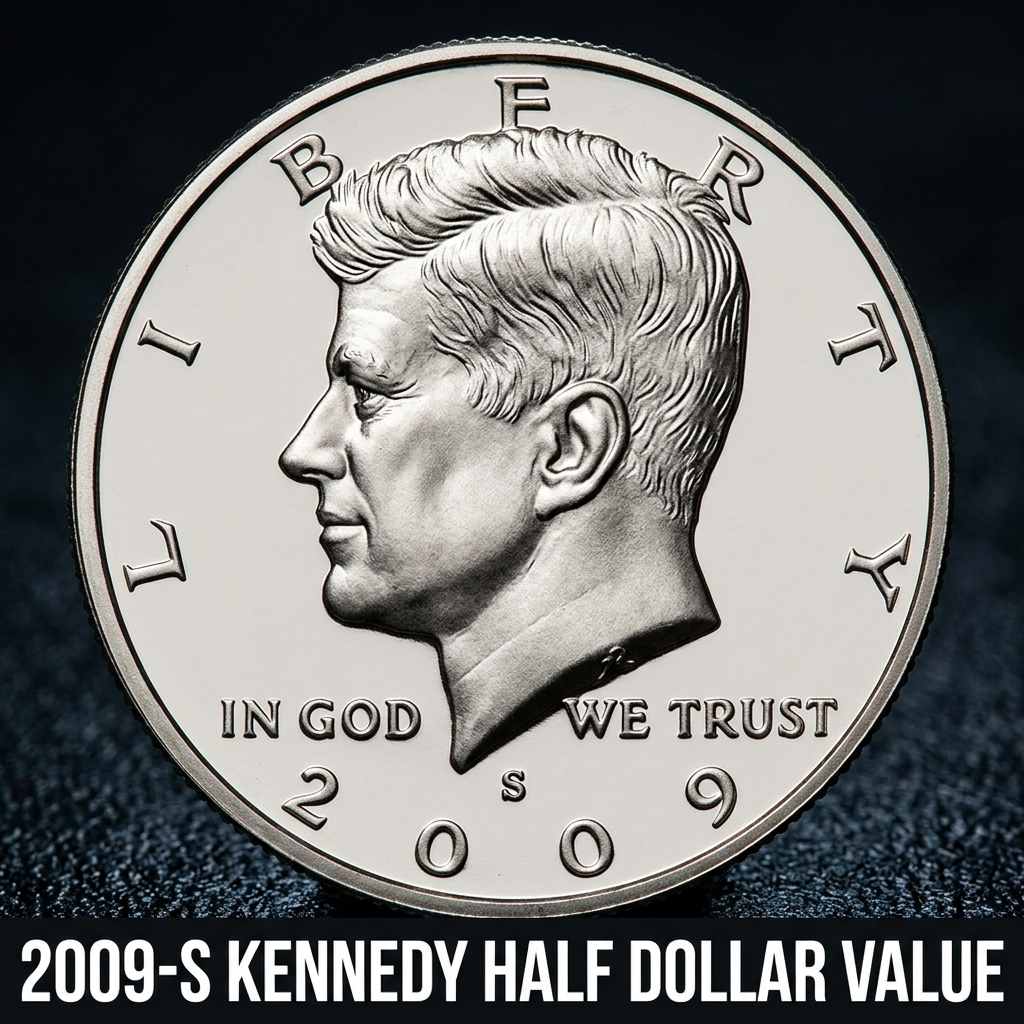
The 2009-S Kennedy Half Dollar is worth anywhere from $5 in lightly circulated condition to over $15 or more in deep cameo proof grades — and if you stumbled across one in an old proof set, you might be sitting on a small but real treasure.
What Is the 2009-S Kennedy Half Dollar?
The 2009-S Kennedy Half Dollar was struck at the San Francisco Mint specifically for collector proof sets — it was never released into general circulation. That “S” mintmark is the key detail. If your coin has a small “S” on the obverse below Kennedy’s portrait, you have a proof coin made for collectors, not a coin that ever passed through someone’s hand at the grocery store.
These coins were included in the 2009 United States Mint Proof Set and the 2009 Silver Proof Set. The standard clad version is made of copper-nickel, while the silver version contains 90% silver. That difference matters a lot when it comes to value.
If you’re not sure which version you have or want a fast answer, a coin identifier and value app can help you figure it out in seconds using just your phone’s camera.
Breaking Down the 2009-S Half Dollar Value by Grade
Proof coins are graded on the same 70-point Sheldon scale as regular coins, but they also carry designations like PR (Proof), DCAM (Deep Cameo), and UCAM (Ultra Cameo). These designations describe the contrast between the frosted design and the mirror-like fields on the coin’s surface — and they heavily influence value.
Here’s a general value breakdown for the 2009-S Kennedy Half Dollar:
| Version | Grade | Estimated Value |
|---|---|---|
| Clad Proof | PR65 | $4 – $6 |
| Clad Proof Deep Cameo | PR69 DCAM | $8 – $12 |
| Silver Proof | PR65 | $10 – $14 |
| Silver Proof Deep Cameo | PR69 DCAM | $15 – $22 |
| Silver Proof Deep Cameo | PR70 DCAM | $30 – $60+ |
For a more detailed look at certified population data and recent sale prices for Kennedy Half Dollars, it’s worth checking auction records before you decide to sell.
Clad vs. Silver — How to Tell the Difference
This is one of the most common questions people ask about the 2009-S, and luckily it’s easy to figure out. Look at the edge of the coin. A clad coin will show a copper-colored stripe running around the edge — that layered look is a dead giveaway. A silver coin will have a solid silver-white edge with no copper stripe at all.
The silver proof version comes from the 2009 Silver Proof Set, which was sold at a higher price directly from the U.S. Mint. If you bought a set back in 2009 or inherited one, check the original packaging — it usually states whether it’s a silver set.
Silver content adds real melt value on top of the numismatic (collector) value. With silver prices fluctuating, even a low-grade silver proof is worth more than face value just for its metal content alone.
What Makes the 2009-S Worth More or Less
Condition is everything with proof coins. Even though these were never meant for circulation, they can still get damaged from improper storage — fingerprints, scratches, and toning can all reduce the grade and, therefore, the value.
Coins that have never been removed from their original mint packaging tend to grade higher and sell for more. A PR70 Deep Cameo, the perfect grade, is rare even among proof coins and can bring strong premiums from serious collectors.
You can explore a complete guide to 2009 Half Dollar values across all mint marks and conditions if you want to compare your coin against the full range of what’s out there.
CoinHix is a great tool for this — it tracks real-time coin prices and lets you look up recent sales so you always know what the current market is doing, not just what a book says from three years ago.
Should You Get It Graded?
If you have a 2009-S Kennedy Half Dollar that looks perfect — brilliant mirrors, sharp frost on Kennedy’s portrait, no visible marks — it might be worth sending it to a third-party grading service like PCGS or NGC. A coin that comes back graded PR70 DCAM in a slabbed holder can sell for significantly more than a raw coin.
That said, for most average-condition proof coins, the grading fee might cost more than the coin is worth. The sweet spot for submitting is if you genuinely believe you have a top-tier example.
Not sure where to start? CoinHix can help you look up current prices for graded examples so you can make a smart decision before spending money on certification.
—
FAQ
Q: Is the 2009-S Kennedy Half Dollar rare?
A: It’s not considered rare in the traditional sense — hundreds of thousands were minted. However, perfect PR70 examples are harder to find, and the silver version is more limited than the clad. Most collectors consider it a common but attractive proof coin.
Q: How do I know if my 2009-S is silver or clad?
A: Check the edge of the coin. A silver proof will have a solid white-silver edge with no copper stripe. A clad proof will show a visible orange-brown copper layer sandwiched between two outer layers. You can also check the original packaging from the U.S. Mint if you still have it.
Q: Where is the best place to sell a 2009-S Kennedy Half Dollar?
A: eBay is one of the most active marketplaces for proof coins. You can also try local coin dealers or coin shows. For certified (slabbed) coins, major auction houses like Heritage or Stack’s Bowers are solid options. Before you sell, use CoinHix to check recent sale prices so you know exactly what yours should fetch.