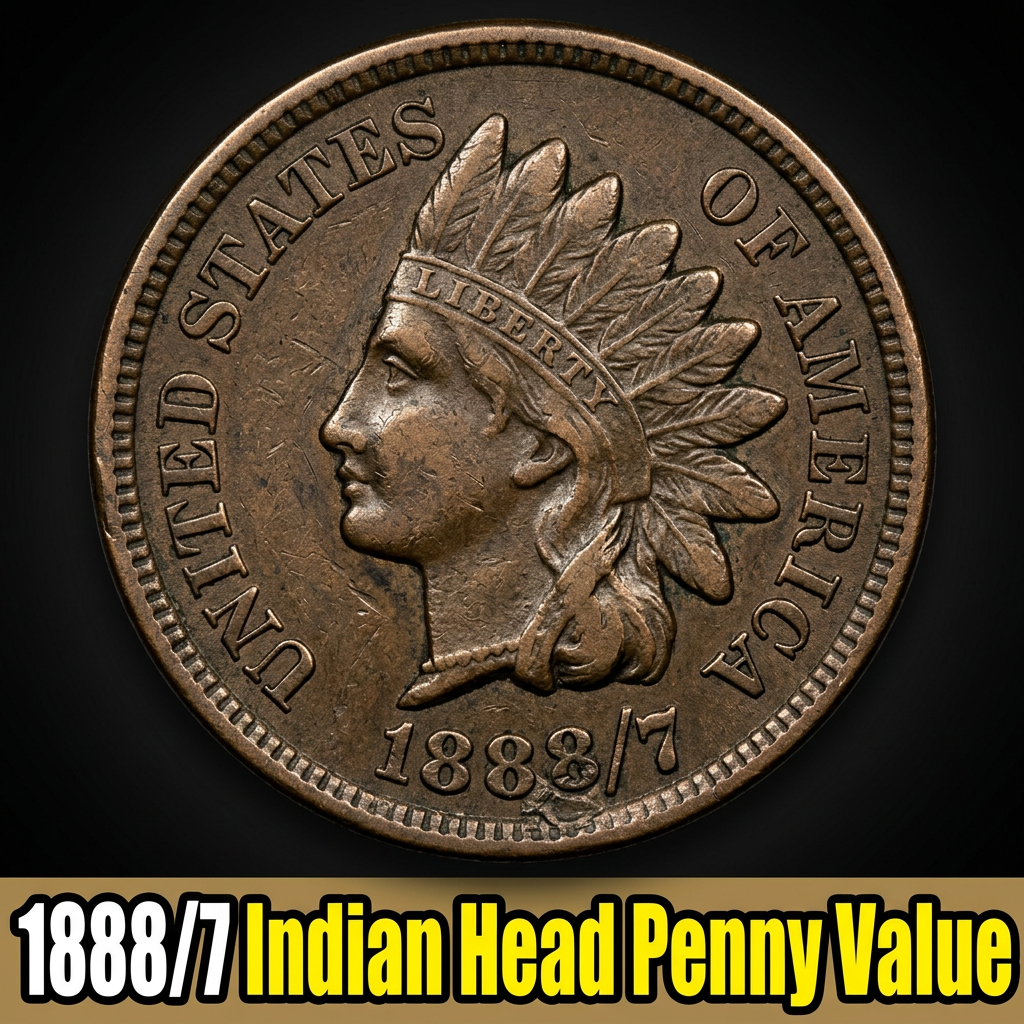
The 1888/7 Indian Head Penny is worth anywhere from $75 in heavily worn condition to well over $1,500 or more in mint state — and that’s because this isn’t just any old penny. It’s a rare overdate variety that collectors actively hunt for, making it one of the most exciting Lincoln-era cents you might stumble across.
If you’ve found an old penny and you’re trying to figure out what you’ve got, a coin identifier and value app can help you quickly confirm the date, variety, and approximate value before you do anything else with it.
What Makes the 1888/7 Indian Head Penny So Special?
The “7” in “1888/7” is the key to everything. This coin was created when a die from 1887 was re-engraved with the date 1888 — but traces of the old “7” were left behind underneath the final “8.” That kind of minting error is called an overdate, and it’s the sort of thing that makes coin collectors go wild.
You can actually see the remnants of the 7 peeking out from behind the last 8 in the date, especially under magnification. That small detail transforms an ordinary penny into a genuine numismatic rarity.
The 1888/7 Indian Head Penny was struck at the Philadelphia Mint, which didn’t use a mint mark. So if you see no mint mark on your coin, that’s completely normal — it doesn’t mean anything is missing.
1888/7 Indian Head Penny Value by Grade
Coin value is almost entirely about condition. A heavily circulated coin with a worn-down design is worth far less than a coin that looks like it just left the mint. Here’s a general breakdown of what the 1888/7 Indian Head Penny is worth across different grades:
| Grade | Description | Estimated Value |
|---|---|---|
| Good (G-4) | Heavily worn, date visible | $75 – $120 |
| Fine (F-12) | Moderate wear, details clear | $150 – $250 |
| Extremely Fine (EF-40) | Light wear on high points | $400 – $600 |
| About Uncirculated (AU-50) | Slight wear, much original luster | $700 – $950 |
| Mint State (MS-63+) | No wear, original mint luster | $1,200 – $1,800+ |
For the most up-to-date pricing data, you can check the current 1888 Indian Head Penny prices in mint red condition to see how top-grade examples are performing in today’s market.
How to Identify the Overdate on Your Coin
To confirm you actually have the 1888/7 variety and not just a regular 1888 Indian Head Penny, you’ll want to look closely at the last digit in the date. Use a magnifying glass or a jeweler’s loupe at 5x–10x magnification.
What you’re looking for is the curved top of a “7” showing through the lower portion of the final “8.” It’s subtle, but once you see it, it’s unmistakable. The overdate variety is noticeably scarcer than the regular 1888 issue, which is exactly why it commands a premium.
If you’re not sure what you’re seeing, CoinHix has a detailed variety database that can help you compare your coin to known examples. It’s one of the most reliable tools available for identifying overdate varieties like this one.
Tips for Getting the Most Money for Your 1888/7 Penny
If you believe you’ve got a genuine 1888/7 Indian Head Penny, don’t rush to sell it. Here’s what experienced collectors recommend:
First, get it graded by a professional third-party grading service like PCGS or NGC. A certified grade adds credibility and can significantly increase what buyers are willing to pay. Second, research recent auction results to understand what the market is doing right now.
You can also explore detailed value information for late 1800s Indian Head Penny issues to get a broader sense of how similar coins from this era are priced. Understanding the range helps you negotiate confidently whether you’re selling to a dealer or listing it online.
Finally, the CoinHix app makes it easy to track values over time so you know the best moment to sell. And for quick, on-the-go identification of any coin in your collection, CoinHix is a tool worth having in your pocket.
FAQ About the 1888/7 Indian Head Penny
Q: How do I know if my 1888 penny is the overdate variety?
A: Look at the last digit of the date under magnification. If you can see remnants of a “7” beneath the final “8,” you have the 1888/7 overdate variety, which is significantly more valuable than a standard 1888 Indian Head Penny.
Q: Is the 1888/7 Indian Head Penny rare?
A: Yes, it is considered a scarce variety. Far fewer 1888/7 examples exist compared to regular 1888 issues, and that scarcity is a big reason why collectors are willing to pay a premium even for worn specimens.
Q: Where is the best place to sell a 1888/7 Indian Head Penny?
A: Options include major auction houses like Heritage Auctions or Stack’s Bowers, reputable coin dealers, and online platforms like eBay. Having the coin professionally graded first will almost always result in a better sale price.