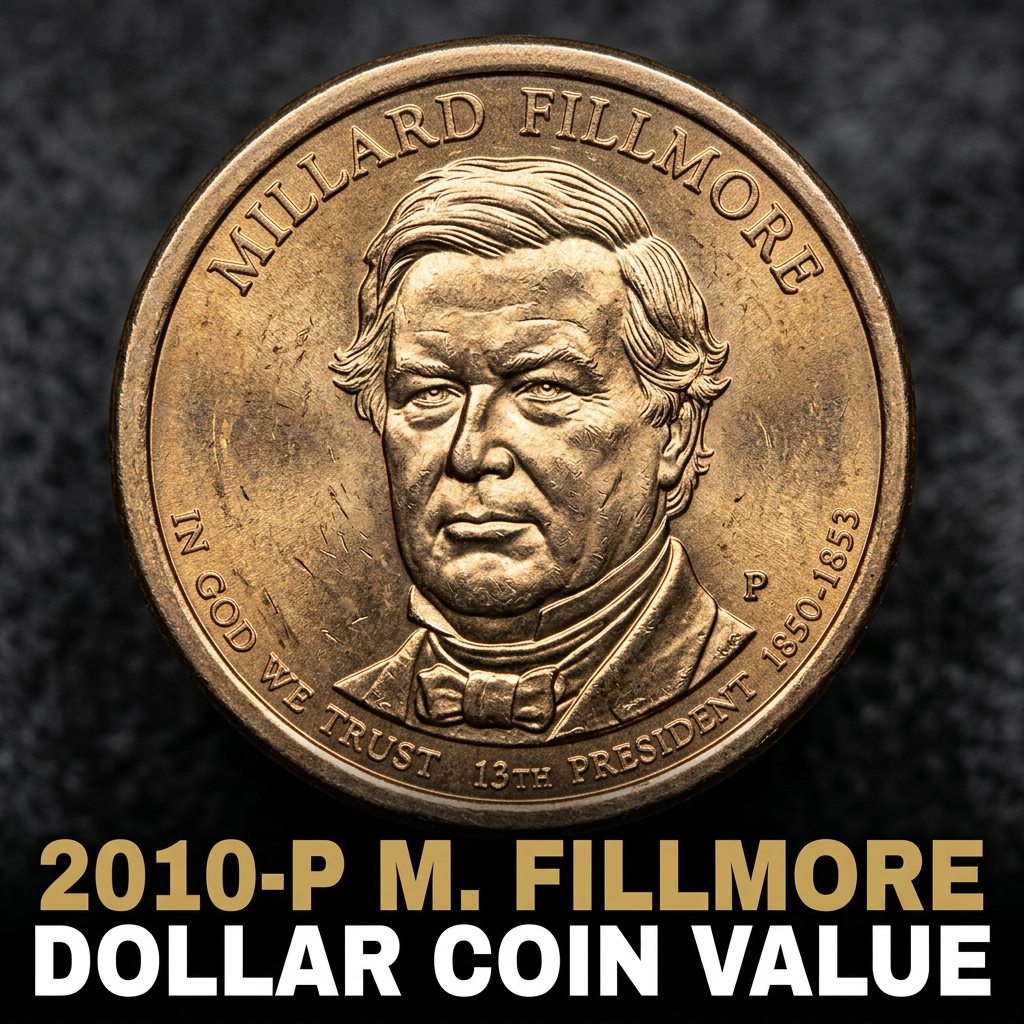
The 2010-P Millard Fillmore Dollar coin is worth anywhere from $1.05 in circulated condition to $10 or more in mint state, with certified high-grade examples occasionally fetching $20 and beyond. If you found one of these gold-colored dollars in your change or tucked away in a drawer, here’s what you need to know.
What Is the 2010-P Millard Fillmore Dollar?
The 2010-P Millard Fillmore Dollar is part of the Presidential Dollar series, which ran from 2007 to 2016. Each year, the U.S. Mint honored several former presidents in order of service, and Millard Fillmore — the 13th President — was among those featured in 2010. The “P” in the coin’s name tells you it was struck at the Philadelphia Mint.
These coins were released both for circulation and in special collector sets. The circulating versions were made from a copper-manganese-zinc alloy that gives them that familiar golden color, though they contain no gold at all. The Mint produced tens of millions of these coins, which is one reason most circulated examples are worth only a small premium over face value.
If you’re unsure exactly which coin you have, using a coin identifier and value app is one of the easiest ways to confirm the coin’s name, date, and mint mark before you start researching its worth.
How Much Is the 2010-P Fillmore Dollar Worth?
For most people who found a 2010-P Millard Fillmore Dollar in everyday change, the honest answer is that it’s worth close to face value — $1 — if it shows signs of wear. But condition is everything in coin collecting, and an uncirculated example pulled from a mint roll can be worth several times that amount.
Coins graded MS65 or higher by professional grading services like PCGS or NGC are where values start climbing. A coin graded MS65 typically sells for $5 to $10, while an MS67 example can fetch $20 to $50 depending on market demand. Coins with deep mirror-like surfaces (designated as Proof or DCAM) from special collector sets carry even stronger premiums.
You can check current market prices for 2010-P dollar coins in MS grades to see where recent examples have been selling at auction and through dealers.
| Condition / Grade | Estimated Value |
|---|---|
| Circulated (worn) | $1.00 – $1.50 |
| Uncirculated (MS60–MS63) | $2 – $4 |
| Choice Uncirculated (MS64–MS65) | $5 – $10 |
| Gem Uncirculated (MS66) | $10 – $20 |
| Superb Gem (MS67+) | $25 – $50+ |
| Proof (PR69–PR70 DCAM) | $15 – $60+ |
Factors That Affect the Fillmore Dollar’s Value
Several key factors determine exactly how much your 2010-P Millard Fillmore Dollar is worth. The most important is grade — the higher the grade, the higher the value. A coin that never entered circulation and was stored carefully in a mint roll or original government packaging will grade much higher than one that passed through countless hands.
Edge lettering is another thing to check. Presidential Dollars have their inscriptions — “IN GOD WE TRUST,” the year, and the mint mark — on the edge of the coin rather than the face. Occasionally, coins were struck without this edge lettering due to a mint error, and those “plain edge” error coins can be worth $50 to $150 or more.
Eye appeal matters too. Even within the same numerical grade, coins with strong luster, sharp strikes, and no distracting marks tend to command better prices from serious collectors.
Should You Get Your Coin Graded?
If your 2010-P Fillmore Dollar looks like it just rolled off the press — brilliant, shiny, with no visible marks or scratches — it might be worth having it professionally graded. PCGS and NGC are the two most respected grading services, and a certified MS67 or higher coin carries significant added value when selling.
That said, for most coins that show average wear, the cost of grading ($20 to $50 or more per coin) will exceed what you’d gain in resale value. Be honest with yourself about the coin’s condition before spending money on certification.
For a quick at-home assessment, CoinHix is a great tool to start with. The CoinHix app lets you scan your coin and get an instant grade estimate and value range, so you can decide whether professional grading makes financial sense before committing.
You can also find a helpful breakdown of how 2010 dollar coin values are determined by grade and condition, which gives useful context even when comparing Presidential and Native American dollar series from the same year.
Where to Sell a 2010-P Fillmore Dollar
If you decide to sell, you have several good options. eBay is one of the most active marketplaces for Presidential Dollars, and you can easily check “sold listings” to see what similar coins actually fetched — not just asking prices. Local coin shops are another option for a quick sale, though expect to receive somewhat below retail value since dealers need to make a profit on resale.
Collector forums and coin shows can also connect you directly with buyers willing to pay closer to retail for a nice example. And if you’re building a collection yourself and wondering what to look for, CoinHix can help you track values across the entire Presidential Dollar series so you always know what’s fair.
Frequently Asked Questions
Q: Is the 2010-P Millard Fillmore Dollar made of gold?
A: No. Despite its golden appearance, the coin contains no gold. It’s made from a manganese-brass clad composition over a pure copper core, giving it that warm color without any precious metal content.
Q: How many 2010-P Fillmore Dollars were minted?
A: The Philadelphia Mint struck approximately 37.1 million 2010-P Millard Fillmore Presidential Dollars for general circulation, making it a relatively common coin in most grades.
Q: What makes a 2010-P Fillmore Dollar rare or valuable?
A: The most valuable examples are those in superb gem condition (MS67 or higher), certified by a reputable grading service, or coins with a known mint error such as missing edge lettering. A plain-edge error version can be worth $50 to $150 or more to the right collector.