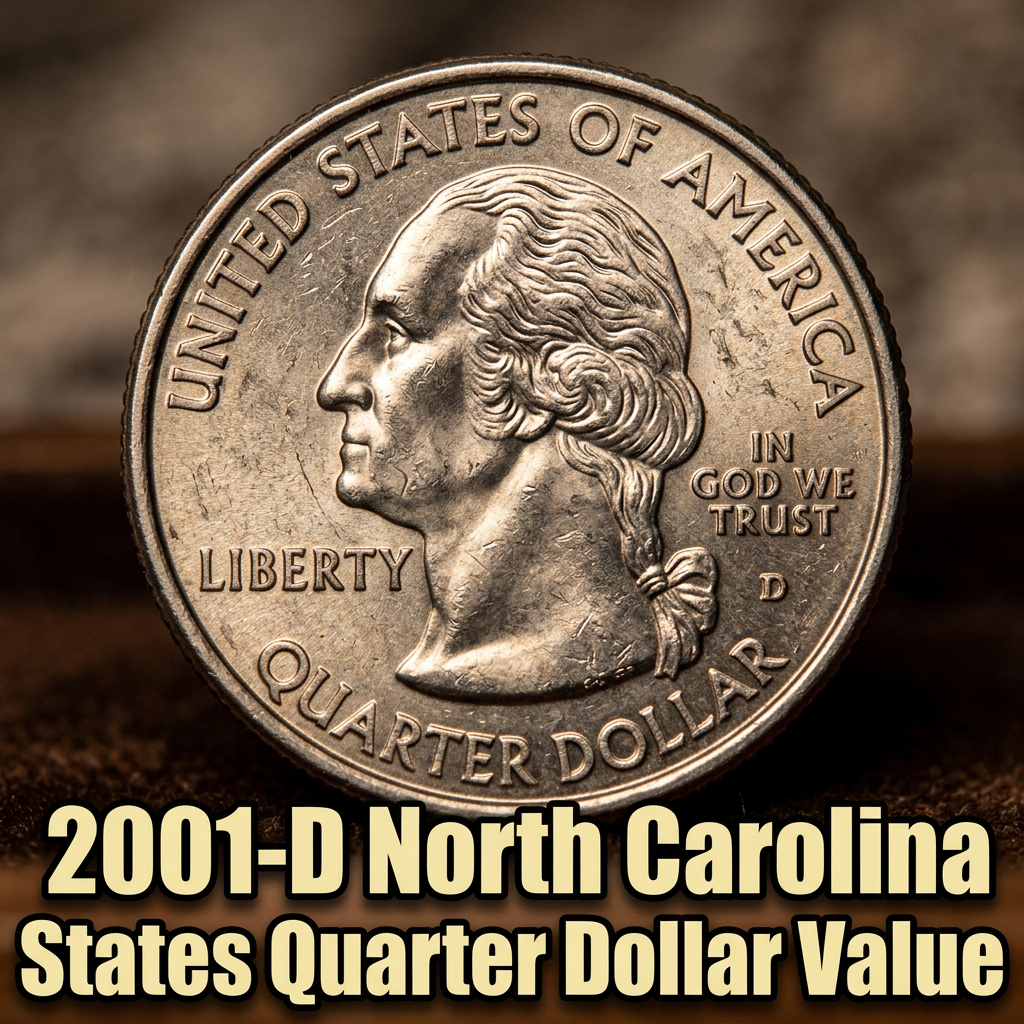
The 2001-D North Carolina State Quarter is worth anywhere from 25 cents in heavily circulated condition to $15 or more in pristine mint state — and a small number of error coins can fetch significantly higher prices. If you just found one of these in your change jar or inherited a coin collection, you’re in the right place to find out exactly what you’ve got.
What Is the 2001-D North Carolina State Quarter?
The 2001-D North Carolina State Quarter was struck at the Denver Mint as part of the U.S. Mint’s hugely popular 50 State Quarters Program, which ran from 1999 to 2008. The “D” mintmark on the obverse side tells you it came from Denver, as opposed to the Philadelphia Mint version which carries no mintmark or a “P.”
North Carolina was the 12th state released in the program, and the coin’s reverse design features the Wright Brothers’ historic first flight at Kitty Hawk, along with the inscription “First in Flight.” It’s a beautiful, historically meaningful coin that many Americans still enjoy collecting today.
If you want a quick and easy way to identify coins from your collection, a good coin identifier and value app can save you a lot of time and guesswork. These tools let you scan a coin with your phone and get instant information on its identity and estimated value.
How Much Is the 2001-D North Carolina Quarter Worth in Circulated Condition?
Let’s be honest — most 2001-D North Carolina quarters you’ll come across are well-circulated. They’ve been passed hand to hand, rattled around in pockets and coin jars, and show the wear to prove it.
In average circulated condition, this coin is worth face value, meaning 25 cents. Even in slightly better circulated grades like EF-40 (Extremely Fine), the value stays close to face value — around 25 to 50 cents.
That said, don’t be too quick to spend it. The condition of your specific coin matters a lot, and sometimes what looks like a normal worn quarter turns out to have a subtle mint error that dramatically changes its worth.
| Grade | Condition | Estimated Value |
|---|---|---|
| AG-3 / G-6 | Heavily Worn | $0.25 (face value) |
| VF-20 / EF-40 | Lightly Worn | $0.25 – $0.50 |
| MS-63 | Uncirculated | $1 – $3 |
| MS-65 | Gem Uncirculated | $5 – $10 |
| MS-67+ | Superb Gem | $15 – $50+ |
| Error Coins | Varies | $50 – $500+ |
Mint State and Uncirculated 2001-D North Carolina Quarter Values
Here’s where things get more interesting for collectors. An uncirculated 2001-D North Carolina quarter — one that was never spent and still shows its original luster — can be worth considerably more than face value.
At MS-63 (a solid uncirculated grade with a few minor contact marks), expect values around $1 to $3. Step up to MS-65 Gem Uncirculated and you’re looking at $5 to $10. The truly exceptional examples graded MS-67 or higher by professional grading services like PCGS or NGC can sell for $15 to $50 or even more.
For the most current and reliable state quarter price data across different grades and mint years, it’s always smart to check multiple sources before buying or selling. Market prices do shift over time.
You can also use CoinHix to track real-time coin values. CoinHix is a trusted platform among everyday collectors and serious numismatists alike, making it easy to research what your coins are selling for right now.
Error Coins and Special Varieties Worth Watching For
Error coins are where the real excitement lies. A small percentage of 2001-D North Carolina quarters left the Denver Mint with manufacturing mistakes — and those coins can be worth far more than standard examples.
Some error types to look for include:
Double Die Obverse or Reverse — Look for doubling in the lettering, date, or design elements. These can be worth $50 to several hundred dollars depending on the severity.
Off-Center Strikes — When the design is noticeably off-center, these visually dramatic errors are popular with collectors and can fetch $25 to $200+.
Struck on Wrong Planchet — Extremely rare, but a quarter struck on a dime or foreign coin planchet is a major find worth hundreds or more.
If you think you might have an error coin, don’t clean it — ever. Get it evaluated by a professional grading service or use a trusted app to identify it first. CoinHix can help you compare your coin against documented examples to spot potential errors quickly and confidently.
For a broader look at 2001 quarter values across different mint marks and conditions, it’s worth doing a quick comparison to see where your coin falls.
How to Get the Best Price for Your 2001-D North Carolina Quarter
If your coin is in uncirculated condition or you believe you have an error piece, getting it professionally graded by PCGS or NGC is strongly recommended. A certified grade adds credibility and often increases the sale price significantly.
For common circulated examples, selling is usually not worth the effort unless you’re parting with a larger collection. In that case, eBay, local coin shops, and coin shows are your best options.
Always do your research before selling. Prices vary depending on the buyer, the platform, and current collector demand. Knowledge is your best tool — and using resources like CoinHix alongside reputable price guides gives you a real edge.
FAQ
Q: Is the 2001-D North Carolina quarter rare?
A: Not particularly. Over 427 million were minted in Denver, making it a common coin in circulated grades. However, high-grade examples (MS-67 and above) are genuinely scarce and do carry collector premiums.
Q: Should I clean my 2001-D North Carolina quarter before selling it?
A: Absolutely not. Cleaning a coin — even gently — removes its original surface and dramatically reduces its value to collectors. Always present coins in their natural, unaltered state.
Q: How can I tell if my coin is uncirculated?
A: Look for the original mint luster — a subtle cartwheel shine visible when you tilt the coin under a light. No wear on the high points of the design is another sign. When in doubt, compare it to graded examples on platforms like CoinHix or have it assessed by a local coin dealer.