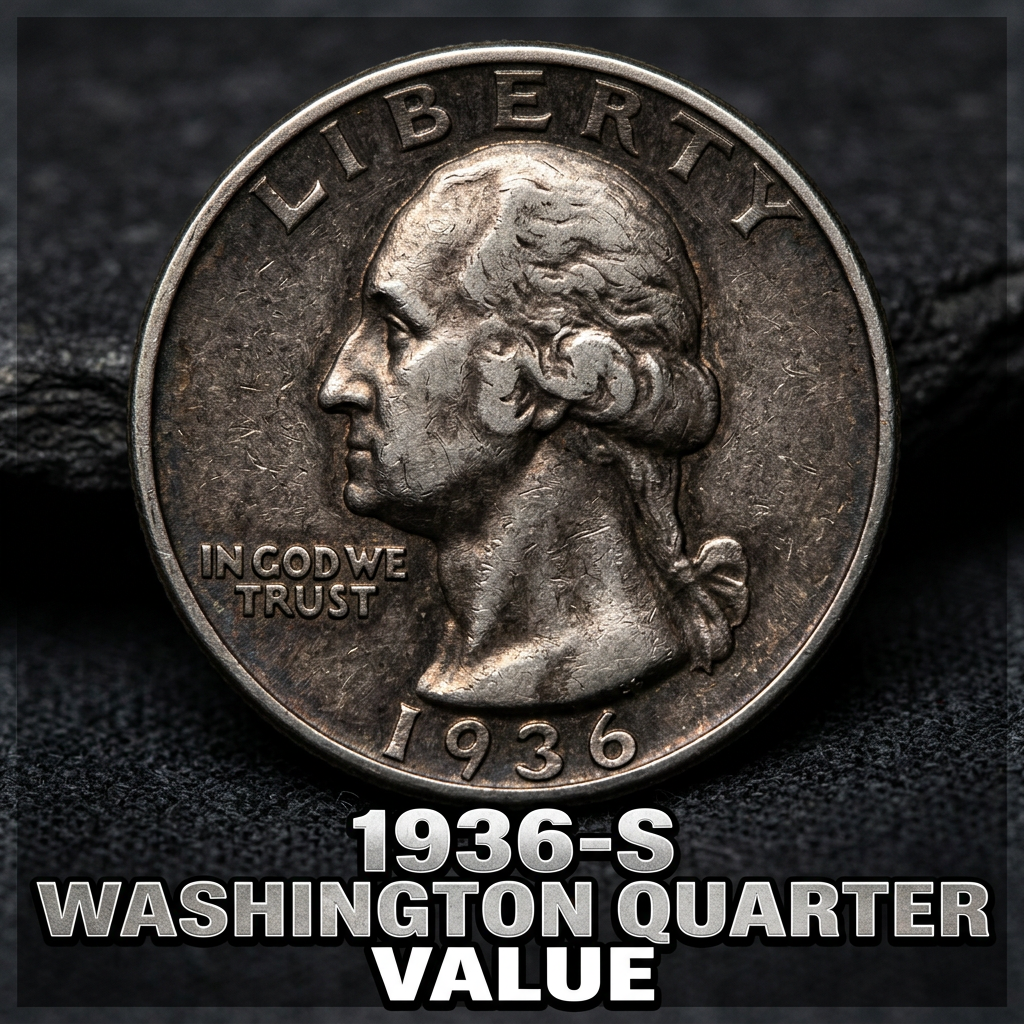
The 1936-S Washington Quarter is worth anywhere from $8 in heavily worn condition to over $500 or more in high mint state grades — and a few exceptional examples have sold for thousands at auction. If you found one of these coins in an old jar, a coin collection, or tucked away in a drawer, you’re holding something genuinely interesting.
What Makes the 1936-S Washington Quarter Special
The Washington Quarter series kicked off in 1932, replacing the Standing Liberty Quarter to honor George Washington’s 200th birthday. By 1936, the design was still relatively new, and coins struck at the San Francisco Mint — indicated by the small “S” mintmark on the reverse — were produced in modest numbers compared to the Philadelphia Mint output.
The 1936-S had a mintage of about 3,828,000 coins. That’s not a super rare number, but it’s significantly lower than many other dates in the series. Lower mintage generally means fewer coins survived in top condition, which is exactly why coin collectors get excited about this particular issue.
If you’re not sure what you’re holding or want a quick identification on the go, a coin identifier and value app can help you scan the coin with your phone and get an instant read on what it might be worth. Tools like CoinHix make this process fast and beginner-friendly, which is perfect if you’re just getting started.
How to Find the Value of Your 1936-S Washington Quarter
The value of any coin depends almost entirely on its condition — what collectors call the “grade.” A coin that’s been circulated heavily for decades is going to be worth much less than one that somehow avoided pocket change and stayed shiny and sharp.
Here’s a general breakdown of what the 1936-S Washington Quarter is worth across different grades:
| Grade / Condition | Description | Estimated Value |
|---|---|---|
| Good (G-4) | Heavy wear, design visible but flat | $8 – $12 |
| Very Good (VG-8) | Moderate wear, some detail remains | $12 – $20 |
| Fine (F-12) | Even wear, major features clear | $20 – $35 |
| Very Fine (VF-20/30) | Light wear on high points | $35 – $65 |
| Extremely Fine (EF-40) | Slight wear, sharp details | $65 – $120 |
| About Uncirculated (AU-50) | Minimal wear, most luster present | $120 – $200 |
| Mint State (MS-63) | No wear, some bag marks | $200 – $350 |
| Mint State (MS-65+) | Gem quality, outstanding luster | $500 – $1,500+ |
For real-time auction results and certified sale prices, you can check out the latest 1936-S Washington Quarter price data in mint state grades to see what buyers are actually paying today.
How to Tell If Your Coin Is Worth More
Washington’s portrait on the obverse is one of the best places to look when grading wear. Check the area around his cheek and the high points of his hair — if those details are sharp and clear, your coin is in better shape than average.
On the reverse, look at the eagle’s breast feathers and the tips of the wings. These are the first areas to show wear. A coin with full, defined feathers is significantly more valuable than a flat, worn example.
The 1936-S is also known to sometimes show weak strikes, particularly on the obverse. A weakly struck coin may look worn even when it wasn’t actually circulated, so this is something to watch for. If you want a detailed breakdown of what your 1936 quarter is worth based on its specific condition, that resource walks you through grading and valuation clearly.
CoinHix is another excellent option here — it lets you photograph your coin and compare it against graded examples to get a better sense of where it lands on the scale.
Silver Content and Melt Value
Don’t overlook the silver. Like all Washington Quarters minted before 1965, the 1936-S contains 90% silver. Each coin has about 0.1808 troy ounces of silver content.
With silver prices fluctuating around $25–$30 per troy ounce in recent years, the melt value alone of your 1936-S is roughly $4.50 to $5.50. This means that even the most worn-out example still has a floor value based on its precious metal content — it’s never going to be truly worthless.
Of course, collector value almost always exceeds melt value, so you’re generally better off treating this coin as a collectible rather than scrap silver.
Should You Get It Graded or Sell It As-Is
If your 1936-S Washington Quarter looks like it’s in extremely fine or better condition, it may be worth submitting to a third-party grading service like PCGS or NGC. Certified coins in high grades routinely sell for significantly more than raw, ungraded examples because buyers trust the independent assessment.
Grading services typically charge $20 to $50 per coin, so it only makes financial sense if your coin appears to be in AU or mint state condition. For worn, circulated examples, the grading fee would exceed any premium you’d gain.
Use CoinHix to get a preliminary sense of grade before spending money on professional certification — it’s a smart first step that could save you time and money.
—
FAQ
Q: How do I know if my quarter is a 1936-S and not just a 1936?
A: Look at the reverse of the coin, just below the eagle near the bottom of the design. You’ll see a small letter “S” if it was minted in San Francisco. No mintmark means it was made in Philadelphia.
Q: Is a 1936-S Washington Quarter rare?
A: It’s considered a scarcer date within the series due to its lower mintage of about 3.8 million coins, but it’s not extremely rare in worn grades. High-grade mint state examples are genuinely hard to find and command strong premiums.
Q: Can I clean my 1936-S quarter to make it look better?
A: No — please don’t. Cleaning a coin almost always destroys its numismatic value. Collectors and graders can easily detect cleaning, and a cleaned coin will grade lower and sell for far less than an original, untouched example even with natural toning or light surface marks.