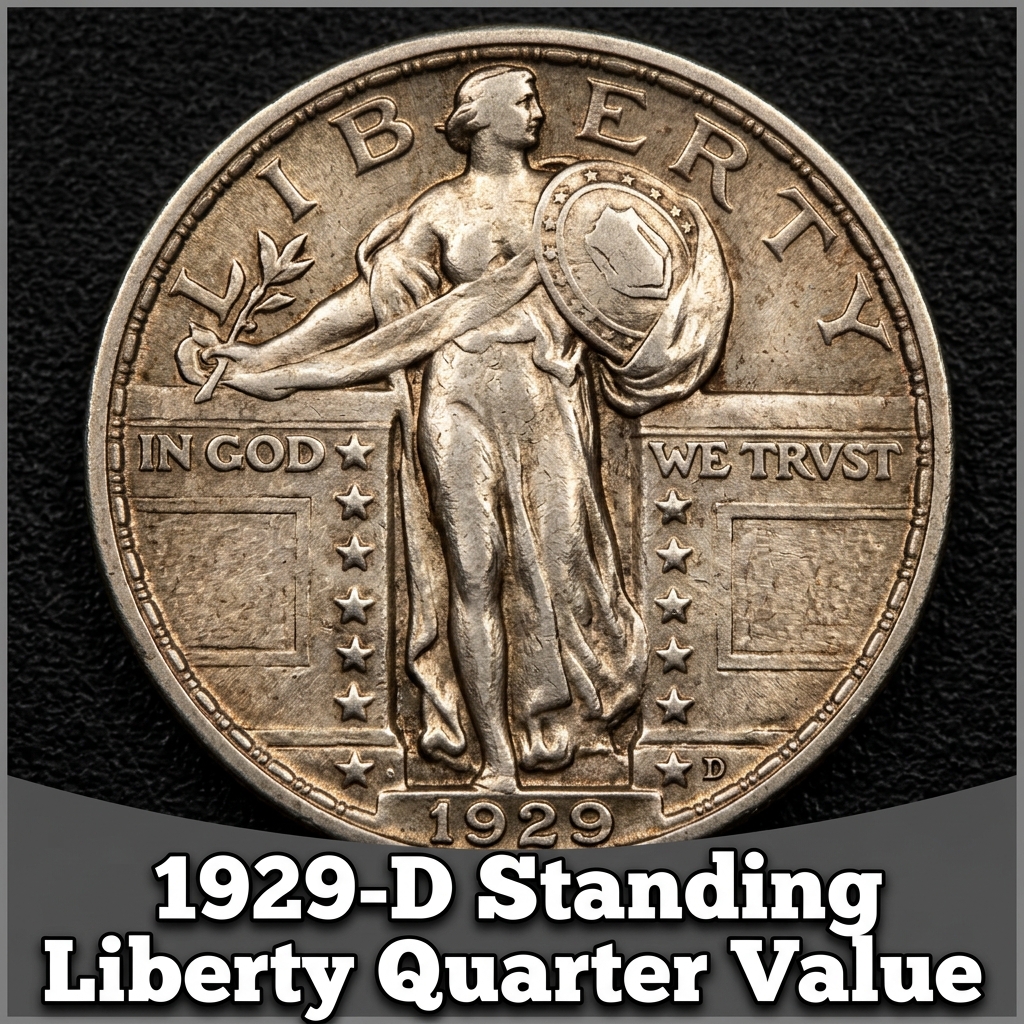
The 1929-D Standing Liberty Quarter is worth anywhere from $8 in heavily worn condition to well over $200 in above-average circulated grades — and in mint state, certified examples can fetch $500 or more. If you pulled one of these coins from an old jar or inherited it from a relative, you may be sitting on something genuinely valuable.
What Is the 1929-D Standing Liberty Quarter?
The 1929-D Standing Liberty Quarter was minted at the Denver Mint and carries a small “D” mintmark on the reverse, just above and to the left of the eagle. It’s part of the Standing Liberty Quarter series, which ran from 1916 to 1930 and is beloved by collectors for its beautiful design featuring Lady Liberty in a flowing gown.
The “D” mintmark is an important detail. Denver-minted coins sometimes had different survival rates and strike quality compared to Philadelphia or San Francisco issues, which affects their value.
The 1929-D had a mintage of 1,358,000 — not a huge number, but not considered rare either. That said, finding one in nice condition is harder than you’d think, because most circulated heavily in everyday use during the Great Depression era.
If you’re not sure what mintmark you’re looking at or want to quickly identify what you have, using a coin identifier and value app can help you figure out the exact variety and grade range in seconds.
How Much Is a 1929-D Standing Liberty Quarter Worth?
The value of this coin depends heavily on its condition, also called its “grade.” A coin with full readable details is worth significantly more than one that’s smooth and worn flat.
Here’s a general breakdown of 1929-D Standing Liberty Quarter values across different grades:
| Grade | Description | Estimated Value |
|---|---|---|
| Good (G-4) | Heavily worn, design visible but flat | $8 – $12 |
| Very Good (VG-8) | Moderate wear, major details clear | $12 – $20 |
| Fine (F-12) | Even wear, design well defined | $22 – $35 |
| Very Fine (VF-30) | Light wear on high points | $40 – $65 |
| Extremely Fine (EF-45) | Slight wear, sharp overall | $75 – $130 |
| About Uncirculated (AU-55) | Trace wear, nearly full luster | $150 – $225 |
| Mint State (MS-63+) | Uncirculated, no wear | $300 – $600+ |
For the most up-to-date auction results and certified coin pricing, you can check out current 1929-D Standing Liberty Quarter prices across mint state grades to see exactly what collectors are paying right now.
What Makes a 1929-D Quarter More (or Less) Valuable?
Beyond basic grade, there are a few specific factors that can make your 1929-D Standing Liberty Quarter worth considerably more — or less.
Full Head (FH) designation is one of the biggest value drivers. On Standing Liberty Quarters, Lady Liberty’s helmet details are the first thing to wear down. If those details are still sharp and complete, certified graders at PCGS or NGC may award a “Full Head” designation, which can double or even triple the coin’s value at a given grade.
Strike quality also matters. Some Denver Mint quarters from this era were weakly struck, especially on Liberty’s head and the eagle’s breast feathers. A well-struck coin stands apart from the crowd.
Original surfaces count too. Cleaned coins — ones that have been polished or dipped — lose significant value. Collectors always prefer original, untouched coins with natural patina over artificially brightened ones.
How to Accurately Grade Your 1929-D Standing Liberty Quarter
If you’re serious about knowing what your coin is worth, grading it properly is the critical first step. You don’t need to be an expert, but you do need a good magnifying glass and decent lighting.
Start by looking at Lady Liberty’s head and shield. If you can see the individual rivets on the shield and clear detail in her helmet, you’re looking at a Fine grade or better. If those features are smooth and mushed together, it’s likely a Good to Very Good coin.
The CoinHix app is a great tool for getting a quick estimate based on photos you take of your coin. It can help you compare your coin’s details against known grade examples and give you a realistic value range before you decide whether to have it professionally certified.
For a detailed breakdown of what your specific 1929-D quarter might be worth based on condition, the 1929 quarter value guide with grade-by-grade pricing is an excellent reference to bookmark.
Should You Sell, Hold, or Get It Graded?
This is the question most people have after they realize their old coin might be worth something real.
If your coin looks worn but readable — say, Fine to Very Fine — it’s probably worth $25 to $65 in the current market. That’s decent money for a coin sitting in a drawer, but it may not justify the cost of professional grading through PCGS or NGC, which typically runs $30 to $50 per coin plus shipping.
However, if your coin looks sharp, nearly uncirculated, or shows a strong Liberty head, professional certification could be worth every penny. A slabbed MS-63 example with a Full Head designation can bring $400 to $600 or more at auction.
Use CoinHix to photograph your coin and get an initial read on its condition. If the app or your own research suggests it might grade EF-45 or better, consider submitting it for grading. You might be surprised at the return.
—
Frequently Asked Questions
Q: How do I know if my quarter is a 1929-D or another mint?
A: Flip the coin over to the reverse side. Look just to the left of the eagle, above the date area. A small “D” means Denver Mint. No mintmark means Philadelphia, and “S” means San Francisco.
Q: My 1929-D quarter looks shiny and clean — is that good or bad?
A: It depends. If it’s naturally toned and uncirculated, that’s great. But if someone polished or cleaned it, that actually reduces the value significantly. Collectors call this “cleaning,” and it’s one of the most common reasons a coin grades lower than expected or gets “details” designation from grading services.
Q: Is the 1929-D Standing Liberty Quarter a rare coin?
A: It’s not considered rare, but it is a scarce coin in high grades — especially with a Full Head designation. With just over 1.3 million minted and most surviving examples heavily worn, finding a sharp example is uncommon. That’s what makes condition so important with this coin.