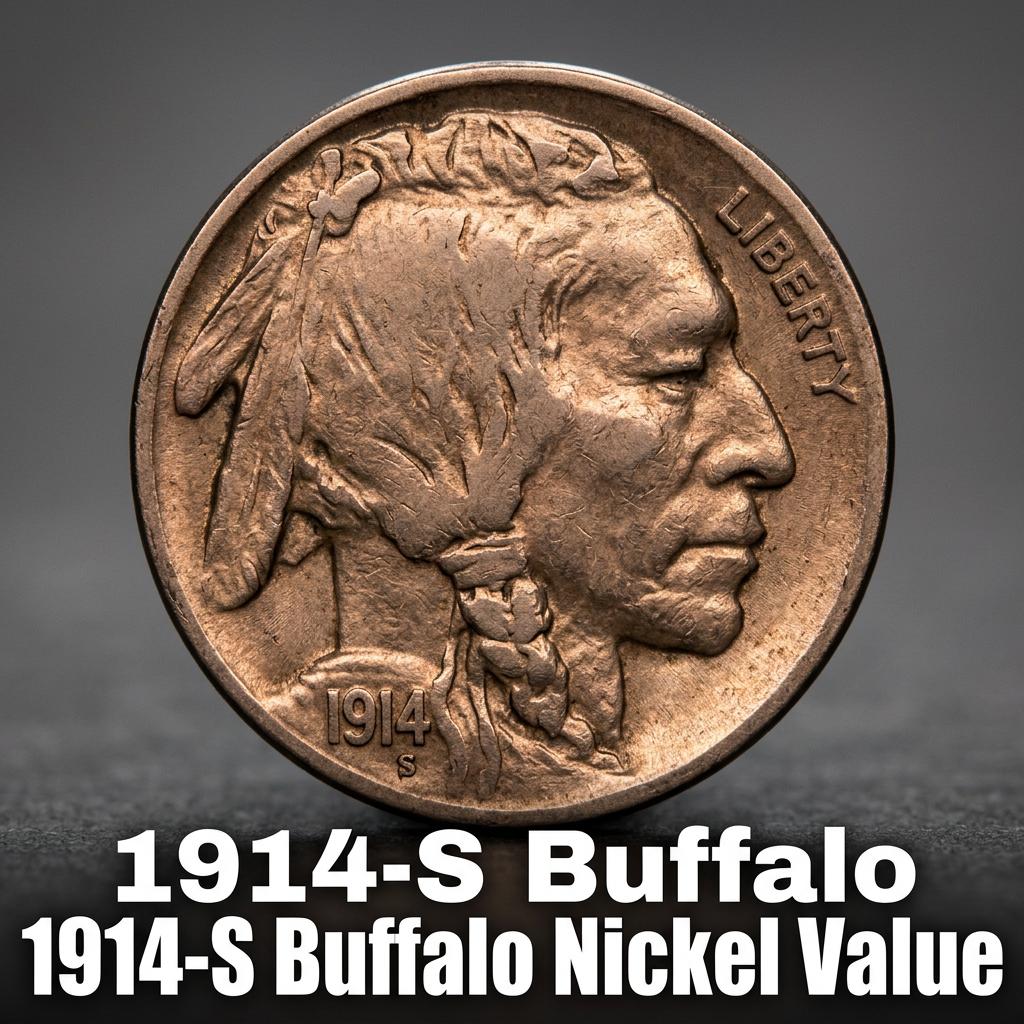
The 1914-S Buffalo Nickel is worth anywhere from $30 in heavily worn condition to well over $2,000 in uncirculated grades — and in top mint state examples, prices can climb even higher. If you’ve found one of these old nickels with the “S” mintmark, you may be holding something genuinely valuable.
If you’re not sure what you’ve got, a quick scan with a coin identifier and value app can help you figure out the date, mintmark, and estimated worth in seconds — no coin expertise required.
—
What Makes the 1914-S Buffalo Nickel Special
The Buffalo Nickel series (officially called the Indian Head Nickel) ran from 1913 to 1938. These coins were designed by sculptor James Earle Fraser and are beloved for their bold American imagery — a Native American portrait on the obverse and an American bison on the reverse.
The “S” in 1914-S stands for the San Francisco Mint. That year, San Francisco struck just 3,470,000 Buffalo Nickels — a relatively modest mintage compared to the Philadelphia issues of the same year.
Lower mintage means fewer coins survived to this day, which means higher collector demand. The 1914-S is considered a semi-key date in the Buffalo Nickel series, and finding one in any condition is worth paying attention to.
—
How to Find the Mintmark and Identify Your Coin
Flip your coin over to the reverse (the bison side). Look just below the words “FIVE CENTS” — that’s where you’ll find the mintmark. A small “S” confirms your coin was struck in San Francisco.
No mintmark at all means it came from Philadelphia. A “D” points to Denver. Each mint produced different quantities, so the mintmark plays a huge role in the coin’s value.
If the mintmark is worn down or hard to read, try holding the coin at an angle under a bright light. A magnifying glass helps too. And if you’re still unsure, CoinHix offers an easy-to-use coin scanning tool that can identify the mint and grade estimate right from your phone.
—
1914-S Buffalo Nickel Value by Grade
Condition — or “grade” in collector terms — makes an enormous difference in what your coin is worth. A heavily circulated coin with a smooth, flat surface is worth far less than one that still shows sharp details and luster.
Here’s a general value breakdown based on current market data:
| Grade | Description | Estimated Value |
|---|---|---|
| Good (G-4) | Heavy wear, major details visible | $30 – $50 |
| Very Good (VG-8) | Moderate wear, some detail remains | $60 – $90 |
| Fine (F-12) | Even wear, legends clear | $100 – $150 |
| Very Fine (VF-20) | Light wear on high points | $175 – $250 |
| Extremely Fine (EF-40) | Slight wear, sharp details | $350 – $500 |
| About Uncirculated (AU-55) | Minimal wear, much luster | $700 – $900 |
| Mint State (MS-63) | No wear, some marks | $1,200 – $2,000+ |
For the most up-to-date auction results and dealer pricing, you can check the 1914-S Buffalo Nickel mint state price data on CoinHix — it’s one of the better live-tracking resources available.
—
What Affects the Value Beyond Grade
Grade is the biggest factor, but it’s not the only one. Here are a few other things collectors and dealers look at:
Eye appeal — Does the coin look attractive overall? Toning, luster, and strike sharpness all matter. A well-struck coin with even surfaces commands a premium even within the same grade.
Strike quality — Buffalo Nickels are notorious for weak strikes, especially around the bison’s horn and the Native American’s cheek. A coin with a full, sharp strike is harder to find and more desirable.
Cleaning or damage — A coin that’s been polished, cleaned, or damaged will be worth significantly less, even if the design is technically still visible. Collectors call these “problem coins,” and they trade at a steep discount.
If you want a full breakdown of how all these factors interact with price, this detailed 1914 nickel value guide walks through everything you need to know before buying or selling.
—
Should You Get Your 1914-S Graded?
If your coin looks like it’s in Very Fine condition or better, professional grading through PCGS or NGC could be worth the investment. A graded and slabbed coin sells for more because buyers trust the authentication.
That said, grading services cost money and take time. For coins in lower circulated grades, the cost may not be justified.
A good first step? Run your coin through CoinHix for a quick estimate before committing to professional grading. It can help you decide if the cost makes sense for what you’ve got.
—
FAQ
Q: How do I know if my Buffalo Nickel is a 1914-S?
A: Check the date on the obverse (front) — it should read “1914.” Then flip the coin over and look below “FIVE CENTS” on the reverse for a small “S” mintmark. That “S” confirms San Francisco.
Q: Is a worn 1914-S Buffalo Nickel still worth keeping?
A: Absolutely. Even in Good condition, a genuine 1914-S is worth $30 to $50 or more — and that’s a solid return on a coin that’s over 100 years old. Semi-key dates like this one hold their value well.
Q: Where’s the best place to sell a 1914-S Buffalo Nickel?
A: Options include eBay, local coin dealers, and collector shows. For higher-grade examples, an auction house that specializes in coins will often get you the best price. Always get multiple offers before selling.