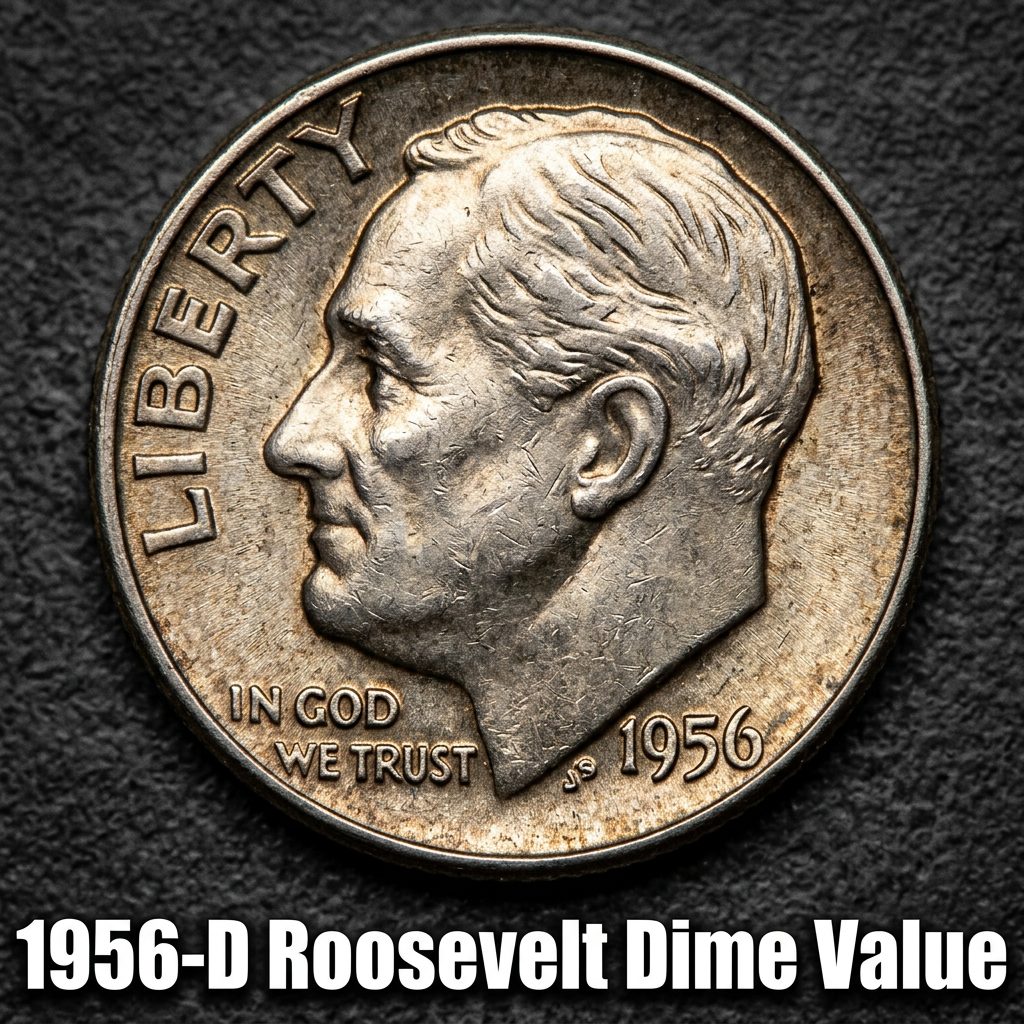
The 1956-D Roosevelt Dime is worth anywhere from $2 to $3 in well-worn condition, but uncirculated examples can fetch $10 to $25 or more depending on grade. If you found one of these coins in an old jar or coin collection, you’re in the right place to find out exactly what it’s worth.
What Is the 1956-D Roosevelt Dime?
The Roosevelt dime has been a staple of American coinage since 1946, introduced to honor President Franklin D. Roosevelt after his death. The “D” mintmark on the 1956-D tells you it was struck at the Denver Mint, and millions of them were produced that year.
Like all Roosevelt dimes from this era, the 1956-D is composed of 90% silver and 10% copper. That silver content alone gives every one of these coins a base melt value — even a heavily worn example is worth more than 10 cents simply because of the metal inside.
If you’ve ever wondered how to tell what you have without visiting a coin shop, a coin identifier and value app can be a fast, easy way to get started from your phone. These tools have become surprisingly accurate for common coins like this one.
How Much Silver Is in the 1956-D Dime?
One of the most important things to understand about the 1956-D Roosevelt dime value is that silver plays a big role. Each coin contains roughly 0.07234 troy ounces of pure silver.
When silver prices are around $25 per troy ounce (a common range in recent years), that gives the coin a melt value of approximately $1.80. But because collectors and dealers know these coins have silver, they almost always sell for a premium above melt.
That means even a coin that’s been in someone’s pocket for years is typically worth $2 to $3. A coin in nice, lightly circulated condition might bring $3 to $6. And a truly uncirculated coin — one that looks like it just left the mint — can be worth $10 to $25 or more.
1956-D Roosevelt Dime Value Chart
Here’s a quick look at what you can expect for the 1956-D dime across different grades. These are approximate retail values based on current market trends.
| Condition | Grade | Estimated Value |
|---|---|---|
| Heavily Worn | G-4 to F-12 | $2 – $3 |
| Lightly Circulated | EF-40 to AU-58 | $3 – $6 |
| Uncirculated | MS-60 to MS-64 | $8 – $18 |
| Gem Uncirculated | MS-65 and above | $20 – $50+ |
| Full Bands (FB) Designation | MS-65 FB+ | $100 – $300+ |
For a deeper look at certified mint state pricing data for the 1956-D Roosevelt dime, you can browse auction results and population reports to see how recent sales have gone.
What Makes Some 1956-D Dimes Worth More?
The biggest value driver beyond basic condition is the “Full Bands” (FB) designation. On Roosevelt dimes, the horizontal bands in the center of the torch on the reverse side must be sharply and completely separated to earn this designation from grading services like PCGS or NGC.
A 1956-D Roosevelt dime in MS-65 without Full Bands might sell for $20 to $30. The same coin with a Full Bands designation can jump to $100, $200, or even higher in top grades like MS-67 FB.
Strike quality and original luster also matter a lot. Coins with blazing, undisturbed mint luster and no contact marks are what collectors chase. CoinHix is a great tool to check recent auction results for specific grades — it pulls real market data so you can see what people are actually paying, not just price guide estimates.
Should You Get It Graded?
For most circulated 1956-D Roosevelt dimes, professional grading isn’t worth the cost. Grading fees typically start around $20 to $30, which exceeds the retail value of a coin in average condition.
However, if your coin looks absolutely pristine — no wear, strong luster, crisp details — it might be worth having it evaluated. Coins grading MS-66 FB or higher can be legitimately valuable, and a certified coin always sells for more than a raw one.
You can also get a quick sense of your coin’s condition right at home. Use CoinHix or check out the 1956 Roosevelt dime value guide with detailed condition explanations to compare your coin against photos and descriptions before spending money on professional grading.
A loupe or magnifying glass helps too — look at the torch bands on the reverse and check for original mint luster on the high points of Roosevelt’s portrait.
FAQ About the 1956-D Roosevelt Dime
Q: Is the 1956-D Roosevelt dime made of silver?
A: Yes. All Roosevelt dimes made before 1965, including the 1956-D, are composed of 90% silver and 10% copper. Each coin contains about 0.07234 troy ounces of pure silver, giving it a base melt value even in heavily worn condition.
Q: How many 1956-D Roosevelt dimes were made?
A: The Denver Mint produced approximately 108,015,100 Roosevelt dimes in 1956. That’s a large mintage, which is why circulated examples are fairly common and modestly priced. High-grade examples with Full Bands are the scarce pieces collectors compete for.
Q: Where is the mintmark on a 1956-D Roosevelt dime?
A: On 1956-D Roosevelt dimes, the “D” mintmark is located on the reverse side of the coin, just above the “E” in “ONE” on the lower right side. Starting in 1968, the mintmark was moved to the obverse, but coins from the 1950s carry it on the back. CoinHix can help you identify mintmarks on other coins you might have in your collection as well.