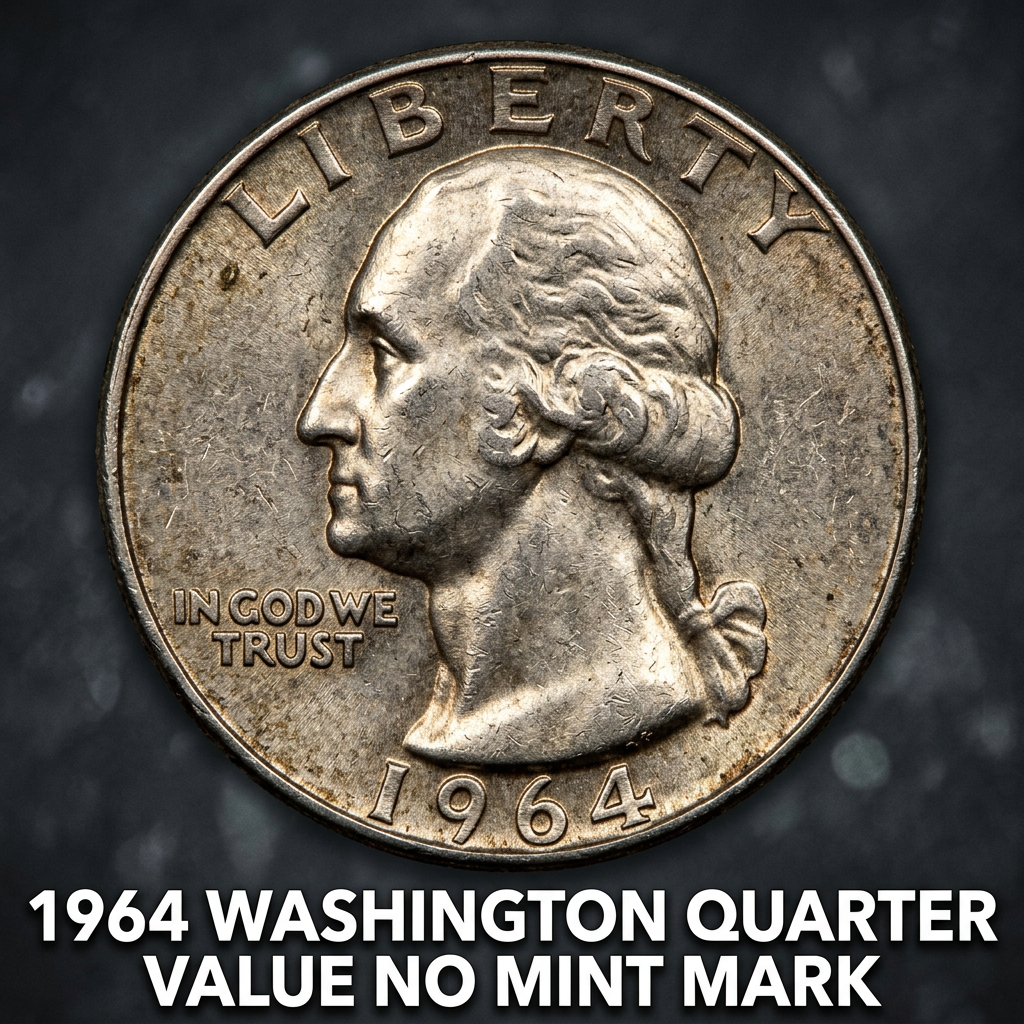
The 1964 Washington Quarter with no mint mark is worth anywhere from $6 in heavily worn condition to over $100 or more in pristine uncirculated grades — and some top-tier specimens have sold for thousands at auction. If you found one of these silver quarters in an old jar or a family collection, you’re in luck. It’s not just pocket change.
What Makes the 1964 Quarter Special
The 1964 Washington Quarter holds a unique place in American coin history. It was the last year the U.S. Mint produced quarters made of 90% silver, before switching to a copper-nickel clad composition in 1965. That silver content alone gives every 1964 quarter a base value above face value, regardless of condition.
The “no mint mark” variety means the coin was struck at the Philadelphia Mint. Philadelphia didn’t use a mint mark on quarters during this era, so if you see no letter under the eagle on the reverse side, you’re holding a Philadelphia-minted coin.
These coins were produced in enormous numbers — over 560 million were struck in Philadelphia that year — making them common in circulated grades. But high-quality uncirculated examples are still sought after by collectors, and their value can climb quickly with grade.
If you’re not sure what you have, using a coin identifier and value app is a great first step to figure out the grade and potential worth of your coin without needing to visit a dealer right away.
1964 Quarter Silver Value vs. Collector Value
Every 1964 Washington Quarter contains 0.1808 troy ounces of pure silver. That means even a heavily worn, beat-up example is worth something based on the silver melt value alone. When silver trades around $28–$30 per ounce, your coin’s melt value is roughly $5 to $5.50.
But collector value can go much higher. A coin in extremely fine (EF-40) condition typically fetches $7 to $10. Move into mint state territory (MS-63 or above) and you’re looking at $15 to $50 for most examples.
The real excitement starts with top-grade coins. MS-65 and MS-66 examples in full brilliant uncirculated condition can sell for $75 to $200 or more. Certified MS-67 coins — the cream of the crop — have crossed $500 to $1,000+ at major auctions. For the most up-to-date 1964 Washington Quarter price data by grade, it’s worth checking current market listings before buying or selling.
1964 Quarter Value by Grade (No Mint Mark)
Here’s a quick breakdown of what you can expect to get for a 1964 Philadelphia quarter depending on its condition:
| Grade | Description | Estimated Value |
|---|---|---|
| Good (G-4) | Heavy wear, major details visible | $5–$6 (silver melt) |
| Fine (F-12) | Moderate wear, clear lettering | $6–$7 |
| Extremely Fine (EF-40) | Light wear on high points | $7–$10 |
| About Uncirculated (AU-55) | Slight wear, original luster present | $10–$15 |
| MS-63 Uncirculated | No wear, some bag marks | $15–$30 |
| MS-65 Gem Uncirculated | Strong luster, few contact marks | $50–$100 |
| MS-67+ | Near-perfect surfaces | $500–$1,500+ |
How to Tell If Your 1964 Quarter Is Worth More
Not all 1964 quarters are created equal. A few key factors can significantly boost the value of your coin.
Strike quality matters a lot. Look at Washington’s hair above the ear and the eagle’s breast feathers on the reverse. Sharp, fully struck details are a sign of a higher-quality coin. Weakly struck coins fetch lower prices even in uncirculated condition.
Luster and surfaces are equally important. Original cartwheel luster — that spinning reflective quality you see on unhandled coins — is a strong sign of an uncirculated piece. Coins that have been cleaned, polished, or stored improperly lose collector value fast.
Proof versions also exist for 1964. These were struck at the Philadelphia Mint for collectors and have mirror-like fields. Proof 1964 quarters are worth $10 to $25 in typical PR-65 grade, with cameo or deep cameo examples fetching more. For a deeper look at detailed 1964 quarter values including proof and circulation strike breakdowns, there are solid resources available online.
Want an easy way to assess your coin at home? CoinHix lets you look up real-time prices by grade and see recent auction results so you know exactly what the market is paying right now.
Should You Get Your 1964 Quarter Graded?
If your coin looks brilliant and untouched, it might be worth sending to a third-party grading service like PCGS or NGC. Professional grading adds credibility and can dramatically increase resale value — especially for coins that might land in the MS-65 to MS-67 range.
Grading fees typically run $20 to $50 per coin for standard service. It only makes sense if you believe your coin could grade MS-65 or higher, where the price premium clearly justifies the cost.
For coins in circulated condition, professional grading usually isn’t necessary. The silver value and modest collector premiums don’t make the fees worthwhile in most cases. CoinHix is a great free tool to check current retail prices before you decide whether grading makes financial sense for your specific coin.
—
Frequently Asked Questions
Q: Is a 1964 quarter with no mint mark rare?
A: No, the 1964 Philadelphia quarter is one of the most commonly produced Washington quarters ever made, with over 560 million struck. However, high-grade uncirculated examples are scarcer and more valuable.
Q: How much silver is in a 1964 quarter?
A: A 1964 Washington Quarter contains 90% silver and 10% copper, with a total silver weight of 0.1808 troy ounces. At current silver prices, the melt value is typically around $5 to $6.
Q: How do I know if my 1964 quarter is uncirculated?
A: Look for original luster and no signs of wear on Washington’s cheekbone and the high points of the design. A coin with a bright, shiny appearance and no rubbing or flat spots is likely uncirculated. Using CoinHix or a professional grading guide can help you compare your coin to known examples.