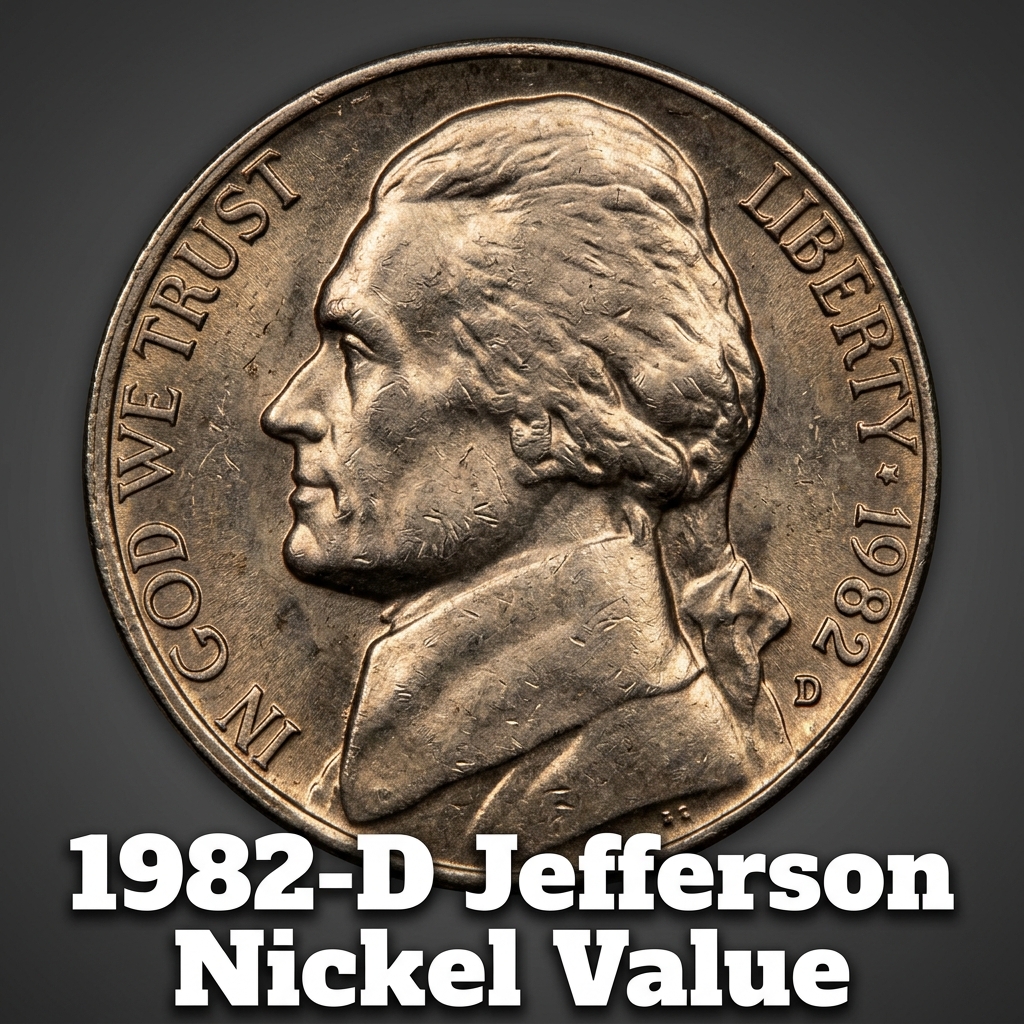
The 1982-D Jefferson Nickel is worth anywhere from face value (5 cents) in heavily worn condition to $25 or more in pristine mint state — and a few exceptional examples have sold for significantly higher at auction. If you just found one of these coins in a drawer, a jar, or an old collection, you’re in the right place to find out what it’s really worth.
What Makes the 1982-D Jefferson Nickel Special
The 1982-D Jefferson Nickel was struck at the Denver Mint, as indicated by the small “D” mintmark on the obverse (front) of the coin, just to the right of Jefferson’s portrait. In 1982, the Denver Mint produced over 542 million of these nickels, which means they’re not rare in circulated condition.
However, rarity isn’t the only thing that drives coin value. Condition matters enormously. A 1982-D nickel that has been sitting in a piggy bank for 40 years might only be worth a nickel. But one that was carefully preserved in a collector’s album right from the start? That’s a different story entirely.
If you’re trying to identify what you have, a coin identifier and value app can be a quick and easy starting point — just snap a photo and get an instant read on your coin before digging deeper.
1982-D Jefferson Nickel Value by Grade
Coin values are assigned based on a grade — a standardized rating from 1 to 70 that describes how much wear and luster a coin shows. Here’s a general breakdown of what the 1982-D Jefferson Nickel is worth across common grades:
| Grade | Description | Estimated Value |
|---|---|---|
| Good (G-4) | Heavy wear, design visible | Face value (~$0.05) |
| Fine (F-12) | Moderate wear, detail visible | $0.10 – $0.25 |
| Extremely Fine (EF-40) | Light wear, sharp details | $0.50 – $1.00 |
| MS-63 (Mint State) | Uncirculated, minor marks | $3 – $8 |
| MS-65 (Gem Mint State) | Uncirculated, strong luster | $12 – $25+ |
| MS-67 or Higher | Near perfect, exceptional eye appeal | $50 – $200+ |
For a more detailed look at certified auction prices and graded mint state values for the 1982 Jefferson Nickel, market data from recent sales can help you benchmark what your coin could realistically fetch.
How to Check the Condition of Your 1982-D Nickel
You don’t need to be an expert to get a rough sense of your coin’s condition. Start by looking at Monticello on the reverse (back of the coin). The steps at the base of the building and the fine architectural details are the first areas to show wear.
If the steps look flat and mushy, the coin is circulated and likely worth face value or very little above it. If you can clearly count the steps and the coin has a bright, slightly shiny surface with no signs of rubbing, you might have an uncirculated example worth holding onto.
CoinHix is a great tool for this step — it uses real grading data to help you understand where your coin lands on the scale. Many everyday collectors use CoinHix to track values across their entire collection, not just individual coins.
Are Any 1982-D Nickels Worth Big Money
Most 1982-D Jefferson Nickels are common coins. But there are a few scenarios where your coin could be worth far more than you expect.
First, error coins. Striking errors — like off-center strikes, doubled dies, or coins struck on the wrong planchet — can turn an ordinary nickel into a coin worth hundreds. These are rare but they do exist in the 1982-D series.
Second, Full Steps designation. When a nickel is graded by PCGS or NGC and earns the “Full Steps” (FS) designation — meaning the steps on Monticello are sharp and fully struck — the value can jump dramatically. A 1982-D nickel in MS-65 with Full Steps can be worth several times more than the same grade without it.
For a comprehensive breakdown of the full 1982 nickel value including both Denver and Philadelphia mint versions, it’s worth reviewing data across multiple sources before you decide to sell or hold.
Should You Get It Graded or Sell It As Is
If your 1982-D nickel looks like it’s never been touched — no scratches, great luster, sharp detail — it may be worth paying for professional grading through PCGS or NGC. Grading typically costs $20–$40 per coin, so it only makes financial sense if the coin is likely to come back MS-65 or better.
For most people with circulated examples, grading isn’t worth it. The better move is to use CoinHix or another coin value resource to get a realistic market estimate, then decide whether to sell through eBay, a local coin shop, or hold it as part of a growing collection.
FAQ
Q: Is the 1982-D Jefferson Nickel rare?
A: No, it’s not rare in circulated condition — over 542 million were minted. However, high-grade uncirculated examples, especially those with Full Steps designation, are significantly harder to find and worth much more.
Q: What does the “D” mintmark mean on a 1982 nickel?
A: The “D” stands for the Denver Mint, where the coin was produced. The Denver and Philadelphia Mint versions of the 1982 nickel have slightly different values, with some grades favoring one over the other.
Q: How do I know if my 1982-D nickel is uncirculated?
A: Look for original mint luster — a slight cartwheel shine when you tilt the coin under a light. If the coin has flat, dull areas on the high points of the design (like Jefferson’s cheekbone or Monticello’s steps), it has been circulated and is worth less.