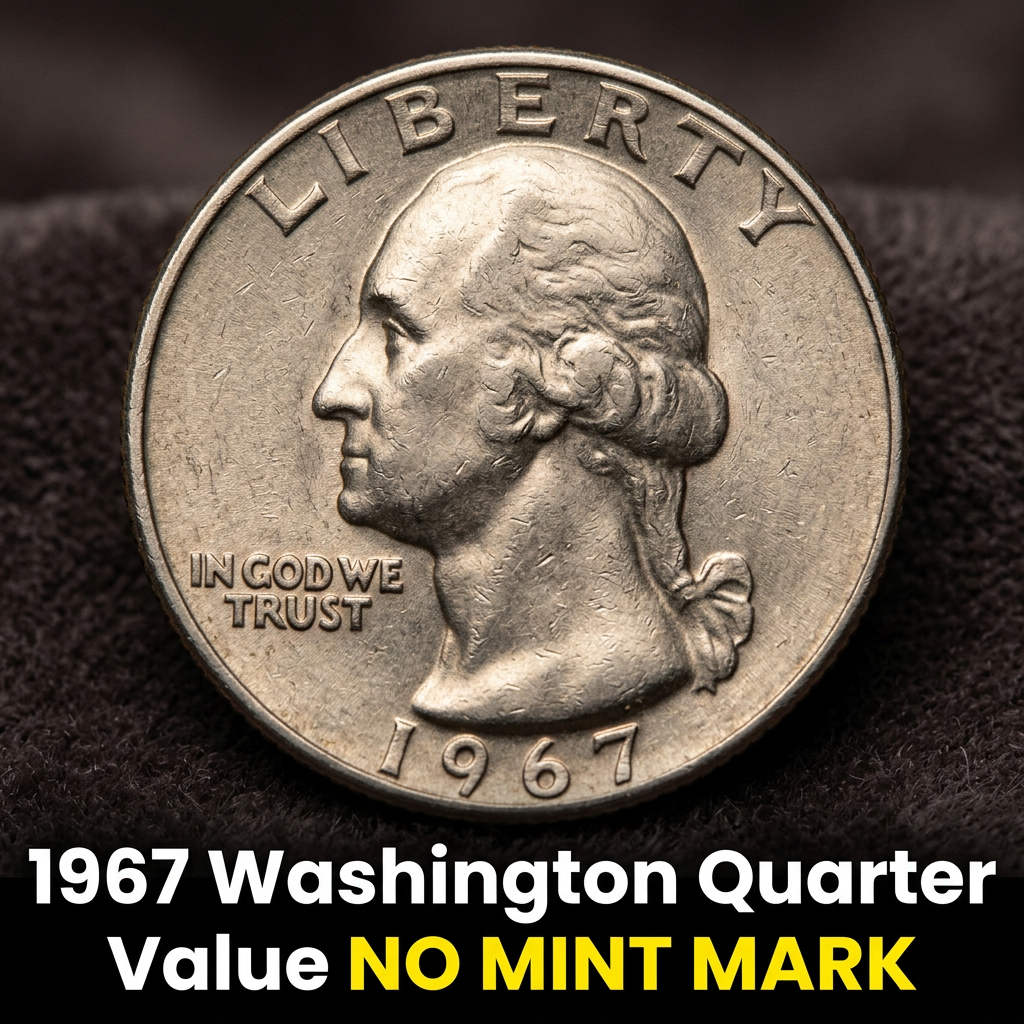
The 1967 Washington Quarter is worth anywhere from 25 cents in heavily circulated condition to over $15,000 in flawless mint state — and yes, that gap is enormous. If you pulled one of these out of an old coin jar or your grandfather’s collection, stick around, because the value depends heavily on condition and a few key details most people overlook.
Why There’s No Mint Mark on the 1967 Quarter
If you’re holding a 1967 quarter and can’t find a mint mark, don’t panic — you haven’t lost it. The U.S. Mint intentionally removed mint marks from all coins produced between 1965 and 1967 as part of a government policy during a national coin shortage. This was called the Special Mint Set era, and every 1967 Washington Quarter was struck at the Philadelphia Mint without a mint mark.
This means ALL 1967 quarters have no mint mark. It’s not a rare error or a missing letter — it was done on purpose. So you can stop squinting at that coin with a magnifying glass wondering where the “P” went.
That said, the absence of a mint mark doesn’t reduce the coin’s value. In fact, understanding this history helps you appreciate what you’re actually holding. If you want a quick way to identify coins like this and get an instant value estimate, a good coin identifier and value app can save you a lot of research time.
How Much Is the 1967 Washington Quarter Worth?
The honest answer? Most circulated 1967 quarters you find in pocket change or old jars are worth face value — just 25 cents. They were made in massive quantities (over 1.5 billion coins), so worn examples are extremely common.
But condition changes everything. A coin that spent decades rattling around in someone’s pocket looks completely different from one that was stored carefully. Collectors grade coins on a scale from 1 (barely identifiable) to 70 (perfect), and price jumps dramatically as you move up that scale.
The sweet spot for most collectors is the MS65 to MS67 range. These are coins with no wear, sharp details, and excellent luster. At MS67, a 1967 Washington Quarter can fetch anywhere from $500 to several thousand dollars at auction. At MS68, prices have gone well above $10,000.
Here’s a breakdown to give you a clearer picture:
| Grade | Condition | Estimated Value |
|---|---|---|
| Circulated (G-VF) | Well-worn, dull | $0.25 – $1 |
| MS60–MS63 | Uncirculated, some marks | $1 – $5 |
| MS65 | Gem uncirculated | $10 – $30 |
| MS67 | Superb gem | $500 – $3,000+ |
| MS68 | Near perfect | $10,000 – $15,000+ |
For a deeper look at certified sale prices across grade levels, check out this detailed 1967 Washington Quarter price data across MS grades — it pulls from real auction records so you know exactly what the market is doing.
Special Mint Sets and the 1967 SMS Quarter
Here’s something that makes the 1967 quarter stand out from its peers. The U.S. Mint produced Special Mint Sets (SMS) in 1967, featuring coins with a unique finish — not quite proof, not quite business strike, but sharper and more reflective than your average coin.
A 1967 SMS Washington Quarter in perfect condition is a real prize. These coins were struck with more care, and high-grade SMS examples command serious premiums. An SMS coin graded SP67 or SP68 by PCGS or NGC can sell for thousands of dollars. The key here is getting the coin professionally graded — it’s the difference between someone offering you $5 for it and $5,000.
If you think you might have an SMS coin, don’t clean it, handle it with cotton gloves, and look into submitting it for grading.
How to Know If Your 1967 Quarter Is Worth More
Not every 1967 quarter is a treasure, but here’s how to know if yours might be:
Look at the high points of the coin — Washington’s cheek and the eagle’s breast feathers. If those areas show wear or flatness, the coin has been circulated and probably won’t grade above MS60.
Check for luster. Uncirculated coins have a natural shine that catches light in a flowing, cartwheel pattern. Dull, flat-looking coins have lost that quality.
Look for contact marks and scratches. Even uncirculated coins get small bag marks from being stored with other coins at the mint. Fewer marks mean a higher grade.
And finally, use the right tools. CoinHix is a great resource for checking auction history and current market values on specific grades — exactly what you need before deciding whether to sell, hold, or submit for grading.
For a full breakdown of 1967 quarter values across all conditions and varieties, that page covers everything from circulated coins to SMS specimens in one place.
Should You Get Your 1967 Quarter Graded?
If your coin looks like it’s never been used and has strong luster and minimal marks, it may be worth submitting to a third-party grading service like PCGS or NGC. The cost is typically $20–$50 per coin for basic submission, so it only makes sense if you believe the coin could grade MS66 or higher.
A graded coin in a sealed holder is much easier to sell and typically fetches 30–100% more than a raw ungraded coin of the same quality. If you’re unsure whether grading is worth it for your specific coin, CoinHix lets you check recent sale prices by grade so you can make an informed decision before spending any money.
For everyday coins with obvious wear, grading isn’t necessary. Just enjoy them as a piece of American history — or spend them, since that’s exactly what they were made for.
—
FAQ
Q: Is a 1967 quarter with no mint mark an error coin?
A: No. All 1967 quarters were made without a mint mark by official U.S. Mint policy between 1965 and 1967. It is not an error and does not add value on its own.
Q: What is the most valuable 1967 Washington Quarter ever sold?
A: High-grade SMS and business strike examples in MS68 have sold for over $10,000 at major auctions. A PCGS-graded MS68 example is among the most prized versions of this coin.
Q: How can I tell if my 1967 quarter is an SMS coin?
A: SMS coins typically have a sharper strike and a semi-reflective, almost frosty finish compared to regular circulation coins. The best way to confirm is by having it examined by a professional grader or using CoinHix to compare photos of known SMS examples.