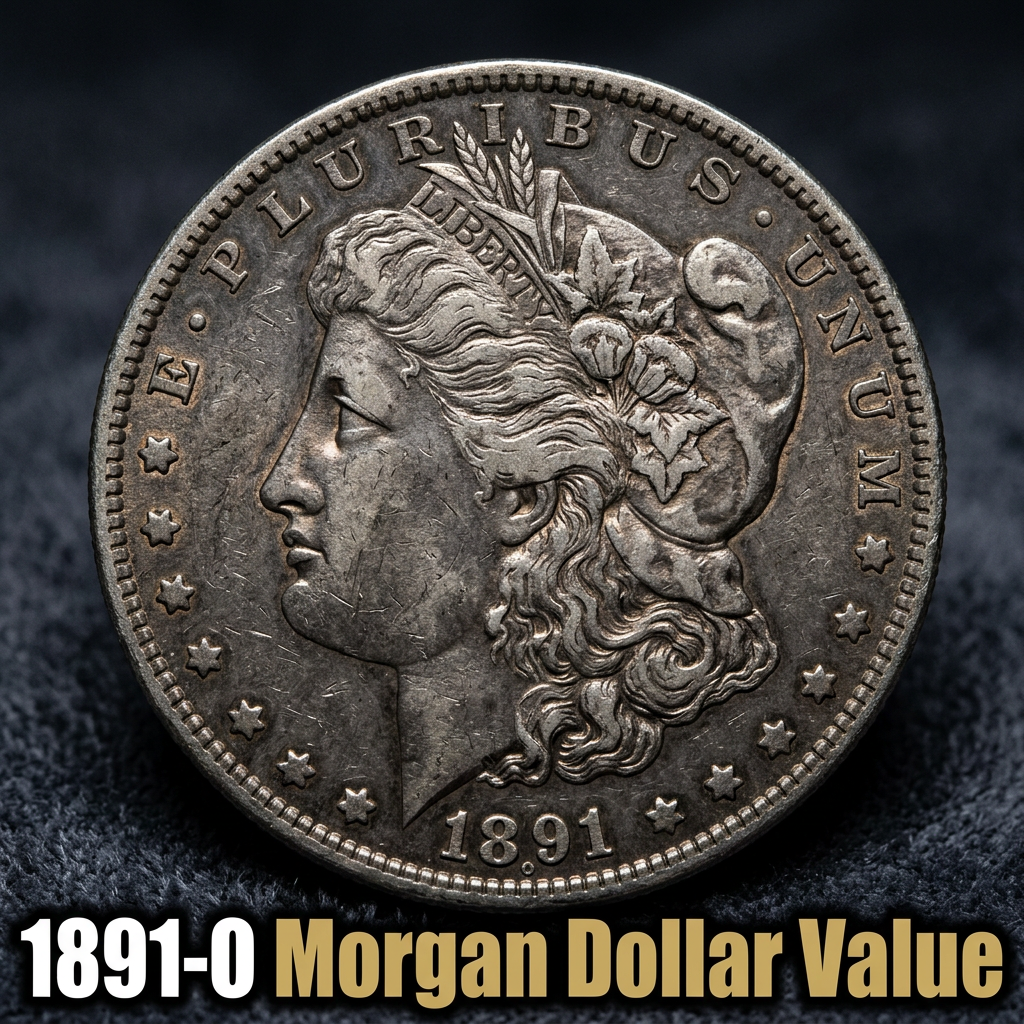
The 1891-O Morgan Dollar is worth anywhere from $30 in heavily worn condition to well over $1,000 or more in high mint state grades — and if you just found one in an old collection or coin jar, you may be sitting on something seriously valuable. This New Orleans-minted silver dollar has fascinated collectors for decades, and for good reason.
If you’re not sure what you’ve got, a quick scan with a coin identifier and value app can help you figure out the mint mark, grade, and estimated value in just a few seconds — no coin expertise required.
What Is the 1891-O Morgan Dollar?
The 1891-O Morgan Dollar was struck at the New Orleans Mint in Louisiana, which is identified by the small “O” mint mark found on the reverse side of the coin, just above the “DO” in “DOLLAR.” Morgan Dollars were produced from 1878 to 1904, and again briefly in 1921. They were large, heavy 90% silver coins designed by George T. Morgan — hence the name.
The New Orleans Mint was active during this era but wasn’t always known for producing the sharpest strikes. As a result, many 1891-O coins come with somewhat weak details, especially in the hair above Liberty’s ear and the eagle’s breast feathers. That can affect grading and value significantly.
In total, approximately 7,954,529 examples of the 1891-O Morgan Dollar were minted. That’s a fairly large mintage, which keeps circulated examples affordable — but high-grade survivors are genuinely scarce.
How Much Is the 1891-O Morgan Dollar Worth Today?
Value depends heavily on condition. A coin that’s been passed hand to hand for decades will show heavy wear and might only fetch melt value or a small premium. But one that was tucked away in a drawer shortly after it was minted could be worth hundreds or even thousands of dollars.
Here’s a general value breakdown based on grade:
| Grade | Description | Estimated Value |
|---|---|---|
| Good (G-4) | Heavy wear, major details visible | $30 – $40 |
| Very Fine (VF-20) | Moderate wear, clearer features | $45 – $65 |
| Extremely Fine (EF-40) | Light wear on high points | $75 – $120 |
| About Uncirculated (AU-55) | Slight wear, mostly luster intact | $150 – $250 |
| Mint State (MS-63) | Uncirculated, some contact marks | $300 – $600 |
| Mint State (MS-65) | Gem uncirculated, sharp and lustrous | $1,500+ |
For the most current auction results and certified coin pricing, you can check real-time 1891-O Morgan Dollar prices across mint state grades to see what collectors are actually paying right now.
What Makes Some 1891-O Dollars More Valuable Than Others?
Beyond the grade, a few specific factors can push the value of your 1891-O Morgan Dollar higher than average.
Strike quality is a big one. As mentioned, New Orleans coins from this period sometimes came out weakly struck. A coin that shows unusually sharp detail — especially in Liberty’s hair and the eagle’s feathers — commands a premium because it’s the exception, not the rule.
Luster is another major factor. Original, untouched luster gives coins a cartwheel-like shimmer when rotated under a light. Coins that have been cleaned or polished lose that luster and drop in value significantly, even if they look shiny to the naked eye.
Eye appeal matters too. Collectors and grading services like PCGS and NGC consider overall visual appeal when assigning grades. A coin with attractive original toning — natural color that developed over time — can sometimes sell above standard price guides. CoinHix is a great resource to compare how toned versus untoned examples have sold recently.
Should You Get It Graded?
If your coin looks uncirculated or close to it, professional grading is absolutely worth considering. PCGS and NGC are the two leading third-party grading services. A certified MS-63 or higher coin is far easier to sell and commands a much higher price than a raw, ungraded example.
For coins in lower grades, the grading fee may not be worth it unless you have reason to believe it’s exceptional. A good starting point is to look up detailed 1891 silver dollar value information by grade and mint mark before deciding whether professional certification makes financial sense for your specific coin.
If you’re not ready to pay for grading, using CoinHix to browse sold listings can give you a realistic ballpark on what your coin might fetch on the open market.
How to Tell If Your Coin Is Genuine
Morgan Dollars are widely counterfeited, so it’s smart to do a quick check before getting too excited. Real Morgan Dollars weigh 26.73 grams and measure 38.1 mm in diameter. They’re made of 90% silver and 10% copper.
A strong magnet test is a good start — silver is not magnetic, so if your coin sticks, it’s fake. You can also check the reeded (ridged) edge for uniformity. Fakes often have slightly off details in Liberty’s features or the eagle.
The best way to authenticate a Morgan Dollar at home is by using a dedicated CoinHix lookup combined with a reliable coin identifier tool to compare known images against your coin.
FAQ
Q: How do I find the mint mark on my 1891 Morgan Dollar?
A: Flip the coin over to the reverse side. Look just above the “DO” in “DOLLAR,” below the eagle’s tail feathers. An “O” means New Orleans, “S” means San Francisco, and “CC” means Carson City. No mint mark means it was struck at Philadelphia.
Q: Is a cleaned 1891-O Morgan Dollar worth anything?
A: Yes, but significantly less than an uncleaned example. A cleaned coin loses its original luster and is often noted as “cleaned” or “improperly cleaned” by grading services, which can cut the value in half or more depending on the grade it would have otherwise received.
Q: What’s the most valuable version of the 1891 Morgan Dollar?
A: The 1891-CC (Carson City) is generally considered the most desirable of the 1891 Morgan Dollar issues due to its lower mintage and strong collector demand. The 1891-O is more common in circulated grades but becomes quite scarce in gem mint state, making high-grade examples particularly sought after.