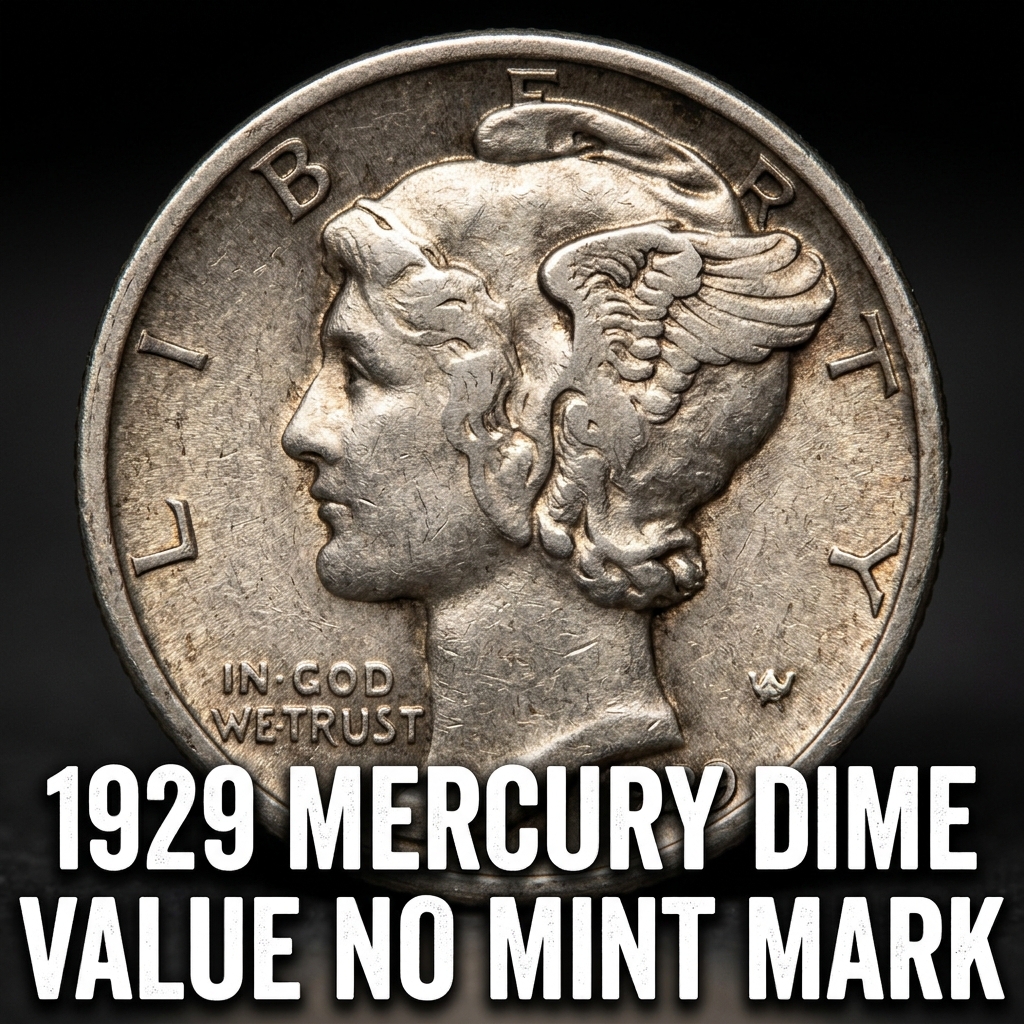
The 1929 Mercury Dime with no mint mark is worth anywhere from $3 in heavily worn condition to over $50 in well-preserved mint state grades, with some exceptional examples climbing even higher. If you found one of these beautiful silver dimes tucked away in an old coin jar or inherited collection, you’re holding a piece of genuine American history — and it might be worth more than you think.
What Is the 1929 Mercury Dime?
The Mercury Dime — officially called the Winged Liberty Head Dime — was designed by Adolph Weinman and minted from 1916 to 1945. The “Mercury” nickname came from the resemblance of Lady Liberty’s winged cap to the Roman god Mercury. These coins are beloved by collectors for their artistic beauty and historical charm.
The 1929 no mint mark version was struck at the Philadelphia Mint, which was the standard practice at the time — Philadelphia coins carried no mint mark. That year, the Philadelphia facility produced approximately 19,480,000 dimes, making this a relatively common issue compared to some of its counterparts from other years.
Still, “common” doesn’t mean worthless. Silver content alone gives these coins real monetary value, and collectors prize well-preserved examples significantly. If you want a quick and easy way to identify and grade your coin at home, a coin identifier and value app can be a fantastic starting point before you consult a dealer.
How Much Is the 1929 Mercury Dime Worth?
Value depends heavily on the coin’s condition, also called its “grade.” A coin that’s been heavily circulated — scratched, worn smooth, with barely visible details — will bring much less than one that still shows crisp feather details on the cap and sharp band lines on the reverse torch.
Here’s a general breakdown of what you can expect:
| Grade / Condition | Estimated Value |
|---|---|
| Good (G-4) – Heavy wear | $3 – $4 |
| Fine (F-12) – Moderate wear | $4 – $6 |
| Extremely Fine (EF-40) | $8 – $12 |
| About Uncirculated (AU-50) | $14 – $22 |
| Mint State (MS-63) | $30 – $50 |
| Mint State Full Bands (MS-65 FB) | $80 – $150+ |
The “Full Bands” designation — meaning the horizontal bands on the reverse torch are fully struck and separated — can dramatically increase value. For a full breakdown of 1929 Mercury Dime prices across mint state grades, numismatic databases offer detailed population reports and auction records that can help you benchmark your coin.
Silver Value and the Melt Price Factor
Every Mercury Dime is composed of 90% silver and 10% copper, with a total weight of 2.5 grams. That means each coin contains approximately 0.07234 troy ounces of pure silver.
With silver trading around $28–$30 per troy ounce (prices fluctuate daily), the raw silver melt value of a 1929 Mercury Dime is roughly $2.00 to $2.20. This sets a floor — even the most worn, beaten-up examples retain at least this much intrinsic value.
Of course, collector premiums push most coins well above melt. Even a Good-grade example typically sells for 50–100% above silver spot. If you’re trying to understand the full picture of what your 1929 dime is worth in today’s market, factoring in both silver content and collector demand gives you the most accurate estimate.
Tips for Evaluating Your 1929 Mercury Dime
Before you run to a coin shop, take a few minutes to examine your coin carefully. Use a magnifying glass and look at key areas: the feathers on Lady Liberty’s cap, the detail on her hair, and especially the torch on the reverse side with its distinctive bands.
Avoid cleaning the coin — this is one of the biggest mistakes new collectors make. A cleaned coin loses significant numismatic value because it destroys the natural patina that graders and collectors expect to see.
CoinHix is a great tool for looking up real-time auction results and certified coin populations. Whether you’re trying to grade your coin or compare it to recent sales, CoinHix gives you access to the kind of data that used to be reserved for professional dealers. It’s free to browse and genuinely helpful for first-time sellers.
Where to Sell or Get It Appraised
If your coin grades AU-55 or better — meaning it still has most of its original mint luster — it may be worth getting it professionally graded by PCGS or NGC. A certified coin in a tamper-evident slab sells for considerably more than a raw, ungraded one, especially online.
For lower-grade coins, local coin dealers, coin shows, and eBay are all solid options. Just do your research before selling. Apps like CoinHix can show you comparable recent sales so you walk into any negotiation knowing your coin’s fair market value.
FAQ
Q: How do I know if my 1929 dime is from Philadelphia?
A: If there’s no mint mark on the coin — look on the reverse side, to the left of the “E” in “ONE” — then it was minted in Philadelphia. The 1929 Philadelphia Mercury Dime carries no mint mark by design.
Q: Is a 1929 Mercury Dime rare?
A: Not particularly. With nearly 19.5 million struck, it’s one of the more common Mercury Dime dates. However, coins in high mint state grades — especially with Full Bands — are genuinely scarce and command strong premiums from collectors.
Q: Should I clean my 1929 Mercury Dime before selling it?
A: Absolutely not. Cleaning a coin removes its natural surface patina and almost always lowers its value in the eyes of collectors and professional graders. Leave it exactly as you found it and let a dealer or grading service evaluate its natural condition.