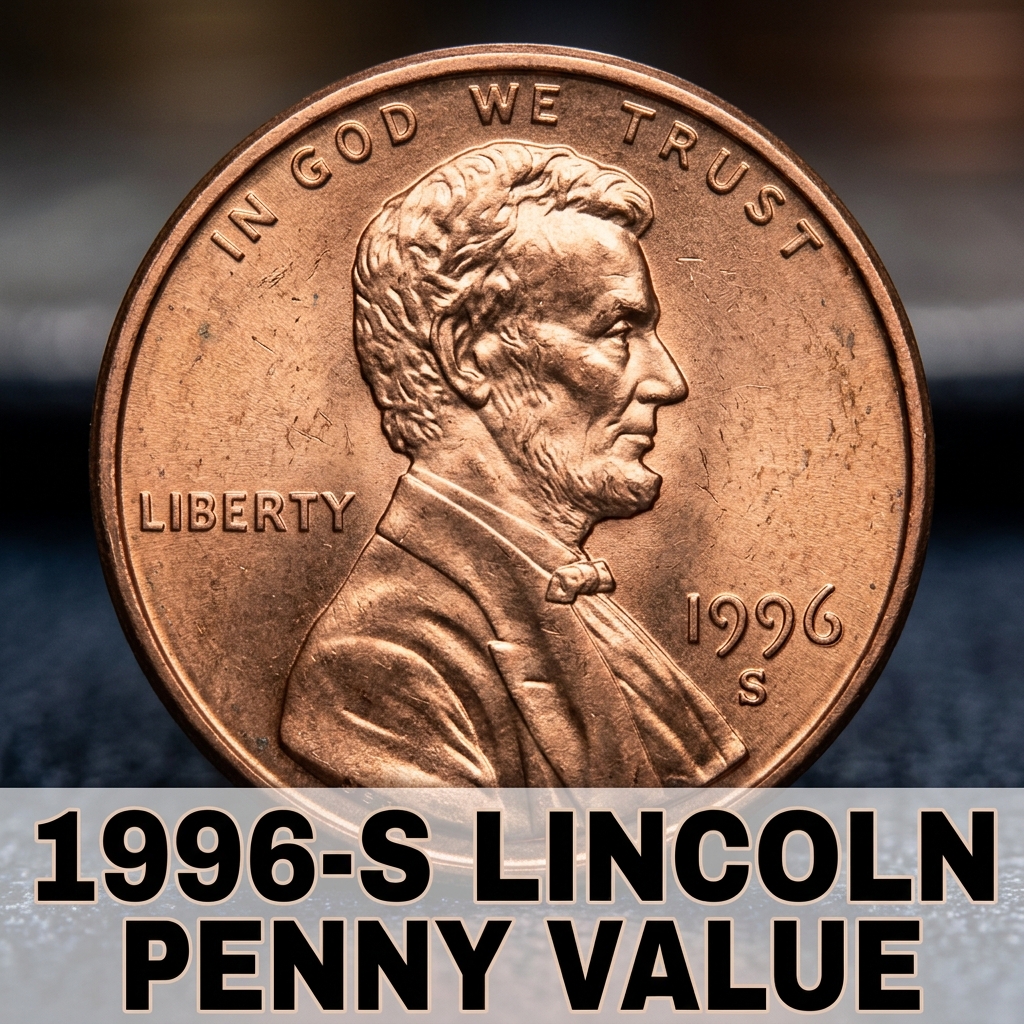
The 1996-S Lincoln Penny is worth anywhere from $2 in lightly circulated condition to over $10 or more in pristine proof grades — and if you stumbled across one in an old coin jar or collection, you might be sitting on a small but genuine treasure. This guide breaks down everything you need to know in plain English.
What Makes the 1996-S Penny Different From a Regular Cent
If you look at the bottom of the Lincoln Memorial on the back of your penny — or check just below Lincoln’s portrait on the front — you might spot a tiny letter “S.” That small letter is a mint mark, and it tells you the coin was struck at the San Francisco Mint.
Unlike the Philadelphia and Denver Mints, which produce billions of pennies for everyday circulation, the San Francisco Mint in 1996 made Lincoln cents exclusively as proof coins. These were sold directly to collectors in special proof sets, not released into your pocket change.
That means the 1996-S penny was never meant to jingle around in a cash register or bounce around in a coin jar. It was made with polished dies on specially prepared planchets, giving it that mirror-like finish that proof coins are known for.
Using a coin identifier and value app can help you quickly confirm whether the coin in your hand is truly a proof issue or just a well-preserved business-strike penny from another mint.
How Much Is the 1996-S Lincoln Penny Worth?
The short answer: more than face value, but probably not life-changing money — unless you have a perfect specimen or a rare error variety.
Most 1996-S Lincoln pennies grade somewhere between PR-65 and PR-69 on the professional coin grading scale. In the PR-65 to PR-67 range, these coins typically sell for $2 to $6. In PR-68 and PR-69 grades, prices jump to $8–$15 or higher. A perfect PR-70 Deep Cameo (DCAM) example — essentially flawless under magnification — can fetch $20 to $50 or more from the right collector.
Current 1996-S Lincoln penny graded price data shows how values shift by grade, and it’s worth checking that resource before buying or selling.
Here’s a simple breakdown of typical retail values:
| Grade | Type | Estimated Value |
|---|---|---|
| PR-65 | Proof | $2 – $4 |
| PR-67 | Proof | $4 – $7 |
| PR-68 DCAM | Deep Cameo Proof | $8 – $15 |
| PR-69 DCAM | Deep Cameo Proof | $12 – $25 |
| PR-70 DCAM | Perfect Deep Cameo | $30 – $60+ |
Understanding Proof Grades and What “DCAM” Means
When coin graders look at a proof coin, they’re checking for two key qualities: overall surface perfection and contrast. “Cameo” refers to the frosted, raised design elements against a mirror-like field (background). “Deep Cameo” or DCAM means that contrast is especially sharp and dramatic — the kind that makes Lincoln’s portrait practically jump off the coin.
For the 1996-S penny, most examples come with at least some degree of cameo contrast. Getting a PR-69 or PR-70 DCAM designation from a top grading service like PCGS or NGC can meaningfully boost the coin’s value and marketability.
If your coin still has its original proof set packaging and hasn’t been cleaned or touched, that’s a good sign it might grade well.
For a deeper look at 1996 Lincoln penny values across all mint marks and conditions, that resource covers the full picture, including Philadelphia and Denver issues.
How to Know If You Have a Real 1996-S Penny
Not every 1996 penny has an “S” mint mark — in fact, the vast majority don’t. The Philadelphia Mint produced over 6.6 billion Lincoln cents in 1996, while Denver struck another 5.3 billion. The San Francisco Mint, by contrast, produced only around 2.5 million proof versions.
If you think you have a 1996-S, here’s what to look for:
– A clear “S” mint mark just below the date on the obverse
– A mirror-bright, reflective surface on the fields
– Sharp, frosted details on Lincoln’s portrait
– No signs of circulation wear or cleaning
It’s also worth noting that a circulated 1996-S penny — one that somehow ended up in pocket change — is extremely unusual and would be an interesting find on its own. CoinHix is a great tool for looking up certified examples and seeing what they’ve actually sold for at auction.
Tips for Selling or Keeping Your 1996-S Penny
If you’re thinking about selling your coin, the best approach depends on its condition. Raw (ungraded) coins in average proof condition can sell for a few dollars on eBay or at local coin shows. If you believe your coin is near-perfect, paying to have it professionally graded by PCGS or NGC is worth considering — a verified PR-69 or PR-70 DCAM label can significantly increase buyer confidence and final sale price.
On the other hand, if you just want a fun keepsake or a starter piece for a collection, the 1996-S penny is a nice, affordable example of U.S. proof coinage.
CoinHix makes it easy to track recent auction results and compare prices so you’re never selling blind. And if you want to build out a complete proof set collection, the 1996 San Francisco set is a solid, budget-friendly starting point.
Whether you’re a casual finder or a growing collector, CoinHix has the data tools to help you make smarter decisions.
—
Frequently Asked Questions
Q: Is a 1996-S penny rare?
A: It’s not considered rare, but it is less common than regular circulation pennies. The San Francisco Mint struck about 2.5 million proof examples in 1996, which is a small number compared to the billions produced in Philadelphia and Denver. Most examples end up in proof sets rather than circulation.
Q: Can I find a 1996-S penny in everyday change?
A: It’s extremely unlikely. The 1996-S was sold only in proof sets directly to collectors and was never intended for general circulation. If you did find one in change, it would be an unusual and interesting find — and worth holding onto.
Q: Should I clean my 1996-S penny before selling it?
A: Absolutely not. Cleaning a coin — even gently — almost always reduces its value in the eyes of collectors and graders. Proof coins are especially sensitive to surface damage. Store it in a coin flip or original packaging and let a professional assess it as-is.