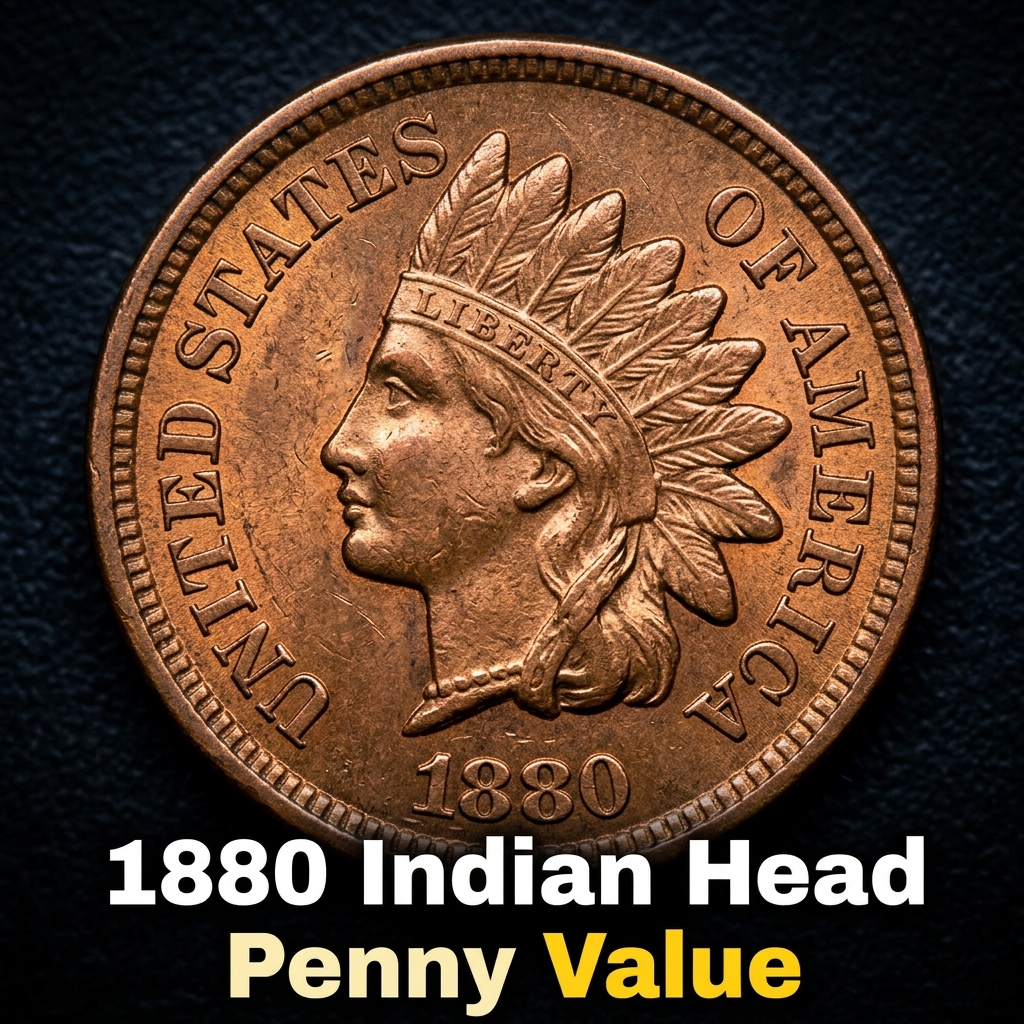
The 1880 Indian Head Penny is worth anywhere from $2 in heavily worn condition to over $100 or more in mint state, making it a surprisingly valuable little coin for something that once bought a piece of candy. If you recently found one in an old jar, a coin collection, or tucked away in a drawer, you’re in the right place to find out what you’ve got.
A Quick Look at the 1880 Indian Head Penny
The Indian Head Penny was minted from 1859 to 1909, and the 1880 issue came out of the Philadelphia Mint with a mintage of just over 38 million coins. That sounds like a lot, but keep in mind most of those coins circulated heavily through daily life — buying groceries, riding streetcars, and passing through thousands of hands. After more than 140 years, coins that survived in decent condition are far less common than you might think.
The design features a portrait of Lady Liberty wearing a Native American headdress — not an actual Native American, despite the name. The reverse shows a wreath of oak and laurel surrounding the words “ONE CENT.” It’s a classic piece of American history that collectors genuinely love.
If you’re not sure what coin you have or want to identify it quickly, a coin identifier and value app can help you figure out the exact date, mint mark, and grade before you make any decisions about selling or keeping it.
1880 Indian Head Penny Value by Grade
The condition of your coin matters more than almost anything else when it comes to value. Coin collectors use a grading scale from 1 to 70, and even small differences in wear can mean a big jump in price.
Here’s a general value guide based on condition:
| Grade | Description | Estimated Value |
|---|---|---|
| Good (G-4) | Heavy wear, design visible but flat | $2 – $4 |
| Fine (F-12) | Moderate wear, some detail visible | $5 – $10 |
| Extremely Fine (EF-40) | Light wear on high points | $20 – $35 |
| About Uncirculated (AU-55) | Slight wear, mostly sharp | $40 – $65 |
| Mint State (MS-63) | No wear, some minor marks | $75 – $110 |
| Gem Mint State (MS-65) | Outstanding luster and strike | $150 – $250+ |
For the most up-to-date 1880 Indian Head Penny prices in mint red condition, it’s worth checking a live pricing database since the market shifts regularly.
What Makes an 1880 Indian Head Penny More Valuable
Beyond the grade, a few other things can affect how much your coin is worth. Color is a big one — copper coins are graded not just by wear but also by color. “Red” (RD) coins have kept their original copper luster and command the highest prices. “Red-Brown” (RB) coins fall in the middle, and “Brown” (BN) coins, which are fully toned, are at the lower end even in mint state.
Strike quality also matters. A well-struck 1880 penny will show sharp feather details in the headdress and clear lettering. Weakly struck examples are worth less to serious collectors.
The CoinHix app is a great tool for checking real-time values based on grade and color designation — it breaks down prices for RD, RB, and BN examples separately so you know exactly where your coin falls.
How to Grade Your 1880 Indian Head Penny at Home
You don’t need to be a professional numismatist to get a rough sense of your coin’s grade. Start by examining it under good lighting — natural light or a strong lamp works fine. Look at the high points of the design first: the hair above the ear, the feathers in the headdress, and the ribbon on the reverse wreath.
If those areas look smooth and flat, you’re likely looking at a Good or Fine grade. If you can see individual feather details and some luster remains around the edges, you might be in the Extremely Fine to About Uncirculated range. Coins with full original shine and no visible wear at all are mint state examples — and those are the ones worth the most money.
For a more precise assessment, consider using CoinHix to compare your coin’s appearance to certified grading examples. You can also look at how similar late-series Indian Head Penny values are graded and priced to get a better sense of what condition benchmarks look like across the series.
Should You Clean Your 1880 Indian Head Penny?
Please don’t. This is one of the most common mistakes new collectors make, and it can destroy a coin’s value instantly. Even gentle cleaning with a cloth can leave hairline scratches that drop a coin from mint state to a much lower grade under magnification.
Collectors and dealers can almost always spot a cleaned coin, and cleaned examples sell for significantly less — sometimes only a fraction of what an uncleaned example in the same condition would bring. If your coin looks dark or dirty, that natural patina is actually protecting it and tells a story of its age. Leave it as-is.
Frequently Asked Questions
Q: How do I know if my 1880 Indian Head Penny is real?
A: Genuine 1880 Indian Head Pennies are made of 95% copper and weigh about 3.11 grams. Check the date placement, the sharpness of the design, and the coin’s weight if you have a small scale. Counterfeits do exist but are relatively rare for this common date. A reputable coin dealer or grading service can confirm authenticity for higher-value examples.
Q: Is there a mint mark on the 1880 Indian Head Penny?
A: No. The 1880 Indian Head Penny was produced only at the Philadelphia Mint, which did not use a mint mark on cents during this era. If you see a letter on the coin, double-check the date — you may have a different year.
Q: Where is the best place to sell an 1880 Indian Head Penny?
A: For circulated examples worth a few dollars, online marketplaces like eBay work well. For higher-grade coins worth $50 or more, consider getting it certified by PCGS or NGC first, then selling through a coin auction house or dealer. The CoinHix app can also help you track current market prices so you know when to sell and what a fair offer looks like.