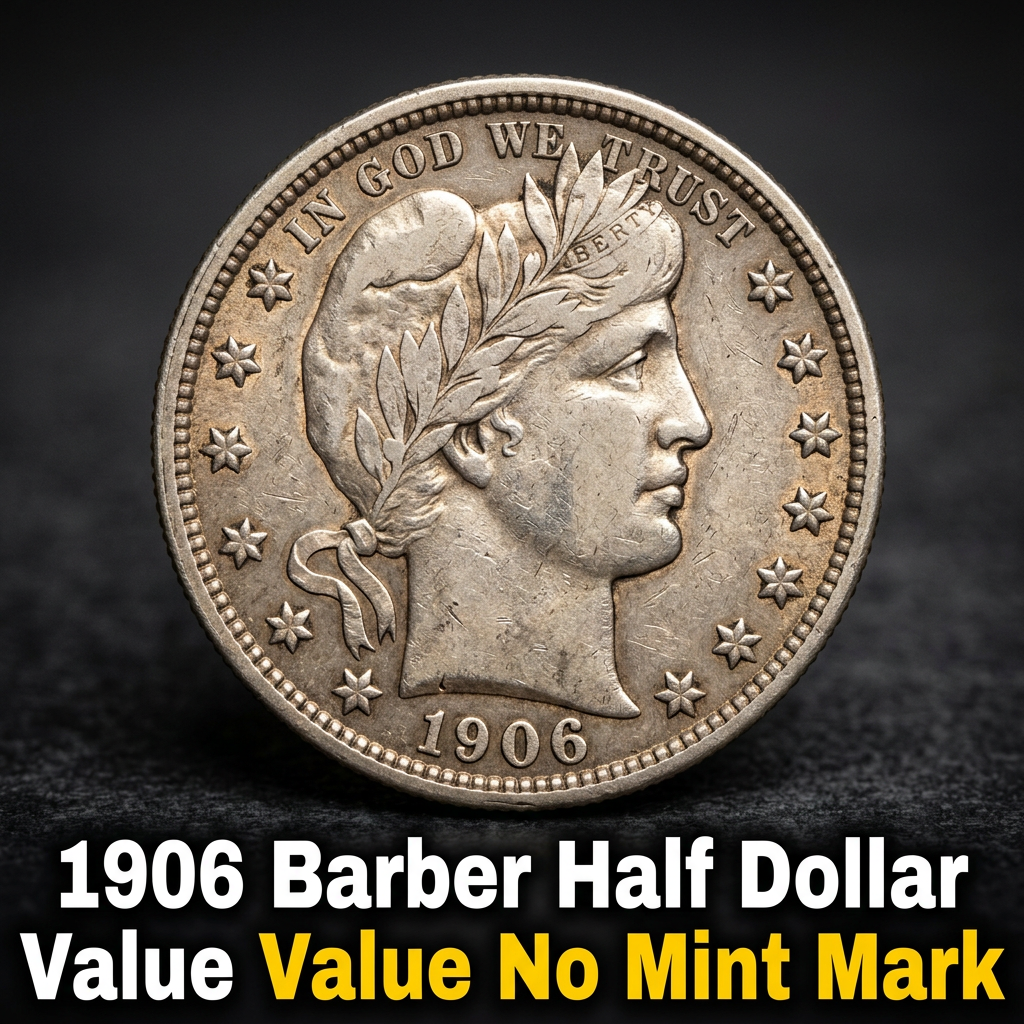
The 1906 Barber Half Dollar is worth anywhere from $15 in heavily worn condition to over $400 or more in higher mint state grades. If you found one of these silver coins tucked away in an old collection or inherited it from a relative, you’re holding a piece of American history that’s over 100 years old — and yes, it has real value.
What Is the 1906 Barber Half Dollar
The 1906 Barber Half Dollar was struck at the Philadelphia Mint, which is why it carries no mint mark. Designed by Charles E. Barber, this coin was part of a series minted from 1892 to 1915. The obverse features Lady Liberty in a Phrygian cap, while the reverse shows a heraldic eagle.
These coins were made of 90% silver and 10% copper, giving them intrinsic metal value in addition to their numismatic worth. Even a heavily circulated example is worth more than face value simply because of its silver content.
If you’re not sure whether what you have is a Barber Half Dollar or another type of coin, using a coin identifier and value app can help you quickly confirm what you’re holding and get an instant value estimate without needing to visit a coin dealer right away.
1906 Barber Half Dollar Value by Grade
The condition of your coin — referred to as its “grade” in the coin collecting world — makes a huge difference in what it’s worth. A coin worn smooth from decades of circulation is worth far less than one that still shows sharp details.
Here’s a general value guide for the 1906 Barber Half Dollar with no mint mark:
| Grade | Description | Estimated Value |
|---|---|---|
| Good (G-4) | Heavy wear, outline visible | $15 – $20 |
| Very Good (VG-8) | Some detail remains | $22 – $30 |
| Fine (F-12) | Moderate wear, readable detail | $35 – $50 |
| Very Fine (VF-20) | Light to moderate wear | $55 – $80 |
| Extremely Fine (EF-40) | Light wear on high points | $100 – $150 |
| About Uncirculated (AU-50) | Slight wear, mostly sharp | $175 – $250 |
| Mint State (MS-60 to MS-65) | No wear, uncirculated | $300 – $450+ |
Keep in mind these are approximate retail values. Actual prices can vary based on current silver prices and demand from collectors.
How Many Were Made and Why That Matters
The Philadelphia Mint produced 2,638,675 Barber Half Dollars in 1906. That’s a reasonably large mintage for the era, which means these coins aren’t rare in the traditional sense — but finding one in better condition is still a real challenge.
Most surviving examples are heavily worn because these coins circulated actively in everyday commerce. A coin grading VF-20 or better is genuinely harder to find than the mintage numbers suggest.
If you want to know exactly where your coin falls on the grading scale, CoinHix is a smart tool to start with. Just take a photo of both sides of your coin, and the app will analyze the condition and give you a value estimate in seconds — no coin show attendance required.
To learn more about which half dollars are worth money and how to spot valuable ones, it’s a great idea to explore a dedicated resource so you can compare your coin against other half dollar series from the same era.
Silver Content and Melt Value
One thing that makes the 1906 Barber Half Dollar appealing even to non-collectors is its silver content. Each coin contains 0.3617 troy ounces of pure silver.
With silver prices fluctuating around $25 to $30 per troy ounce in recent times, the melt value of a single 1906 Barber Half Dollar is roughly $9 to $11. This gives every coin a base value floor regardless of condition — meaning even a badly worn example is never truly worthless.
That said, you should never melt a coin without first checking its numismatic value, because collector value almost always exceeds melt value for coins like this one.
Tips for Getting the Best Price for Your 1906 Barber Half Dollar
If you’re thinking about selling, a few tips can help you get fair value. First, don’t clean the coin — cleaned coins are worth significantly less to collectors because cleaning removes the original surface and luster.
Second, get a sense of what your coin is actually worth before you sell. CoinHix makes this easy by walking you through a quick identification and valuation process right from your phone. Knowing the value going in puts you in a much stronger negotiating position.
Third, consider selling to a reputable coin dealer, through an online coin auction, or to a fellow collector directly. Each option has trade-offs in terms of convenience and how much of the coin’s value you’ll actually pocket.
Frequently Asked Questions
Q: Is a 1906 Barber Half Dollar with no mint mark rare?
A: Not particularly rare in circulated grades, since over 2.6 million were minted at Philadelphia. However, finding one in Very Fine condition or better is genuinely difficult, and those examples command strong collector premiums.
Q: How do I know if my 1906 Barber Half Dollar is worth grading professionally?
A: If your coin shows sharp details, original luster, or is in Extremely Fine or better condition, professional grading through PCGS or NGC can significantly increase its marketability and confirmed value. Use CoinHix to get a quick initial read before spending money on professional grading fees.
Q: Does the 1906 Barber Half Dollar have any mint marks to look for?
A: Yes. In addition to the Philadelphia issue with no mint mark, the 1906 Barber Half Dollar was also struck at the Denver Mint (D) and San Francisco Mint (S). The San Francisco version typically commands higher values in all grades, so check the reverse of your coin just below the eagle to see if a mint mark is present.