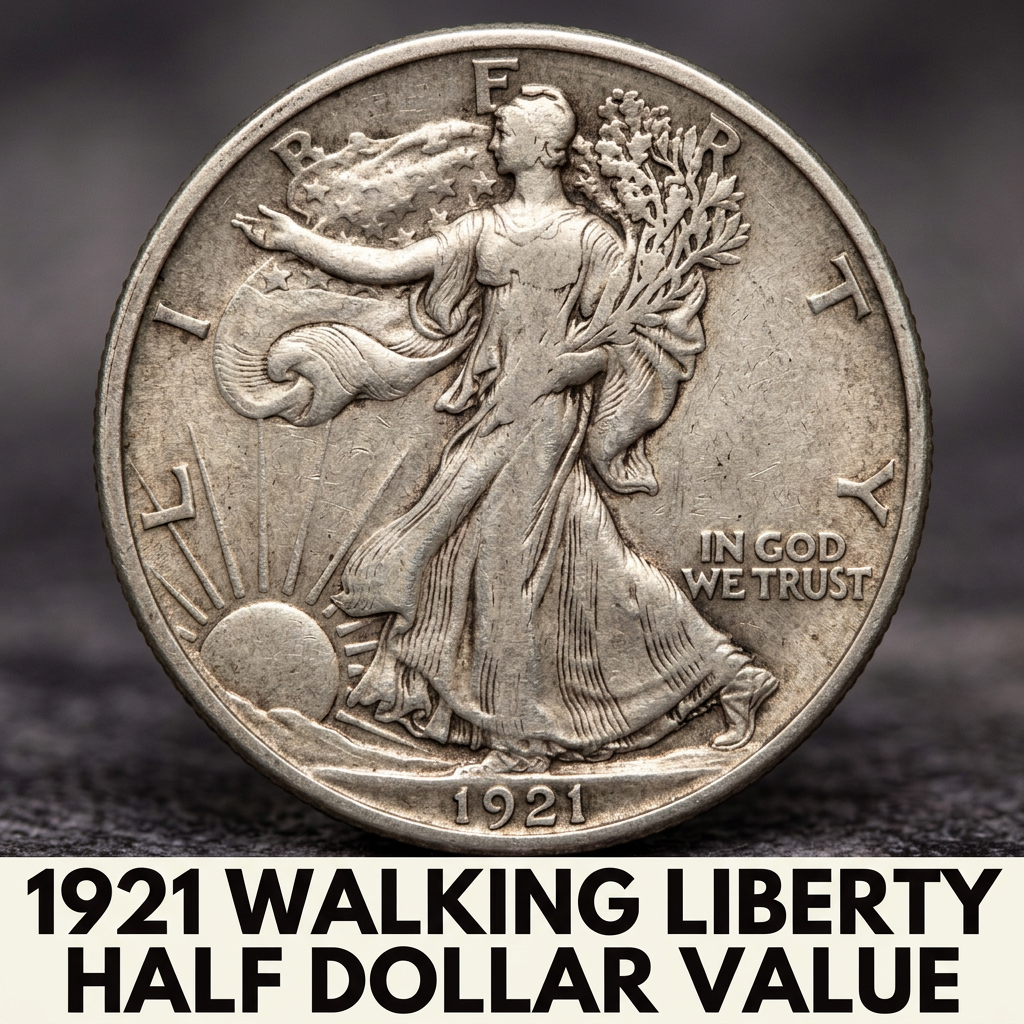
The 1921 Walking Liberty Half Dollar is worth anywhere from $75 in heavily worn condition to well over $1,500 or more in mint state — and some high-grade examples have sold for thousands at auction. If you found one of these coins in an old collection or tucked away in a drawer, you may be sitting on a genuine treasure worth looking into.
What Makes the 1921 Walking Liberty Half Dollar Special
The Walking Liberty Half Dollar series ran from 1916 to 1947, and it’s widely considered one of the most beautiful coins ever produced by the U.S. Mint. The obverse features Lady Liberty draped in an American flag, striding confidently toward the sunrise — a powerful image designed by sculptor Adolph A. Weinman.
The 1921 issue is particularly notable because it was struck in very limited quantities. With a mintage of only 246,000 coins from the Philadelphia Mint and 208,000 from the San Francisco Mint, both the 1921 and 1921-S are considered key dates in the series. That low mintage is a big reason why values start so much higher than other years in the series.
Every coin is made of 90% silver, which gives it an intrinsic melt value regardless of collector grade. Right now, just the silver content alone is worth around $8–$10 per coin — but collector demand pushes the real value far beyond that.
If you want a quick way to identify what you have and get an estimated value, a coin identifier and value app can help you scan and assess your coin right from your phone in seconds.
1921 Walking Liberty Half Dollar Value by Grade
Coin values shift dramatically based on condition. A well-worn example that shows lots of circulation damage will be worth far less than one that looks nearly new. Here’s a general breakdown of what the 1921 Philadelphia issue is worth across common grades:
| Grade | Description | Estimated Value (1921) | Estimated Value (1921-S) |
|---|---|---|---|
| G-4 (Good) | Heavy wear, design visible | $75 – $100 | $100 – $140 |
| VG-8 (Very Good) | Moderate wear, some detail | $120 – $175 | $175 – $250 |
| F-12 (Fine) | Even wear, clear design | $200 – $300 | $275 – $400 |
| EF-40 (Extremely Fine) | Light wear on high points | $450 – $650 | $600 – $900 |
| MS-63 (Mint State) | No wear, minor contact marks | $1,500 – $3,000 | $2,500 – $5,000+ |
You can check the most up-to-date 1921 Walking Liberty Half Dollar price data across all mint state grades to see exactly where current auction results are landing for this key-date coin.
How to Tell the Philadelphia and San Francisco Coins Apart
This matters a lot because the mint mark affects value. The 1921-S was struck at the San Francisco Mint, and it carries a small “S” mint mark on the reverse side of the coin, located just below the eagle’s primary feathers near the bottom center.
The Philadelphia Mint version has no mint mark at all — that was standard practice for Philadelphia coins of this era.
Both are valuable, but in higher grades, the 1921-S often commands a premium due to its slightly lower mintage and greater collector demand. Always look carefully before assuming which one you have.
A magnifying glass or loupe can help you spot that small mint mark clearly. If you’re still unsure, CoinHix makes it easy to look up the coin by year and mint mark and see live pricing data instantly.
What Condition Really Means for Your Coin’s Worth
Grading can feel confusing at first, but here’s a simple way to think about it: the more detail you can see in the coin’s design, the higher the grade and the higher the value.
On a well-worn 1921 Walking Liberty Half Dollar, the lines in Liberty’s gown will be flat and blended together. In fine or extremely fine condition, you’ll see the folds and feathers sharpen up noticeably.
The difference between a coin worth $100 and one worth $2,000 can come down to just a few details. That’s why professional grading services like PCGS and NGC exist — and why so many collectors choose to have key-date coins like the 1921 certified before buying or selling.
For a detailed breakdown of 1921 Half Dollar values by grade and mint mark, it’s worth spending a few minutes reviewing the full picture before making any decisions.
How to Find Out What Your Coin Is Actually Worth
The fastest and easiest first step is to use CoinHix, which gives you real-time pricing based on actual recent auction sales — not outdated price guides. Once you have a ballpark, you can decide whether to get it professionally graded, sell it to a dealer, or hold onto it as part of a collection.
If you believe you have a mint state example, professional grading through PCGS or NGC is strongly recommended. Certified coins sell for significantly more than raw (ungraded) ones, especially for a key date like 1921.
Dealers at coin shows, local coin shops, and reputable online auction platforms like Heritage Auctions are all solid places to sell once you know what you have.
—
Frequently Asked Questions
Q: Is the 1921 Walking Liberty Half Dollar rare?
A: Yes, it’s considered one of the key dates in the Walking Liberty series. With a combined mintage under 500,000 coins for both mints, it’s significantly rarer than most other years in the series — and values reflect that.
Q: How much silver is in a 1921 Walking Liberty Half Dollar?
A: Each coin contains 0.3617 troy ounces of pure silver. At current silver prices, the melt value is roughly $8–$10, though collector value far exceeds the silver melt value for this particular coin.
Q: Should I clean my 1921 Walking Liberty Half Dollar before selling it?
A: Absolutely not. Cleaning a coin — even gently — permanently damages its surface and can reduce its value by 50% or more. Collectors and dealers strongly prefer coins in original, uncleaned condition, even if they look a little dirty or dark.