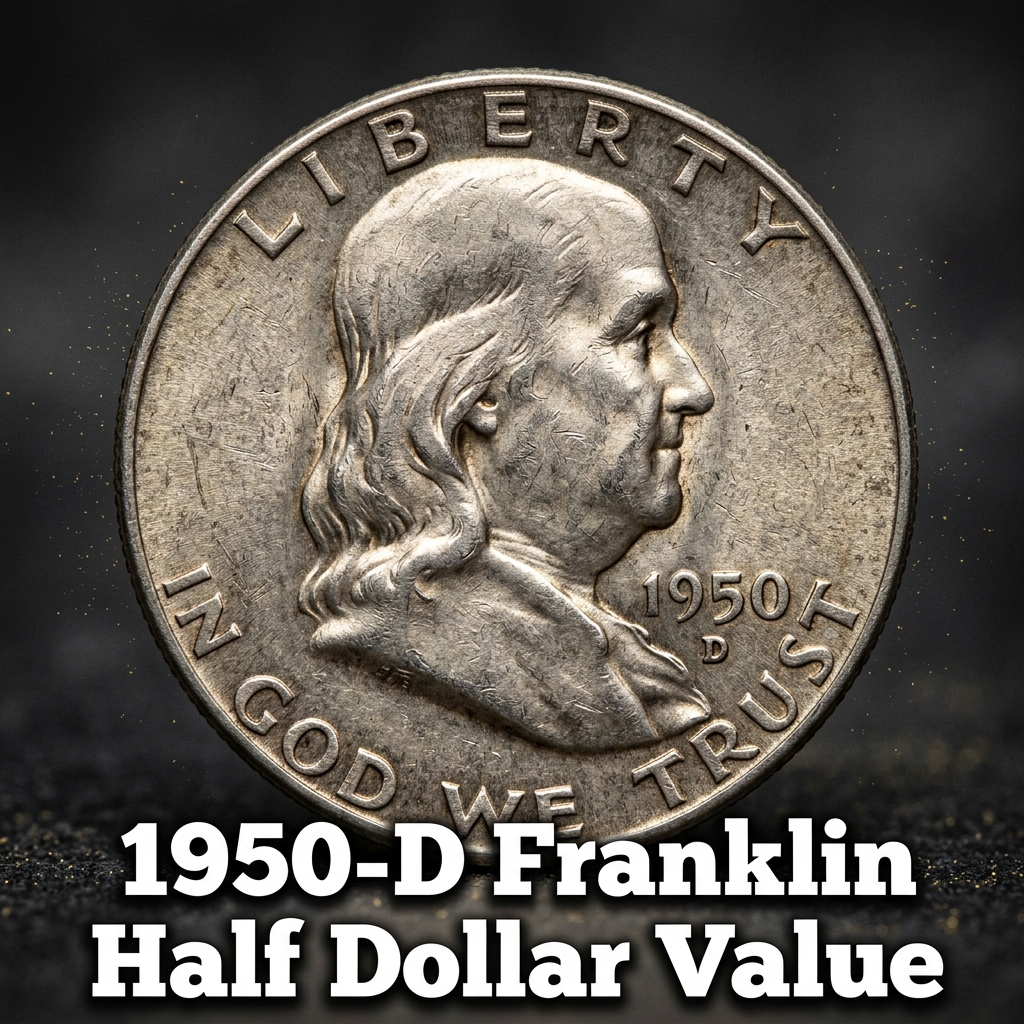
The 1950-D Franklin Half Dollar is worth anywhere from $12 in heavily worn condition to well over $200 or more in high-grade mint state — and certain certified examples have sold for thousands at auction. If you’ve found one of these silver coins tucked away in a drawer or inherited collection, you’re in the right place to find out exactly what it’s worth.
What Makes the 1950-D Franklin Half Dollar Special
The 1950-D Franklin Half Dollar was struck at the Denver Mint and carries the small “D” mintmark on the reverse side of the coin, just above the Liberty Bell. That year, Denver produced 8,031,600 half dollars — a reasonably large mintage, but not so large that every coin survived in great condition.
Like all Franklin Half Dollars minted between 1948 and 1963, the 1950-D is made of 90% silver and 10% copper, giving it real intrinsic metal value even in worn condition. With silver prices hovering around $25–$30 per ounce, the melt value alone sits near $8–$9 per coin.
If you’re trying to figure out what you’ve got, a coin identifier and value app can help you quickly identify your coin’s mintmark, grade, and estimated value right from your phone — no coin shop visit required.
How Much Is the 1950-D Franklin Half Dollar Worth by Grade
Coin value changes dramatically based on condition, or “grade.” A coin that looks shiny and detailed is worth far more than one that’s been rubbed smooth from years of pocket use. Here’s a general breakdown of 1950-D Franklin Half Dollar values:
| Grade | Description | Estimated Value |
|---|---|---|
| Good (G-4) | Heavy wear, main features visible | $12–$14 |
| Fine (F-12) | Moderate wear, some detail remaining | $14–$16 |
| Extremely Fine (EF-40) | Light wear on high points | $18–$25 |
| About Uncirculated (AU-55) | Slight wear, most luster intact | $28–$40 |
| Mint State (MS-63) | No wear, minor bag marks | $55–$80 |
| Mint State (MS-65) | Gem quality, strong luster | $150–$250+ |
For the most up-to-date pricing data, you can check the latest 1950-D Franklin Half Dollar mint state prices and auction records — the numbers can shift with silver spot prices and collector demand.
The Full Bell Lines Detail That Collectors Love
One thing that sets certain 1950-D Franklin Half Dollars apart from the rest is a designation called “Full Bell Lines” or FBL. On the reverse of the coin, the Liberty Bell has horizontal lines running across its lower half. On most coins, these lines are weak or partially struck due to die wear or improper striking pressure.
A coin that shows complete, unbroken bell lines earns the FBL designation from grading services like PCGS or NGC — and that label can multiply the value several times over.
A typical MS-65 1950-D might fetch $150–$250, but an MS-65 FBL example can sell for $800 to $1,500 or more. If your coin looks particularly sharp and detailed near the bottom of the bell, it’s absolutely worth getting it professionally graded before selling.
How to Check Your 1950-D Half Dollar’s Value at Home
You don’t need to be a professional numismatist to get a solid idea of what your coin is worth. Start by looking at the coin under good lighting and compare it to grading images online.
Check for the “D” mintmark on the reverse above the bell. Then look at how sharp the details are — Franklin’s hair, the eagle’s feathers, and those Liberty Bell lines. The sharper and more complete they are, the higher the grade.
CoinHix is a great free tool for this. You can browse the full 1950 Franklin Half Dollar value breakdown including D and Philadelphia mint versions to compare your coin against known sale prices. CoinHix pulls real auction data so you’re seeing what collectors are actually paying — not just guess estimates.
Is Your 1950-D Franklin Half Dollar Worth Selling
If your coin is in circulated condition — worn and dull — it’s still worth keeping or selling for its silver content, which gives it a solid floor value. Dealers will typically pay 70–85% of melt value for common circulated examples.
If your coin looks uncirculated or close to it, that’s when things get exciting. Consider submitting it to PCGS or NGC for professional grading, especially if you suspect it might qualify for the Full Bell Lines designation.
Either way, don’t clean the coin. Cleaning destroys value instantly, even if it makes the coin look shinier. Collectors always prefer original surface, no matter how dark it looks.
Use CoinHix to track current silver prices and half dollar auction results so you know the best time to sell and get the most for your coin.
—
Frequently Asked Questions
Q: How do I know if my Franklin Half Dollar is from Denver or Philadelphia?
A: Look at the reverse side of the coin, just above the Liberty Bell at the bottom right. If you see a small “D,” it was minted in Denver. No mintmark means it came from Philadelphia.
Q: What does the Full Bell Lines designation mean and how does it affect value?
A: Full Bell Lines (FBL) means the horizontal lines at the bottom of the Liberty Bell are complete and unbroken. This indicates a well-struck coin from fresh dies. FBL coins are rarer and can be worth several times more than non-FBL examples in the same grade.
Q: Should I get my 1950-D Franklin Half Dollar professionally graded?
A: If your coin appears uncirculated or nearly so, professional grading from PCGS or NGC is often worth the cost. A certified MS-65 FBL coin can sell for dramatically more than a raw uncertified one. For circulated coins, grading usually isn’t necessary — the silver melt value holds the floor price steady.