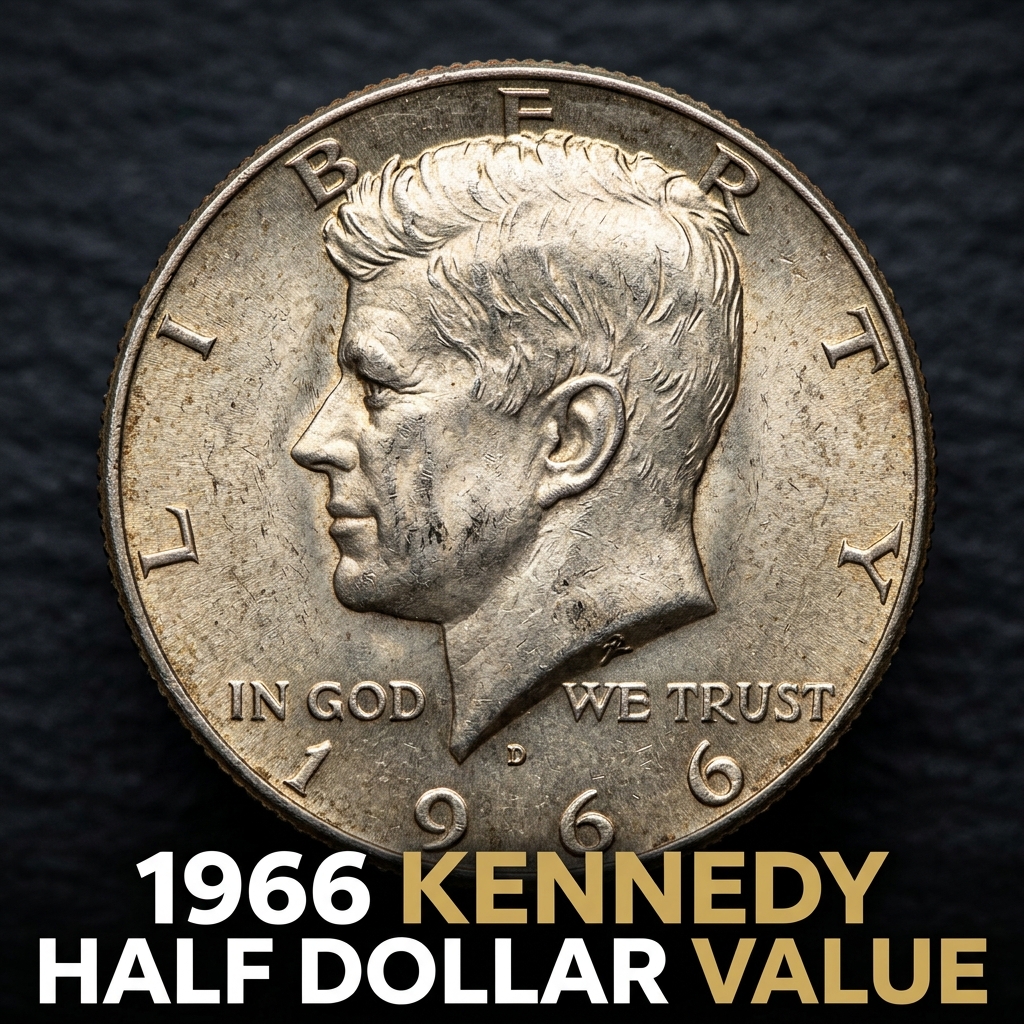
The 1966 Kennedy Half Dollar is worth anywhere from 50 cents in heavily worn condition to over $25 or more in pristine uncirculated grades — and rare high-grade examples have sold for hundreds of dollars at auction. If you found one of these silver-toned coins in a drawer or old jar, you’re in the right place to find out exactly what it’s worth.
—
What Makes the 1966 Kennedy Half Dollar Special
The 1966 Kennedy Half Dollar holds a unique place in American coinage history. It was struck just two years after the first Kennedy halves were produced in 1964, during a transitional period when the U.S. Mint was shifting away from full silver content.
Unlike the 1964 Kennedy half, which was made of 90% silver, the 1966 version contains 40% silver — part of a short-lived series known as “silver clad” coins. This means even a worn example still has some precious metal value, which is more than you can say for most modern coins.
If you’ve recently stumbled across one of these and want a quick identification, a coin identifier and value app can help you scan the coin and get an instant estimate right from your phone. It’s one of the easiest ways to start figuring out what you’ve got.
—
How Much Is a 1966 Kennedy Half Dollar Worth in Circulated Condition
Most 1966 Kennedy Half Dollars that have been used in everyday commerce fall into the “circulated” category. These coins show wear on the high points — Kennedy’s cheekbone, hair detail, and the eagle’s feathers on the reverse.
Even in circulated condition, these coins are worth more than face value thanks to their 40% silver content. At current silver prices, the melt value alone is typically around $2 to $4.
Here’s a general breakdown of circulated values:
| Grade | Description | Estimated Value |
|---|---|---|
| Good (G-4) | Heavy wear, design visible | $2 – $3 |
| Fine (F-12) | Moderate wear, clear details | $3 – $5 |
| Extremely Fine (EF-40) | Light wear on high points | $5 – $8 |
| About Uncirculated (AU-55) | Slight rub, mostly sharp | $8 – $15 |
—
1966 Kennedy Half Dollar Value in Uncirculated and High Grades
This is where things get more interesting. Uncirculated 1966 Kennedy Half Dollars — coins that were never spent or handled — can be worth significantly more, especially in top certified grades.
A coin graded MS-63 (Mint State) typically sells for around $10 to $20. Step up to MS-65, and you’re looking at $25 to $50 or more. The very finest examples, graded MS-67 and above by PCGS or NGC, have sold at auction for several hundred dollars.
You can check detailed 1966 Kennedy Half Dollar MS grade price data to see recent auction results broken down by exact grade — it’s especially helpful if your coin looks particularly sharp or original.
The 1966 Kennedy half was produced at the Philadelphia Mint only, with no mint mark. That’s normal and doesn’t affect value the way missing mint marks might on other issues. CoinHix tracks these coins closely, making it a great free resource for staying current on values as silver prices fluctuate.
—
Special Mint Set (SMS) Coins — A Hidden Gem
Here’s something many people don’t realize: in 1966, the U.S. Mint did not produce standard Proof coins. Instead, they issued Special Mint Sets (SMS) as a substitute. The 1966 Kennedy Half Dollar from an SMS set has a distinctive look — sharper than a regular strike, with a semi-brilliant or cameo appearance.
SMS coins are not Proofs, but they’re clearly a step above typical business strikes. In top grades, SMS examples are considerably scarcer and more valuable.
| Type | Grade | Estimated Value |
|---|---|---|
| SMS | SP-65 | $15 – $30 |
| SMS | SP-67 | $50 – $150 |
| SMS Cameo | SP-67 CAM | $200+ |
If your coin came in an original government set packaging, it’s worth taking a closer look. CoinHix and other grading guides can help you identify whether yours might be an SMS example.
—
How to Tell If Your 1966 Half Dollar Is Worth Getting Graded
Not every coin needs to be professionally graded, but some are absolutely worth the investment. Generally, if your 1966 Kennedy Half Dollar appears to have no visible wear, strong luster, and no damage or cleaning, it may grade MS-65 or higher — at which point third-party grading from PCGS or NGC could significantly boost its resale value.
On the other hand, if the coin is scratched, cleaned, or shows obvious wear, it’s best held as a silver bullion piece or a collector’s filler coin.
For a more thorough breakdown of what your specific coin might be worth, check out this comprehensive guide to 1966 half dollar values by grade and type. It covers everything from worn examples to top-tier SMS coins with cameo designations.
You can also use CoinHix to instantly look up recent sale prices, compare grades side by side, and get a realistic picture of what buyers are actually paying right now.
—
FAQ
Q: Is the 1966 Kennedy Half Dollar made of silver?
A: Yes, but not entirely. It contains 40% silver and 60% copper — a composition used from 1965 to 1970. Even worn coins have a silver melt value of roughly $2 to $4, depending on the current price of silver.
Q: Why does my 1966 Kennedy Half Dollar have no mint mark?
A: That’s completely normal. In 1966, all Kennedy Half Dollars were struck at the Philadelphia Mint, which did not use a mint mark at the time. The absence of a mint mark is standard for this year and does not indicate an error or reduced value.
Q: How do I know if my coin is from the Special Mint Set?
A: SMS coins typically look sharper and more reflective than regular circulation strikes, though they’re not as flashy as true Proof coins. If your coin came in the original 1966 U.S. Mint Special Mint Set packaging, that’s the surest indicator. A coin dealer or grading app like the one offered by CoinHix can also help you assess the strike quality and surface characteristics.