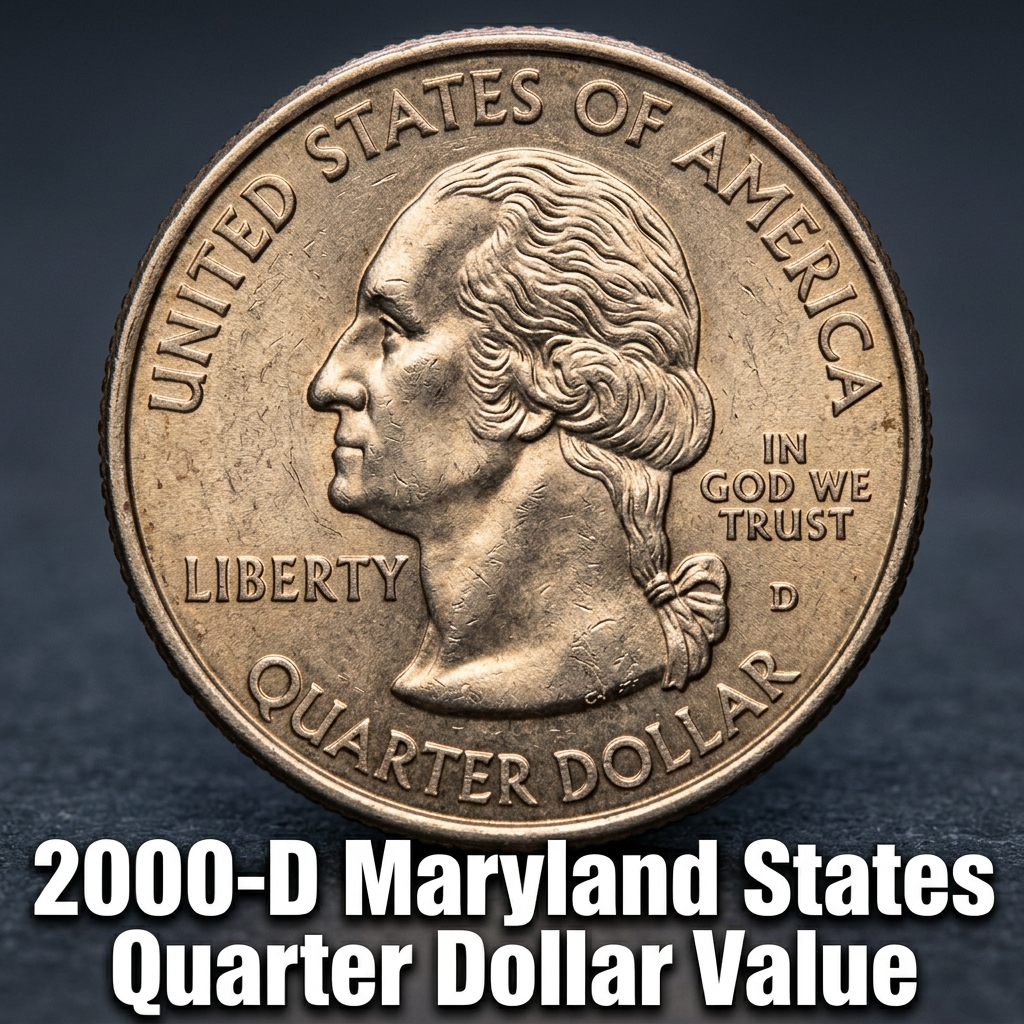
The 2000-D Maryland State Quarter is worth anywhere from 25 cents in heavily circulated condition to $10 or more in uncirculated grades — and a few rare errors have sold for hundreds of dollars. If you found one in your change jar or an old coin collection, you’re in the right place to find out exactly what you’ve got.
What Is the 2000-D Maryland State Quarter?
The 2000-D Maryland State Quarter was minted at the Denver Mint as part of the United States Mint’s 50 State Quarters Program, which ran from 1999 to 2008. The “D” mintmark stands for Denver, and you can find it on the obverse (heads) side of the coin, just below the word “IN GOD WE TRUST” near George Washington’s neck.
Maryland was the seventh state to join the Union, so it was also the seventh quarter released in the series. The reverse design features the Maryland State House dome, a White Oak branch (the state tree), and the state nickname “The Old Line State” along with the year of statehood, 1788.
These coins are not rare by production numbers alone — the Denver Mint struck over 556 million of them. But condition, errors, and collector demand all play a huge role in final value. If you want to quickly identify what you have and what it’s worth, a coin identifier and value app can be a fast, reliable first step before you visit a dealer.
2000-D Maryland Quarter Value by Grade and Condition
Coin value is heavily tied to condition, which is graded on a scale from Poor (P-1) to Perfect Mint State (MS-70). For everyday Americans who just found a coin, it comes down to three basic categories: circulated, uncirculated, and certified.
A circulated 2000-D Maryland Quarter — one that’s been used in everyday transactions — is typically worth face value, or about 25 cents. However, if it still has good detail and minimal wear, a collector might pay 50 cents to $2 for it.
Uncirculated coins that have never been used in commerce are worth more. A raw (non-certified) uncirculated example might fetch $1 to $5. If it’s been professionally graded by PCGS or NGC and comes back MS-65 or higher, it can be worth $8 to $20 or more.
| Grade / Condition | Description | Estimated Value |
|---|---|---|
| Circulated (G to VF) | Used in everyday transactions, visible wear | $0.25 – $1.00 |
| Extra Fine (EF-40 to EF-45) | Light wear on high points, sharp details | $1.00 – $3.00 |
| Uncirculated (MS-60 to MS-64) | No wear, minor contact marks | $3.00 – $8.00 |
| Gem Uncirculated (MS-65+) | Bright luster, minimal marks, sharp strike | $8.00 – $20.00+ |
| Error Coins (various) | Die cracks, double strikes, off-center | $25.00 – $300.00+ |
For up-to-date pricing across all mint state grades, you can check current market price data for 2000 State Quarters in MS grades to see where the market currently sits.
Error Coins That Are Worth a Lot More
Most 2000-D Maryland Quarters are common, but errors are a different story. The U.S. Mint occasionally produces coins with striking mistakes, die cracks, or other anomalies — and these can be worth significant money to collectors.
Common errors to look for include:
Die cracks — raised lines on the coin’s surface caused by a cracked die. Minor ones add small premiums; dramatic ones can be worth $20 to $100.
Off-center strikes — the coin blank wasn’t centered properly when struck. Depending on how far off-center and whether the date is still visible, these can sell for $50 to $300+.
Doubled die errors — look for doubling in the lettering or design elements. Significant doubled die errors on State Quarters can command $100 or more.
Always examine your 2000-D Maryland Quarter under magnification before assuming it’s common. CoinHix is a great tool to research known errors and compare your coin to documented varieties.
How to Get the Best Price for Your 2000-D Maryland Quarter
If you believe you have an uncirculated or error coin, getting it professionally graded is often worth the investment. PCGS and NGC are the two most respected grading services, and a certified coin almost always sells for more than a raw one.
For quick at-home identification, CoinHix lets you look up detailed coin data and compare values across grades and mintmarks without needing to leave your house.
You can also check a comprehensive breakdown of 2000 quarter values across all mint facilities and conditions to get a full picture of what buyers are currently paying.
If you’re ready to sell, options include eBay (great for reaching collectors), local coin dealers, coin shows, and online marketplaces like Great Collections or Heritage Auctions for certified coins.
Is the 2000-D Maryland Quarter Worth Keeping?
For most people who find a circulated 2000-D Maryland Quarter, it won’t make you rich. But it’s a well-designed, historically significant coin that’s worth at least knowing about.
If it’s in crisp, uncirculated condition — especially if it was kept in a mint set or original packaging — it’s worth holding onto or getting graded. Error coins are always worth a second look.
And for any coin you’re unsure about, CoinHix is one of the most convenient ways to get reliable coin value information fast, whether you’re a first-time finder or a seasoned collector.
—
Frequently Asked Questions
Q: How do I know if my 2000-D Maryland Quarter is uncirculated?
A: An uncirculated coin will show no signs of wear on the high points of the design — Washington’s cheek and hair, or the dome on the reverse. It should also have a bright, shiny luster. If it looks dull or has flat spots where the metal has been rubbed smooth, it’s been circulated.
Q: Where is the mintmark on the 2000-D Maryland Quarter?
A: The “D” mintmark is located on the obverse (heads side) of the coin, just below the phrase “IN GOD WE TRUST,” near the lower right side of George Washington’s portrait.
Q: Are any 2000-D Maryland Quarters valuable?
A: Most are worth face value in circulated condition. However, high-grade uncirculated examples (MS-65 or better) can be worth $10 to $20, and confirmed error coins with off-center strikes or doubled dies can sell for $50 to $300 or more depending on the severity of the error.