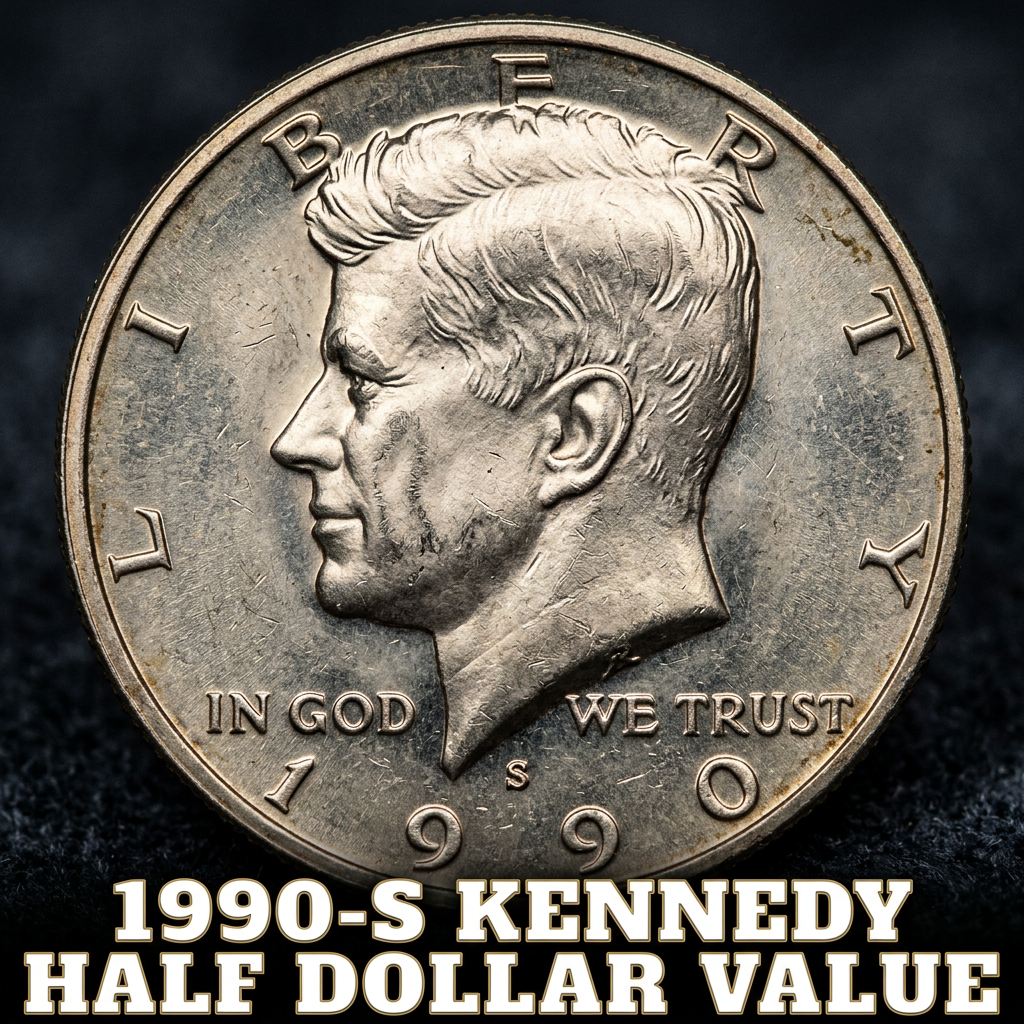
The 1990-S Kennedy Half Dollar is worth anywhere from $5 in circulated condition to over $15 or more in pristine proof quality — and if you stumbled across one in an old coin collection or a box of family keepsakes, you might be sitting on a small but satisfying find. This guide breaks down exactly what makes this coin valuable and how to figure out what yours is worth.
What Makes the 1990-S Kennedy Half Dollar Special
The “S” mint mark on this coin tells you it was made at the San Francisco Mint — and that’s a big deal. Unlike coins struck at Philadelphia or Denver for general circulation, the 1990-S Kennedy Half Dollar was produced exclusively as a proof coin. That means it was specially made for collectors, with polished dies and highly reflective surfaces that give it that mirror-like finish you might notice when you hold it up to the light.
Proof coins were never meant to circulate in your pocket change. They were sold directly to collectors through the U.S. Mint as part of proof sets. If you have one, it likely came in a hard plastic case and was part of a multi-coin set.
Because of its collector-only status, the 1990-S is worth more than a common business-strike half dollar — but it’s also not a rare coin by any stretch. The Mint produced over 3.2 million of them, which keeps values relatively modest.
If you want a quick way to identify your coin and check its grade, a coin identifier and value app can be a handy starting point before you take it to a dealer.
1990-S Kennedy Half Dollar Value by Grade
The value of your 1990-S Kennedy Half Dollar depends heavily on its condition and whether it has been professionally graded. Here’s a general look at what this coin trades for:
| Grade / Condition | Estimated Value |
|---|---|
| Proof 65 (Average Proof) | $5 – $8 |
| Proof 67 (Gem Proof) | $8 – $12 |
| Proof 69 (Near Perfect) | $12 – $20 |
| Proof 70 (Perfect Proof) | $50 – $100+ |
| Deep Cameo (DCAM) Designation | Adds 20–50% premium |
For a closer look at how the 1990 Kennedy Half Dollar grades and auction prices compare, it’s worth checking recent sales data before making any decisions about buying or selling.
What Is Deep Cameo and Why Does It Matter
You might see the abbreviation “DCAM” or “Deep Cameo” when researching your 1990-S Kennedy Half Dollar. This refers to the contrast between the frosted, raised design elements and the mirror-like background fields of the coin.
The stronger and more dramatic that contrast, the more collectors want it. A coin graded PR-69 DCAM (Proof 69 Deep Cameo) can easily be worth two to three times more than the same coin without the cameo designation.
When the Mint first strikes proof coins, the dies are fresh and produce beautiful deep cameo contrast. As the dies wear down from repeated use, that frosty finish fades. So early strikes from a given die run tend to command the highest premiums.
If your coin looks like it has that frosty, almost snowy finish on Kennedy’s portrait and the eagle on the reverse — that’s a very good sign.
How to Check the Value of Your 1990-S Kennedy Half Dollar
Not everyone wants to pay for a professional coin grading service, especially for a coin in this value range. A good starting point is to compare your coin to photos online and look at recent sold listings on auction platforms.
You can also explore detailed value breakdowns for the 1990 Half Dollar to get a better sense of what condition-specific grades are actually selling for in today’s market.
For a faster, on-the-go option, CoinHix is a popular app that lets you scan your coin and get an instant value estimate based on real market data. It’s especially useful if you’ve found a whole collection and don’t know where to start.
CoinHix also shows you historical price trends, so you can see whether a coin’s value has been rising or falling over time — helpful if you’re thinking about holding onto your 1990-S rather than selling it right away.
Is the 1990-S Kennedy Half Dollar Worth Keeping or Selling
Honestly, for most people, the 1990-S Kennedy Half Dollar is more of a sentimental keeper than a retirement fund. With values typically in the $5 to $20 range for most grades, it’s not going to change your life financially.
That said, if you have a high-grade DCAM example — especially one graded PR-70 by PCGS or NGC — it can be worth considerably more, and some collectors actively seek them out.
If you’re not sure what you have, take a few clear photos and run them through CoinHix before assuming it’s just a common coin. You might be pleasantly surprised.
Frequently Asked Questions
Q: Was the 1990-S Kennedy Half Dollar ever used in everyday circulation?
A: No. The 1990-S was struck only as a proof coin at the San Francisco Mint and sold exclusively in collector proof sets. It was never released for general circulation, which is why most examples you find are still in good condition.
Q: How can I tell if my 1990-S Kennedy Half Dollar has the Deep Cameo designation?
A: Look closely at Kennedy’s portrait and the eagle on the reverse. If the raised design has a frosty, white appearance against a mirror-bright background, your coin likely qualifies as cameo or deep cameo. For an official designation, you’d need to submit it to a grading service like PCGS or NGC.
Q: Is it worth getting my 1990-S Kennedy Half Dollar professionally graded?
A: For most examples in typical proof condition, the cost of grading ($20–$30 minimum per coin) may exceed the coin’s value. However, if you believe your coin is a PR-69 or PR-70 Deep Cameo, professional grading could significantly boost its resale value and is usually worth the expense.