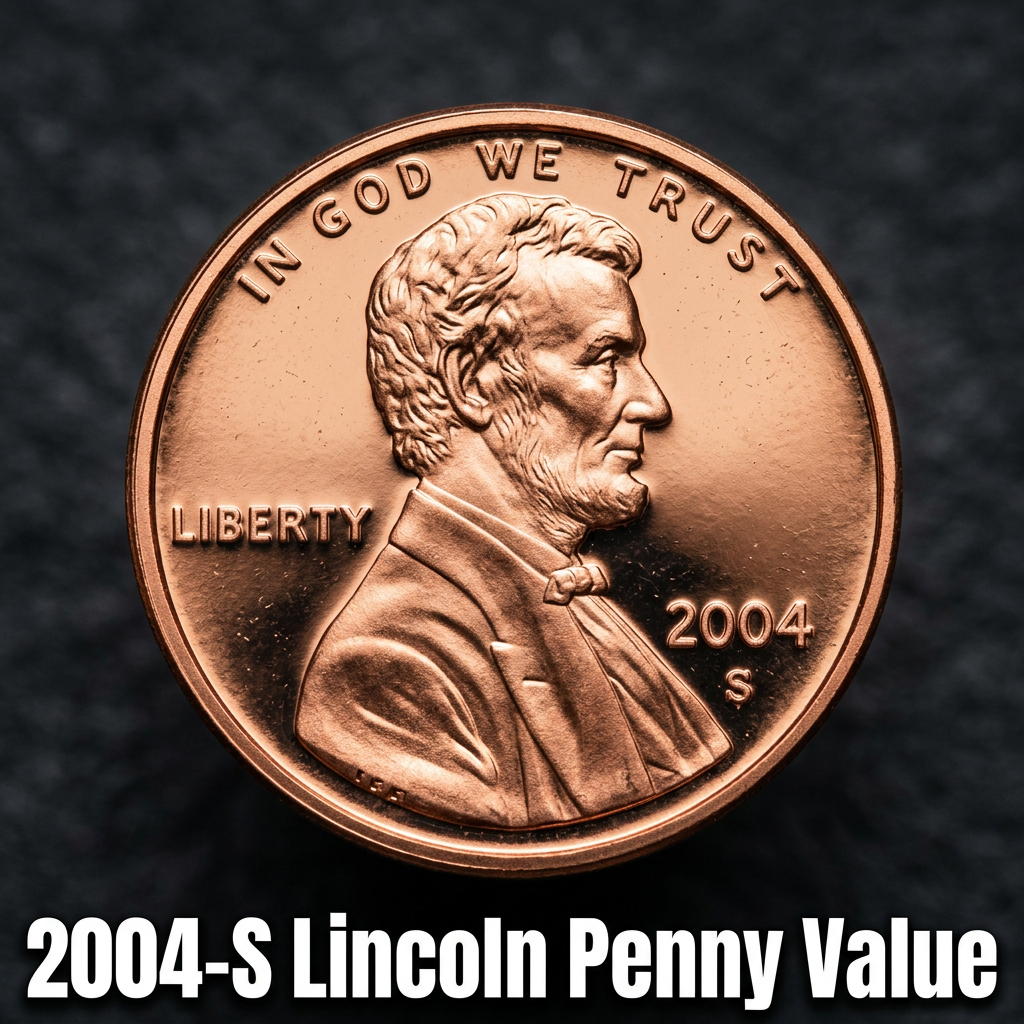
The 2004-S Lincoln Penny is worth anywhere from $1 to $5 for a typical proof specimen, but high-grade examples graded PR-70 DCAM can fetch $20 to $50 or more depending on the buyer and market conditions. If you’ve got one of these shiny coins sitting in an old collection or coin album, you’re in luck — it’s one of the more interesting modern Lincoln cents for collectors to explore.
What Makes the 2004-S Lincoln Penny Special
The 2004-S Lincoln Penny was struck at the San Francisco Mint and was never intended for everyday pocket change. The “S” mintmark is the first clue — coins bearing that mark from this era were produced exclusively as proof coins, sold directly to collectors through the U.S. Mint in annual proof sets.
Because these coins weren’t made for circulation, they tend to be in excellent condition right out of the box. They feature deeply mirrored fields and frosted design elements, giving them that classic “cameo” appearance that collectors love.
If you’re not sure what you have or want to identify your coin quickly, a coin identifier and value app can help you figure it out in seconds — no numismatic experience needed.
Proof coins are graded on a scale from PR-60 to PR-70, and the difference in value between grades can be surprisingly significant even for a modern coin like this one.
How Much Is the 2004-S Lincoln Penny Worth?
Most 2004-S Lincoln Pennies you’ll find are in proof condition, and their value largely depends on the grade assigned by a professional grading service like PCGS or NGC.
Here’s a general breakdown of values based on grade:
| Grade | Description | Estimated Value |
|---|---|---|
| PR-65 | Gem Proof | $2 – $5 |
| PR-67 | Superb Gem Proof | $5 – $12 |
| PR-69 DCAM | Near Perfect Deep Cameo | $10 – $25 |
| PR-70 DCAM | Perfect Deep Cameo | $30 – $60+ |
For the most up-to-date auction records and certified coin sales data, you can check out the 2004 Lincoln Penny price history and MS-RD grade values on CoinHix, which tracks real market transactions across major platforms.
Keep in mind that ungraded coins pulled directly from a proof set are typically worth $1 to $3 in the current market — still a nice little find, but grading makes a real difference at the top end.
What About the 2004 Lincoln Penny Without an S Mintmark?
If your 2004 penny doesn’t have a mintmark, it was likely made at the Philadelphia Mint (no mintmark) or the Denver Mint (D mintmark). These are regular circulation coins worth face value in worn or average condition.
However, there’s always a small chance your coin has an error or variety that bumps up the value. Collectors look for things like doubled dies, off-center strikes, and die cracks. These aren’t common, but they’re not impossible either.
A worn 2004-P or 2004-D penny in circulated grades is worth exactly one cent. But an uncirculated example graded MS-65 or above could be worth a few dollars, and a high-grade MS-68 or MS-69 red example can sometimes reach $20 to $100 at auction.
You can get a full breakdown of the complete 2004 penny value across all mint marks and grades to compare your coin against certified sale prices.
How to Find Out If Your Coin Is Worth Getting Graded
Grading a coin costs money — usually between $15 and $30 or more per coin through PCGS or NGC — so it’s only worth it if the coin has a realistic chance of returning more than that in value.
For the 2004-S Lincoln Penny, grading makes the most sense if your coin looks absolutely flawless. We’re talking mirror-like fields with no hairlines, fingerprints, or contact marks under magnification.
The easiest way to do a quick check is to use CoinHix, a free app that lets you scan your coin and get an instant value estimate based on current market data. It’s a great starting point before you decide to invest in professional grading.
If you’re new to all of this, don’t worry — coin collecting doesn’t have to be complicated. Start with what you have, do some basic research, and go from there.
Tips for Storing and Protecting Your 2004-S Lincoln Penny
Whether your coin is worth $2 or $50, proper storage is important. Proof coins are especially sensitive to environmental damage because of their highly polished surfaces.
Always handle proof coins by the edges — never touch the flat fields with your fingers. Store them in airtight flips, capsules, or the original U.S. Mint packaging if you still have it.
Avoid exposing your coins to humidity, direct sunlight, or PVC-containing plastic holders, which can cause green residue over time. A simple 2×2 mylar flip from any coin supply store works perfectly.
CoinHix also has a collection tracking feature so you can log your coins, record purchase prices, and monitor value changes over time — handy if you’re building a set or just keeping tabs on what you’ve got.
—
Frequently Asked Questions
Q: Is the 2004-S Lincoln Penny rare?
A: Not particularly — the San Francisco Mint produced millions of proof sets that year. But high-grade examples in PR-70 DCAM are much harder to find and command premium prices from collectors.
Q: Can I spend a 2004-S Lincoln Penny as regular change?
A: Technically yes, but it would be a waste. Even a lower-grade proof coin is worth more than face value to collectors. Keep it stored safely and don’t spend it.
Q: How do I know if my 2004-S penny is a real proof coin?
A: Look for the “S” mintmark above the date on the obverse, along with highly mirrored fields and a frosted Lincoln portrait. Real proof coins look noticeably different from circulation strikes — the contrast is sharp and the finish is almost glass-like.