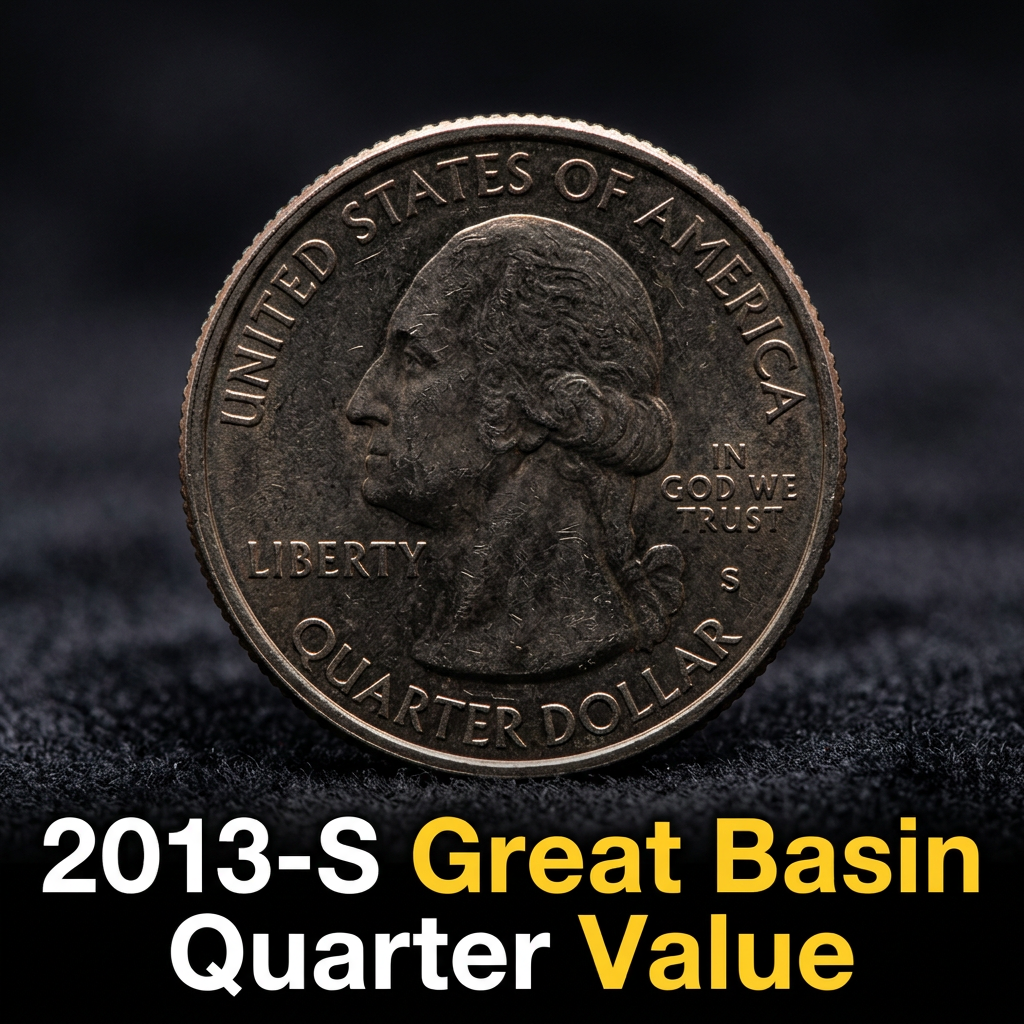
The 2013-S Great Basin National Park Quarter is worth anywhere from $1.25 in circulated condition to $5 or more in proof or high-grade mint state — and certain special versions can fetch even higher prices among serious collectors. If you found one in your pocket change or came across it in an old coin jar, you’re in the right place to find out exactly what you’ve got.
What Is the 2013-S Great Basin Quarter?
The 2013-S Great Basin Quarter is part of the America the Beautiful Quarters Program, a U.S. Mint series that ran from 2010 to 2021. Each year, five national parks or landmarks were honored on the reverse of a quarter, and Great Basin National Park in Nevada was one of the five selected for 2013.
The “S” in 2013-S tells you this coin was minted at the San Francisco Mint. That mint doesn’t produce coins for general circulation — instead, it focuses on proof and collector sets. So if you have an “S” mint mark, your coin almost certainly came from a proof set, not someone’s change.
If you want a quick way to identify your coin and check its grade at home, a coin identifier and value app can walk you through the details in seconds — no numismatic experience needed.
How Much Is the 2013-S Great Basin Quarter Worth?
The value of your 2013-S Great Basin Quarter depends mostly on what type of proof it is. The San Francisco Mint struck this coin in two versions: the standard clad proof and the Silver Proof. The silver version contains 90% silver and is naturally worth more.
Here’s a simple breakdown of current market values:
| Coin Type | Condition | Estimated Value |
|---|---|---|
| 2013-S Clad Proof | PR65 | $2 – $4 |
| 2013-S Clad Proof | PR69 | $5 – $10 |
| 2013-S Silver Proof | PR65 | $8 – $12 |
| 2013-S Silver Proof | PR69 | $15 – $25 |
| 2013-S Silver Proof | PR70 (Perfect) | $50+ |
For a deeper look at what 2013 quarters are worth across different mint marks and conditions, it’s worth cross-referencing a few trusted sources to get a well-rounded picture.
Clad vs. Silver — Does Your 2013-S Quarter Have Silver In It?
This is one of the most common questions people ask, and it’s a fair one. The standard 2013-S proof quarters are made of copper-nickel clad — the same sandwich metal used in everyday quarters. These are lovely coins with mirror-like surfaces, but they have no precious metal value beyond face value and collector interest.
The 2013-S Silver Proof quarters, however, are 90% silver and weigh slightly more than their clad counterparts. They were sold as part of the U.S. Mint’s annual Silver Proof Set.
To tell them apart, the easiest trick is to look at the edge of the coin. A clad coin will show a visible copper stripe around the rim. A silver coin will have a uniform silver-gray edge all the way around. You can also weigh the coin — silver proofs weigh about 6.25 grams, while clad proofs come in around 5.67 grams.
Finding Real-Time Prices for Your 2013-S Great Basin Quarter
Coin values shift with the market, and that’s especially true for silver coins, which move alongside silver spot prices. The values in the table above are ballpark figures based on recent sales data, but they can change.
For the most up-to-date pricing, you can check recent auction results on platforms like eBay or PCGS CoinFacts. You can also look at live price data for 2013 America the Beautiful Quarters in mint state grades to see exactly where the market stands right now.
Another great option is CoinHix, a dedicated coin pricing tool that tracks real-time values across grades and mint marks. It’s especially useful if you’re trying to compare your coin’s condition to graded examples before deciding whether to sell or hold.
Is the 2013-S Great Basin Quarter Worth Grading or Selling?
For most people, getting a coin professionally graded by PCGS or NGC only makes financial sense when the coin is expected to be worth $50 or more after grading fees. Grading a standard clad proof probably isn’t worth the cost unless you suspect you have a PR70.
If your coin looks absolutely flawless — deep mirror surfaces, no spots, no contact marks, sharp design details — it might be a PR69 or PR70 candidate, especially if it has never been removed from its original mint packaging.
CoinHix can help you compare your coin’s appearance to graded photos online before you commit to professional grading. That kind of visual reference can save you money and help you make a smarter decision about what to do with your coin.
FAQ
Q: Is the 2013-S Great Basin Quarter rare?
A: It’s not rare in the traditional sense — the U.S. Mint produced millions of proof quarters each year. However, perfect PR70 examples, especially in silver, are scarcer and command a premium from collectors.
Q: Can I find a 2013-S Great Basin Quarter in pocket change?
A: Very unlikely. The “S” mint mark means it was made only for collector sets, not for everyday circulation. If you find one in change, someone probably spent a proof coin by accident.
Q: How do I know if my 2013-S quarter is silver or clad?
A: Check the edge of the coin. A clad quarter will show an orange-copper stripe, while a silver quarter has a uniform gray edge. You can also weigh it — silver proofs weigh about 6.25 grams compared to 5.67 grams for clad.