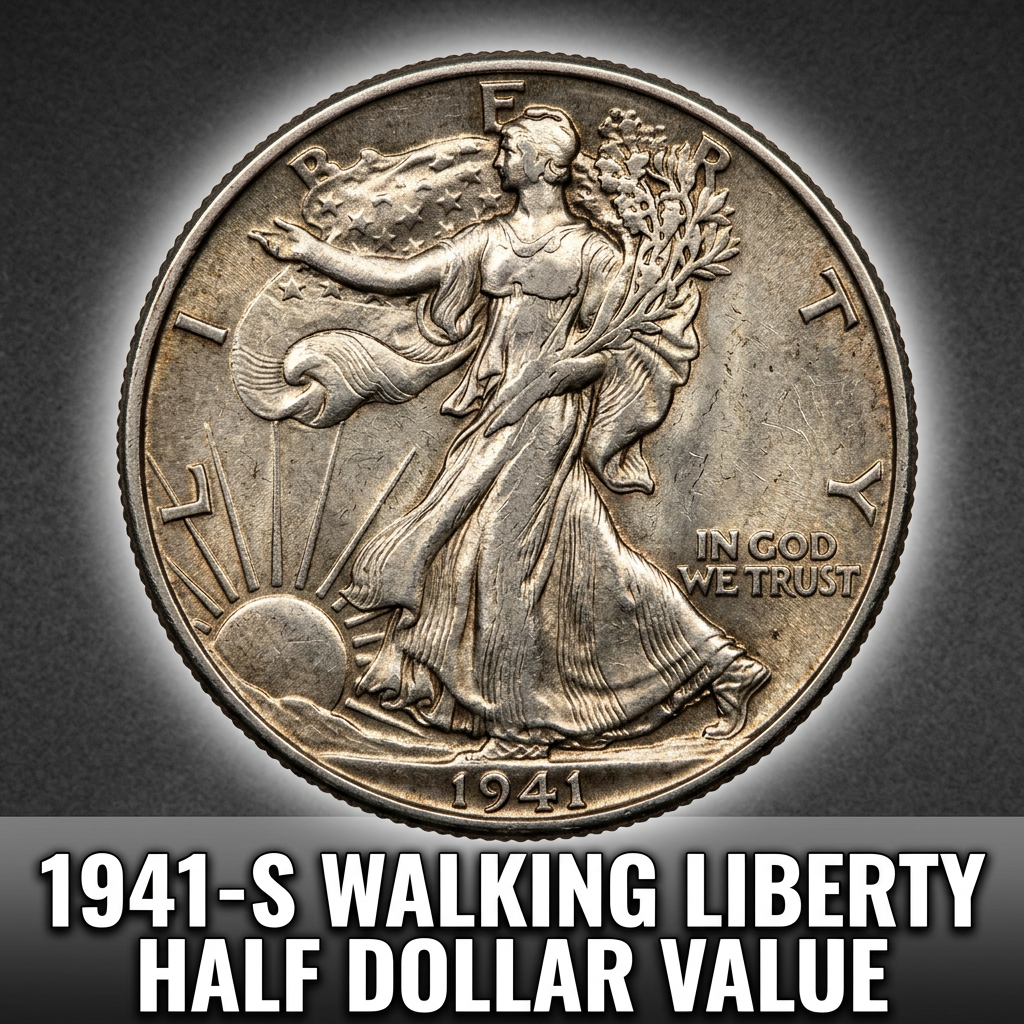
The 1941-S Walking Liberty Half Dollar is worth anywhere from $15 in heavily worn condition to well over $500 or more in high mint state grades. If you just found one of these beautiful silver coins in an old collection or tucked away in a drawer, you’re in the right place — let’s break down exactly what it’s worth and what makes it special.
What Makes the 1941-S Walking Liberty Half Dollar Special
The 1941-S Walking Liberty Half Dollar was struck at the San Francisco Mint, identified by the small “S” mintmark on the reverse side of the coin. This was wartime America, and the mint was cranking out coins to meet demand. Over 8 million of these half dollars were produced that year in San Francisco alone.
The Walking Liberty design — created by Adolph A. Weinman — is widely considered one of the most beautiful coin designs in American history. Lady Liberty strides confidently toward the rising sun, draped in the American flag. It’s the same design that inspired the American Silver Eagle bullion coin.
These coins are 90% silver, which means even a worn example has real metal value. At current silver prices, the melt value alone sits around $8–$10 per coin, giving them a solid floor no matter what condition they’re in.
If you’re not sure which mint your coin came from or what condition it might be in, a coin identifier and value app can help you get a fast, reliable read without needing to visit a dealer.
1941-S Walking Liberty Half Dollar Value by Grade
Condition is everything when it comes to coin values. Collectors use a grading scale from 1 to 70, and the difference between a Good-4 and an MS-65 can be hundreds of dollars. Here’s a general value breakdown for the 1941-S:
| Grade | Description | Estimated Value |
|---|---|---|
| Good (G-4) | Heavy wear, flat details | $15 – $18 |
| Very Fine (VF-20) | Moderate wear, some detail visible | $22 – $35 |
| Extremely Fine (EF-40) | Light wear on high points | $40 – $60 |
| About Uncirculated (AU-55) | Slight wear, most luster present | $75 – $120 |
| Mint State (MS-63) | Uncirculated, minor marks | $175 – $275 |
| Mint State (MS-65) | Gem uncirculated, sharp strike | $450 – $700+ |
For the most up-to-date auction results and certified coin prices, you can browse detailed 1941-S Walking Liberty Half Dollar price data in mint state grades to see what these coins are actually selling for right now. The market shifts, and real sale records tell a more accurate story than any static price list.
How to Check the Condition of Your 1941-S Half Dollar
Grading coins at home isn’t rocket science, but it does take a careful eye. Start by looking at the high points of the design — Lady Liberty’s left hand, her head, and the eagle’s breast feathers on the reverse. These areas show wear first.
A coin in Good condition will look flat and heavily rubbed, with the date and mintmark still legible but little fine detail remaining. A coin grading Very Fine or better will show some texture in Liberty’s gown and the eagle’s feathers.
Hold the coin under a bright light and tilt it gently. Look for original mint luster — that cartwheel shimmer that spins across the surface. If it’s there, you likely have an About Uncirculated or better coin, and it could be worth significantly more.
Don’t clean your coin. This is the number one mistake people make. Cleaning removes original surfaces and can drop a coin’s value by 50% or more. Keep it exactly as you found it until you get a professional opinion.
Where to Sell or Get Your 1941-S Half Dollar Appraised
Once you’ve got a general idea of condition and value, you have a few solid options. Local coin shops are a good starting point — they can give you a quick verbal appraisal for free in most cases. Just make sure to visit more than one to compare offers.
Online platforms like eBay, Heritage Auctions, and PCGS CoinFacts also show recent sold prices, which can give you real-world benchmarks. Certified coins — those professionally graded and slabbed by PCGS or NGC — tend to sell for higher prices because buyers trust the grade.
You can also get quick estimated values on your phone. CoinHix is a popular app among everyday collectors and treasure hunters. Snap a photo of your coin and let CoinHix pull up value ranges, historical auction data, and grade comparisons instantly — no coin expertise required.
For a broader look at what your 1941 half dollar might fetch, check out this complete 1941 Walking Liberty Half Dollar value guide covering all mint marks and grades. It’s a helpful companion resource whether you’re buying, selling, or just curious.
Is the 1941-S Walking Liberty Half Dollar Rare
With a mintage of around 8 million coins, the 1941-S isn’t considered rare in circulated grades. You’ll find plenty of them in the $15–$60 range at coin shows and online. But in high mint state grades — MS-65 and above — finding a sharply struck, fully lustrous example becomes much harder.
The 1941-S is known for sometimes having a weak or mushy strike, particularly on the high relief areas of Liberty’s hand and the eagle’s feathers. A coin with a full, sharp strike in MS-65 or MS-66 is genuinely scarce and commands a serious premium from serious collectors.
So while the coin isn’t rare in general terms, a top-tier example absolutely is — and that’s where the real money is. CoinHix can help you identify strike quality and compare your coin against certified examples.
FAQ
Q: How do I find the mintmark on a 1941-S Walking Liberty Half Dollar?
A: Look on the reverse (back) of the coin, near the lower left edge just above the rim. The “S” mintmark for San Francisco is located there. On some earlier Walking Liberty halves, the mintmark appears on the obverse, but by 1941 it had been moved to the reverse.
Q: Is a 1941-S Walking Liberty Half Dollar made of real silver?
A: Yes. Like all Walking Liberty Half Dollars minted before 1965, the 1941-S is composed of 90% silver and 10% copper. Each coin contains approximately 0.3617 troy ounces of pure silver, giving it real melt value regardless of collector grade.
Q: Should I get my 1941-S half dollar professionally graded?
A: It depends on the condition. If your coin looks uncirculated or close to it — with visible luster and sharp detail — professional grading by PCGS or NGC could be worth the investment. Certified high-grade examples sell for significantly more than raw coins. For circulated coins in Good to Very Fine condition, the cost of grading usually isn’t worth it.