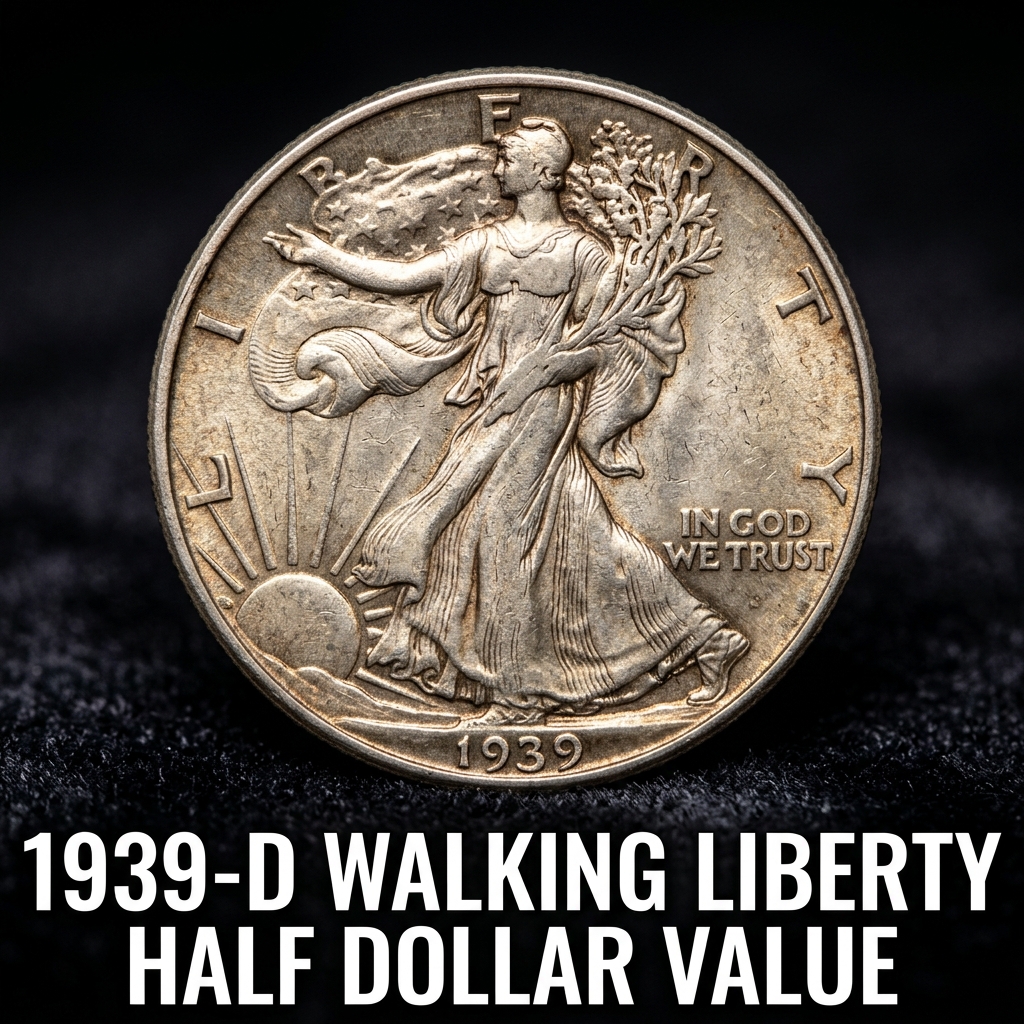
The 1939-D Walking Liberty Half Dollar is worth anywhere from $15 in heavily worn condition to over $1,000 or more in high-grade mint state examples. If you’ve come across one of these beauties in an old coin collection, a drawer, or an estate sale, you’re holding a piece of genuine American history — and it could be worth real money.
What Makes the 1939-D Walking Liberty Half Dollar Special
The Walking Liberty Half Dollar series is widely considered one of the most beautiful coin designs ever produced by the United States Mint. Designed by Adolph A. Weinman, the obverse features Lady Liberty draped in an American flag, striding confidently toward the rising sun. The reverse showcases a proud bald eagle perched on a mountain crag.
The “D” mint mark on a 1939 Walking Liberty Half Dollar tells you this coin was struck at the Denver Mint. In 1939, the Denver Mint produced 4,267,800 of these half dollars — a moderate mintage that makes the coin collectible but not extraordinarily rare in lower grades.
Still, condition is everything. A coin that spent decades in a pocket is worth far less than one that was tucked away in a drawer and never circulated. That’s the basic rule every coin collector lives by.
If you’re not sure what you have, a coin identifier and value app can help you quickly identify your coin and get a ballpark value before you take it to a dealer.
1939-D Walking Liberty Half Dollar Value by Grade
Coin values are determined by grade — a standardized scale from 1 (barely identifiable) to 70 (perfect). For everyday folks, the most common grades you’ll encounter are Good (G-4), Very Fine (VF-20), Extremely Fine (EF-40), and Mint State (MS-60 and above).
Here’s a look at current estimated values for the 1939-D Walking Liberty Half Dollar:
| Grade | Description | Estimated Value |
|---|---|---|
| G-4 (Good) | Heavily worn, design visible | $15 – $20 |
| VG-8 (Very Good) | Moderate wear, details clearer | $20 – $28 |
| F-12 (Fine) | Even wear, major features sharp | $28 – $40 |
| VF-20 (Very Fine) | Light wear on high points | $40 – $60 |
| EF-40 (Extremely Fine) | Slight wear, strong details | $65 – $90 |
| AU-55 (About Uncirculated) | Trace wear only, luster present | $100 – $150 |
| MS-63 (Mint State) | Uncirculated, minor bag marks | $200 – $350 |
| MS-65 (Gem Mint State) | Brilliant, very few marks | $700 – $1,200+ |
For the most up-to-date auction results and certified coin sales, you can check out the 1939-D Walking Liberty Half Dollar price data across mint state grades to see what buyers are actually paying right now.
How to Tell What Grade Your Coin Is
You don’t need to be an expert to get a rough idea of your coin’s grade. Start by looking at Lady Liberty’s hand and the folds in her gown on the obverse — these are the first areas to show wear.
If the details in her skirt folds are nearly gone and the surface looks flat and dull, you’re likely looking at a Good or Very Good example. If you can still make out the individual lines in the gown and the eagle’s feathers are well-defined on the reverse, you’re probably in the Fine to Very Fine range.
An uncirculated coin will show original mint luster — that soft, cartwheel-like shine you see when you tilt the coin under light. These coins were never spent and often came from old collections or bank rolls.
When in doubt, CoinHix makes it easy to look up certified sale prices so you know exactly where your coin stands in today’s market.
Silver Content and Melt Value
One thing many people overlook: the 1939-D Walking Liberty Half Dollar is made of 90% silver. Each coin contains approximately 0.3617 troy ounces of pure silver.
That means even a heavily worn example has intrinsic silver melt value. With silver trading around $28–$30 per troy ounce (prices fluctuate), the melt value alone sits around $10–$11. But numismatic (collector) value almost always exceeds melt value for these coins, so selling strictly for silver is rarely the best move.
Always compare your coin’s collector value to its melt value before making any decisions. For a complete breakdown of the 1939 Half Dollar value including silver content and grade-by-grade pricing, it’s worth spending a few minutes doing your research.
Should You Sell, Hold, or Get It Graded?
If your coin looks like it’s in Extremely Fine or better condition, it may be worth paying to have it professionally graded by PCGS or NGC — the two most respected grading services in the hobby. A certified grade adds buyer confidence and often significantly increases what the coin sells for at auction.
For coins in lower circulated grades, the cost of grading may exceed the added value. In that case, selling raw (ungraded) to a local dealer or through an online platform like eBay is a perfectly reasonable option.
CoinHix is a great tool to check recent certified sale prices before you decide which route to take. And if you’re still identifying coins from a larger collection, the CoinHix app can walk you through multiple coins quickly and efficiently.
—
Frequently Asked Questions
Q: How much is a 1939-D Walking Liberty Half Dollar worth in average circulated condition?
A: In typical circulated grades (Fine to Very Fine), expect a value of around $28 to $60. The exact amount depends on how much detail remains on the coin’s surfaces.
Q: Is the 1939-D Walking Liberty Half Dollar rare?
A: It’s not considered rare, but it is a collectible coin. The Denver Mint struck just over 4.2 million pieces that year. High-grade mint state examples are significantly scarcer and command premium prices.
Q: Should I clean my 1939-D Walking Liberty Half Dollar before selling it?
A: No — never clean an old coin. Cleaning removes the natural patina and surface metal, which dramatically reduces a coin’s collector value. Even a coin that looks “dirty” to you is worth more in original, uncleaned condition to a serious buyer.