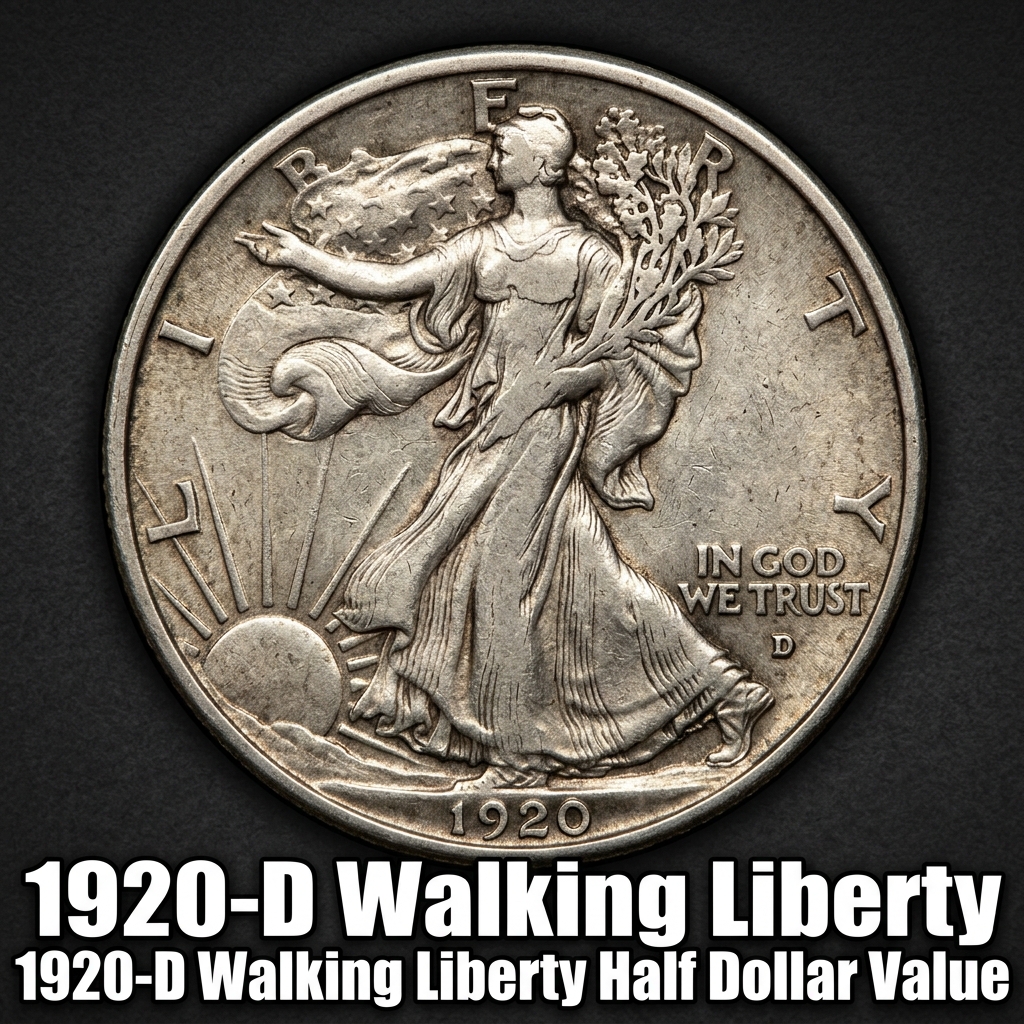
The 1920-D Walking Liberty Half Dollar is worth anywhere from $20 in heavily worn condition to well over $1,000 in high mint state grades. If you’ve stumbled across one of these beautiful old coins, you’re in luck — this is one of the more desirable Denver Mint issues from the early Walking Liberty series.
What Makes the 1920-D Half Dollar Special
The Walking Liberty Half Dollar is widely considered one of the most artistically beautiful coins ever struck by the U.S. Mint. Designed by Adolph A. Weinman, the obverse features Lady Liberty draped in the American flag, striding confidently toward the sunrise. The reverse shows a majestic bald eagle perched on a mountaintop. It’s the kind of coin that collectors genuinely love to look at.
The “D” mintmark on this coin tells you it was struck at the Denver Mint, and that matters. Denver produced 1,551,000 of these half dollars in 1920 — far fewer than the Philadelphia Mint’s output that year. Lower mintage numbers generally mean higher values, especially in nicer grades.
If you’re not sure whether your coin has a “D,” look on the obverse (front) near the bottom of the coin, just below the “IN GOD WE TRUST” motto. You can also use a coin identifier and value app to scan your coin and confirm the mintmark instantly.
1920-D Walking Liberty Half Dollar Value by Grade
Coin value depends heavily on condition, which collectors call “grade.” A coin that’s been sitting in a drawer for decades might be heavily worn, but sometimes people find coins in remarkable shape. Here’s a general breakdown of what the 1920-D is worth across different grades:
| Grade / Condition | Description | Approximate Value |
|---|---|---|
| Good (G-4) | Heavy wear, design visible | $20 – $30 |
| Very Good (VG-8) | Moderate wear, some detail | $30 – $50 |
| Fine (F-12) | Even wear, clear lettering | $55 – $90 |
| Very Fine (VF-20/30) | Light wear on high points | $100 – $200 |
| Extremely Fine (EF-40) | Slight wear, good detail | $225 – $375 |
| About Uncirculated (AU-50) | Trace wear only | $400 – $600 |
| Mint State (MS-60 to MS-63) | No wear, some bag marks | $700 – $1,200 |
| Gem Mint State (MS-65+) | Sharp, lustrous, near perfect | $3,000 – $10,000+ |
For the most up-to-date auction data and recent sale prices, you can browse 1920-D Walking Liberty Half Dollar mint state price records to see what collectors are actually paying right now.
How to Evaluate the Condition of Your Coin
You don’t need to be a professional numismatist to get a rough idea of your coin’s grade. Start by examining it under good lighting — a simple desk lamp works fine. Look at the high points of the design: Liberty’s hand, head, and the eagle’s breast feathers. These areas wear first.
If the detail on Liberty’s hand holding the branches is sharp and clearly defined, your coin is in at least Fine condition. If you can still see individual feathers on the eagle’s breast, you’re probably looking at Very Fine or better. Heavy flatness across those areas suggests a Good or Very Good grade.
Avoid cleaning your coin. It might seem like polishing it would help, but cleaning actually destroys the natural surface and dramatically reduces collector value. A coin with original, unaltered surfaces — even if it looks a little dark — is always worth more.
CoinHix offers a fast and easy way to check your coin’s grade against real-world sale prices without needing a dealer. It’s a great starting point before you decide whether to sell or hold.
Where the 1920-D Fits in the Walking Liberty Series
Among all the Walking Liberty Half Dollars minted between 1916 and 1947, the 1920-D sits in a moderately scarce category. It’s not a key date like the 1921 or 1921-D, which can sell for thousands even in poor condition. But it’s not a common date either.
What makes the 1920-D interesting is the combination of a modest mintage and high collector demand. The Walking Liberty series as a whole is extremely popular — many collectors are building complete date-and-mintmark sets, and they need the 1920-D to fill a slot.
That steady collector demand keeps prices firm even for worn examples. And if your coin turns out to be in AU or Mint State condition, you could be holding something genuinely valuable. For a full breakdown of 1920 Half Dollar values across all mint marks and grades, it’s worth reviewing detailed reference data before making any decisions.
Should You Sell, Hold, or Get It Graded
If your coin looks like it might grade EF or better, seriously consider having it professionally graded by PCGS or NGC. Third-party grading adds credibility and can significantly increase what a buyer is willing to pay. A raw (ungraded) coin in AU-50 might fetch $450 in a private sale, but a PCGS-certified AU-50 could easily hit $600 or more at auction.
For coins in lower grades — Good through Very Fine — professional grading usually isn’t worth the fee. In that case, selling to a local coin dealer or through an online marketplace makes more sense.
CoinHix makes it easy to compare prices from multiple sources before you commit to any sale. You’ll walk in knowing what your coin is actually worth, which means you won’t leave money on the table.
Frequently Asked Questions
Q: How do I know if my 1920 Half Dollar is the Denver “D” mint variety?
A: Look at the obverse (front) of the coin near the bottom, just below the motto “IN GOD WE TRUST.” If you see a small “D” mintmark, it was struck at the Denver Mint. No mintmark means it came from Philadelphia. You can also use CoinHix or another coin identification tool to confirm the variety quickly.
Q: Is the 1920-D Walking Liberty Half Dollar made of silver?
A: Yes. Like all Walking Liberty Half Dollars, the 1920-D is composed of 90% silver and 10% copper. At current silver prices, the melt value alone is around $9 to $11, but collector value in most grades far exceeds the silver content.
Q: What’s the most valuable 1920-D Walking Liberty Half Dollar ever sold?
A: Gem examples in MS-65 or higher have sold at major auction houses for $5,000 to well over $10,000. The finest known examples in grades like MS-66 or MS-67 are extremely rare and command premium prices among serious collectors.