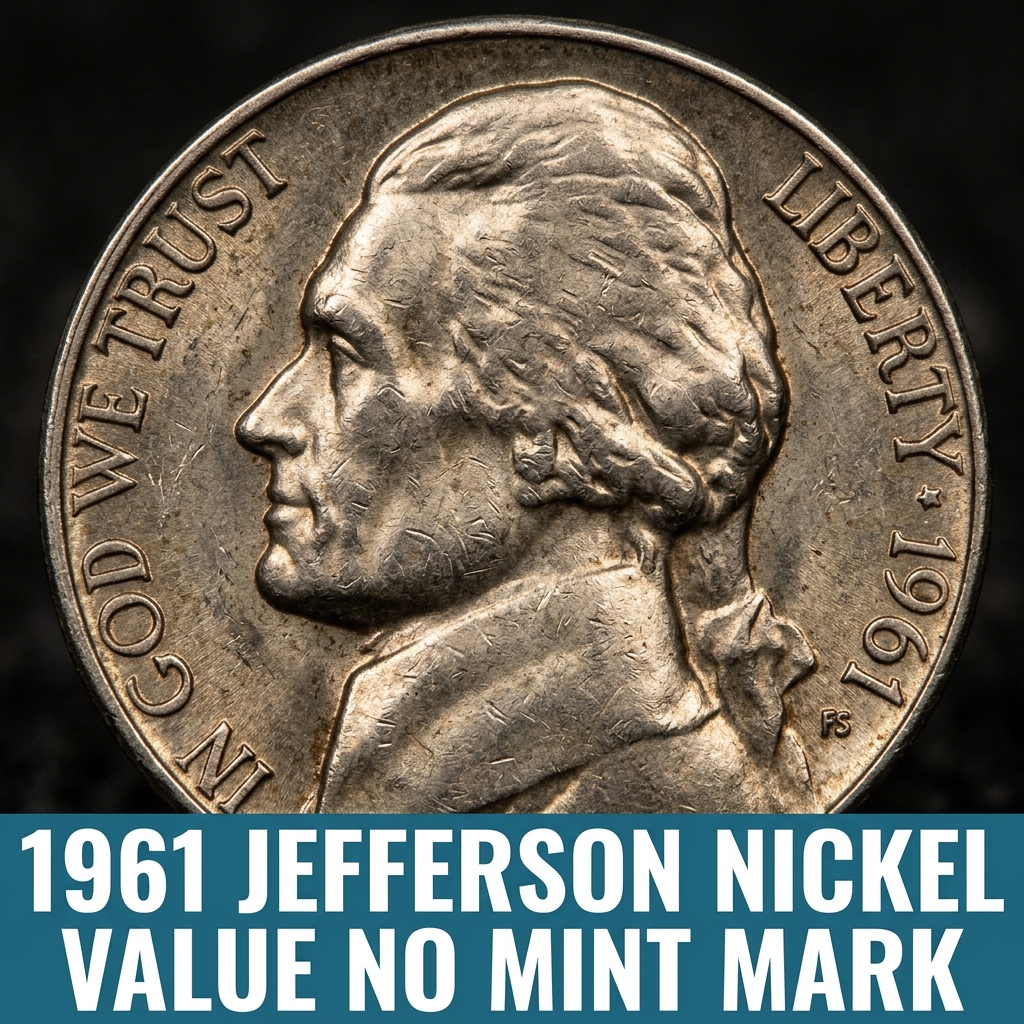
The 1961 Jefferson Nickel with no mint mark is worth anywhere from face value (5 cents) in heavily worn condition to over $100 or more in pristine mint state. Most circulated examples you find in pocket change or an old jar are worth a modest premium, but high-grade specimens can surprise you.
If you stumbled across one of these coins and you’re curious whether it’s a keeper, you’re in the right place. A coin identifier and value app can be a great first step to quickly scan your coin and get a general idea of its condition and worth before diving deeper.
What Is the 1961 Jefferson Nickel No Mint Mark?
The 1961 Jefferson Nickel with no mint mark was produced at the Philadelphia Mint. Back in 1961, the Philadelphia Mint did not stamp a mint mark on its coins — that practice only returned to Jefferson Nickels in 1980. So if you see a 1961 nickel with no letter beneath the date, it’s a Philadelphia coin, not a rare error.
The Philadelphia Mint struck over 73 million Jefferson Nickels in 1961, making them relatively common in circulated grades. That said, finding a truly well-struck, fully detailed example with all the steps visible on Monticello is a whole different story.
The coin features Felix Schlag’s iconic portrait of Thomas Jefferson on the obverse and the famous Monticello building on the reverse — a design that ran virtually unchanged from 1938 all the way to 2003.
1961 Jefferson Nickel No Mint Mark Value Chart
Coin values depend heavily on condition, also known as grade. Here’s a general breakdown of what the 1961 Jefferson Nickel is worth across different grades:
| Grade | Description | Estimated Value |
|---|---|---|
| Good (G-4) | Heavily worn, major details visible | $0.05 – $0.10 |
| Fine (F-12) | Moderate wear, clear design | $0.10 – $0.25 |
| Extremely Fine (EF-40) | Light wear on high points | $0.50 – $1.00 |
| Uncirculated (MS-60) | No wear, but many bag marks | $1.50 – $4.00 |
| Choice Uncirculated (MS-65) | Sharp strike, minimal marks | $15 – $40 |
| Gem Uncirculated (MS-66+) | Nearly perfect, exceptional luster | $50 – $150+ |
For a more detailed look at auction records and graded examples, you can explore 1961 Jefferson Nickel mint state price data to see what certified coins have actually sold for at major auction houses.
Full Steps Designation — The Detail That Changes Everything
One of the biggest factors in Jefferson Nickel collecting is the Full Steps (FS) designation. This refers to the steps at the base of Monticello on the reverse. A coin with five or six fully defined, uninterrupted steps is considered a Full Steps coin and commands a dramatically higher premium.
A 1961 Jefferson Nickel graded MS-65 might sell for $20–$40 in regular uncirculated condition. But the same coin with a Full Steps designation (MS-65 FS) can jump to $200 or even higher in some cases.
Full Steps coins from Philadelphia in 1961 are genuinely scarce because the Mint’s dies wore down quickly during high-volume production runs. So if your coin has crisp, clear steps on Monticello, it could be worth getting it professionally graded through PCGS or NGC.
You can also use CoinHix to quickly look up recent sales data and compare Full Steps versus non-Full Steps examples side by side — it’s a handy tool for understanding just how much that detail matters.
How to Grade Your 1961 Jefferson Nickel at Home
Grading coins at home doesn’t require any special equipment to get started. Pick up your 1961 nickel and look at Jefferson’s cheekbone, hair above the ear, and the high points of his coat. If those areas are smooth and worn flat, the coin is circulated and worth only a small premium over face value.
If the coin has original mint luster — that soft, flowing brightness you see when you tilt it under a light — and shows no wear at all, you’re looking at an uncirculated example. That’s where value starts to climb.
Check the reverse carefully. Count the steps on Monticello. Five or six fully separated, unbroken horizontal lines mean a Full Steps coin. Even one interrupted step drops it out of FS designation.
For a handy reference that walks through all the value tiers for this specific date, the complete 1961 nickel value breakdown is a great resource to bookmark.
Is Your 1961 Jefferson Nickel Worth Getting Graded?
Professional grading through PCGS or NGC costs money — usually $20 to $50 per coin for basic submissions — so it only makes sense if the coin could realistically be worth more than that in a slab.
For most circulated 1961 Jefferson Nickels, grading isn’t worth the expense. But if your coin looks uncirculated AND has strong steps on Monticello, it’s a different conversation entirely.
A great way to do a quick pre-screen at home is by using CoinHix — look up recent certified sales for 1961 Jefferson Nickels in MS-65 FS and MS-66 FS. If coins at that level are selling for $100+, then yes, submitting for grading makes financial sense.
Don’t forget to store potential high-grade coins in a soft flip or coin holder right away. Never clean a coin — even gentle polishing destroys original luster and kills the value instantly.
—
Frequently Asked Questions
Q: Is a 1961 Jefferson Nickel with no mint mark rare?
A: No, it’s not rare. The Philadelphia Mint produced over 73 million of them in 1961. Most are common in circulated grades. However, high-grade examples with Full Steps on Monticello are genuinely scarce and worth seeking out.
Q: How can I tell if my 1961 nickel is uncirculated?
A: Look for original mint luster — a bright, flowing shine that moves across the coin when you tilt it under light. No wear on Jefferson’s cheekbone or the high points of his hair is the key sign. Any flat, dull spots on those areas indicate circulation.
Q: What does “Full Steps” mean on a Jefferson Nickel?
A: Full Steps (FS) refers to five or six fully separated, uninterrupted horizontal lines at the base of Monticello on the reverse. This designation significantly increases a coin’s value because strong strikes were uncommon during mass production. A 1961 Jefferson Nickel in MS-65 FS can be worth many times more than the same coin without the Full Steps designation.