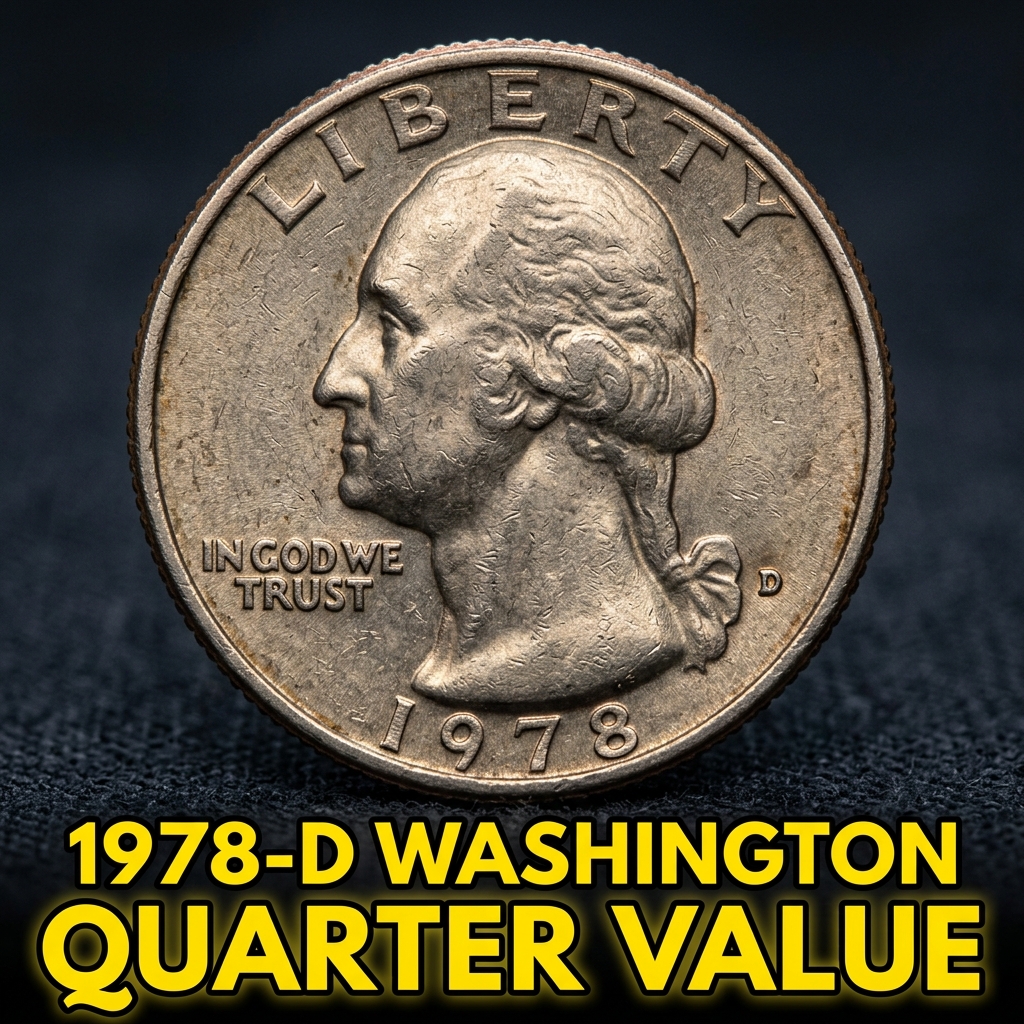
The 1978-D Washington Quarter is worth between $0.25 in heavily circulated condition and around $10 to $20 in uncirculated grades, with top-tier mint state examples occasionally reaching $50 or more. If you found one in your change jar or inherited a collection, you’re in the right place — let’s break down exactly what you’ve got.
—
What Is the 1978-D Washington Quarter?
The 1978-D Washington Quarter was struck at the Denver Mint, indicated by the small “D” mintmark on the obverse just below Washington’s portrait. In 1978, the Denver Mint produced over 287 million of these quarters, making them relatively common in circulation.
That said, “common” doesn’t always mean worthless. The value depends heavily on condition, and even a coin produced by the hundreds of millions can command a nice premium if it’s been well preserved.
If you’re not sure exactly what you’re looking at or how to grade it, a coin identifier and value app can be a fast and easy way to get an instant read on your coin without needing to be an expert.
—
How Much Is the 1978-D Washington Quarter Worth by Grade?
The condition of your coin — referred to as its “grade” — is the single biggest factor in determining its value. Coin grading follows the Sheldon scale from 1 (barely identifiable) to 70 (perfect mint state).
Here’s a quick look at typical values across different grades:
| Grade | Condition | Estimated Value |
|---|---|---|
| G-4 (Good) | Heavy wear, design visible | Face value ($0.25) |
| VF-20 (Very Fine) | Moderate wear, details clear | $0.50 – $1.00 |
| MS-63 (Uncirculated) | No wear, some bag marks | $3 – $8 |
| MS-65 (Gem Uncirculated) | Strong luster, minimal marks | $10 – $25 |
| MS-67 (Superb Gem) | Near perfect, exceptional luster | $50 – $200+ |
For the most up-to-date and detailed pricing data, you can check out current 1978-D Washington Quarter mint state price trends that track real auction results over time.
—
What Makes Some 1978-D Quarters Worth More Than Others?
Beyond the grade, a few other factors can push the value of your 1978-D Washington Quarter higher than average.
Strike quality plays a big role. Coins with sharp, well-defined details on Washington’s hair and the eagle’s feathers on the reverse are more desirable to collectors. A weakly struck coin, even in uncirculated condition, will often grade lower or sell for less.
Luster is another big deal. Original mint luster — that cartwheel-like shine you see when you tilt a coin under light — signals the coin hasn’t been cleaned or mishandled. Cleaned coins are penalized heavily in the collector market, even if they look shiny to the naked eye.
Eye appeal is sometimes subjective, but coins with pleasing toning or exceptional surfaces can attract premium bids at auction. A solid CoinHix search can show you what comparable examples have sold for recently, giving you a realistic market benchmark.
—
1978-D Quarter Error Coins and Special Varieties
While the 1978-D Washington Quarter doesn’t have many widely documented major error varieties, mint errors do occasionally show up — and they can be worth significantly more than a typical example.
Doubled die obverse errors, where design elements appear doubled due to a misaligned hub, are the most common type to look for. Check Washington’s eye, the date, and the lettering with a good magnifying glass.
Off-center strikes happen when the coin blank isn’t properly centered during striking, leaving part of the design missing. Depending on how dramatic the off-center shift is, these can range from a few dollars to over $100.
Die caps and brockage errors are rarer but highly collectible. If your coin looks dramatically different from a normal quarter — misshapen, double-sided impression, or missing design elements — it might be worth getting it authenticated.
You can also explore a full breakdown of 1978 quarter values including error coin premiums to understand what different varieties are currently fetching.
—
How to Find Out What Your Coin Is Worth Right Now
If you’re holding a 1978-D Washington Quarter and want to know its real-world value, the best first step is to assess its condition honestly. Look for wear on Washington’s cheekbone and the high points of the eagle’s breast feathers — those are the first areas to show circulation.
For a quick and reliable identification, CoinHix is a fantastic tool. It lets you look up coins by date, mintmark, and grade, and see actual recent sale prices rather than theoretical values.
If you prefer something even simpler, downloading CoinHix on your phone means you can scan or search your coin in seconds and get a ballpark value immediately — no coin expertise required.
The bottom line: most circulated 1978-D quarters are worth face value to maybe a dollar, but if yours looks crisp and shiny with no wear, it could easily be worth $10 to $50 or more in the right grade.
—
FAQ
Q: Is the 1978-D Washington Quarter made of silver?
A: No. The 1978-D Washington Quarter is made of a copper-nickel clad composition — 75% copper and 25% nickel. The U.S. Mint stopped using silver in circulating quarters after 1964. The only silver Washington Quarters minted in the modern era are special proof and collector issues.
Q: How do I know if my 1978-D quarter has an error?
A: Examine the coin under a loupe or magnifying glass and look for doubling in the lettering or date, off-center designs, or any unusual surface irregularities. If something looks noticeably “off” compared to a normal quarter, it may be an error worth researching further or submitting to a grading service like PCGS or NGC.
Q: Where is the mintmark on a 1978-D Washington Quarter?
A: The “D” mintmark is located on the obverse (heads side) of the coin, just to the right of Washington’s ribbon at the base of his ponytail, above the date. It’s a small letter but visible to the naked eye under decent lighting.