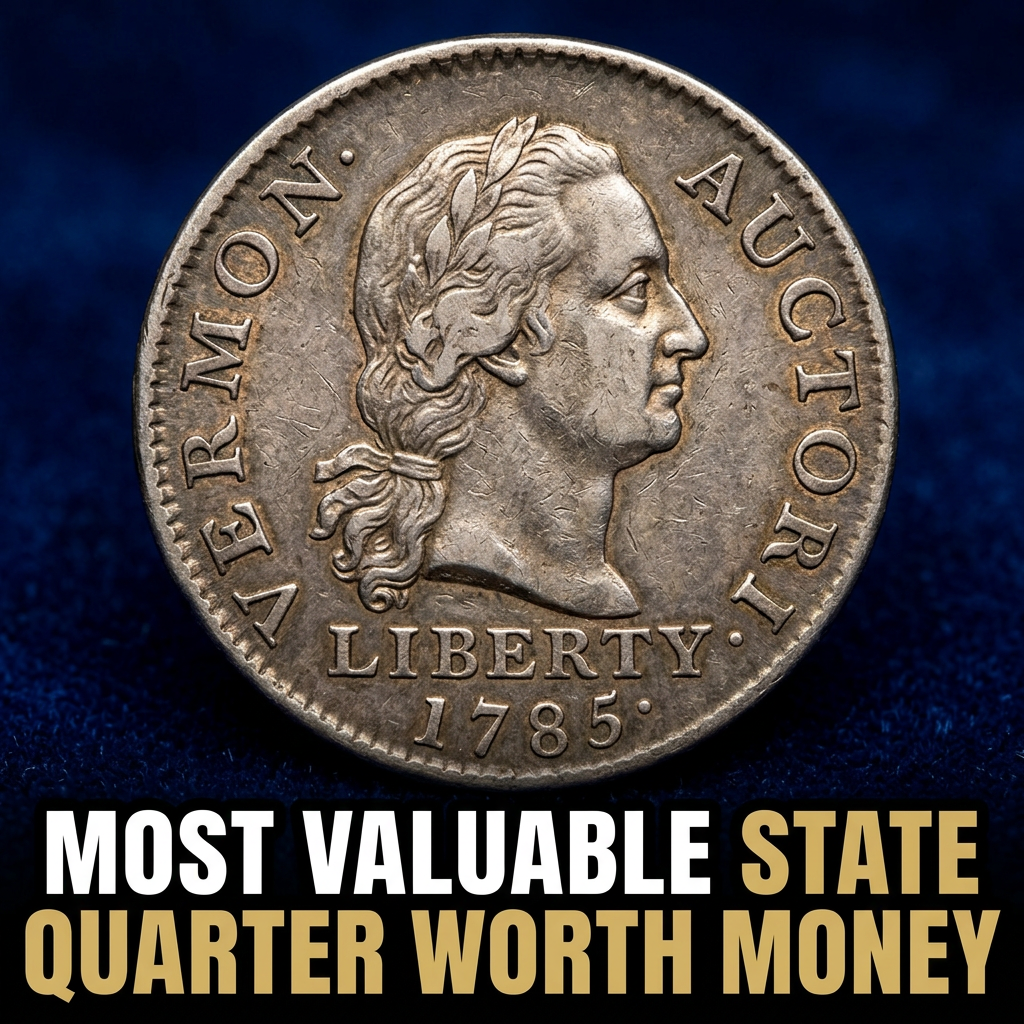
If you’ve been digging through old coin jars or checking your change, you might be sitting on more than you think — some state quarters are worth anywhere from a few dollars to over $500 or even thousands in top grades.
State quarters were minted between 1999 and 2008 as part of the U.S. Mint’s 50 State Quarters Program. Most of them are common, but a handful of dates, mint marks, and rare errors can make certain coins surprisingly valuable. If you’re not sure what you have, a good coin identifier and value app can help you figure it out quickly without needing to visit a dealer.
Whether you’re a casual collector or just curious about that quarter at the bottom of your drawer, this guide breaks down the most valuable state quarters and what makes them worth real money.
Why Some State Quarters Are Worth More Than 25 Cents
Not all state quarters were created equal. Several factors determine whether your quarter is worth face value or a small fortune.
The biggest value drivers are mint errors, high-grade condition, and low mintage numbers. Error coins — those with doubled dies, off-center strikes, or missing clad layers — are the most sought-after by collectors. A quarter that looks slightly “off” compared to a normal coin might actually be a rare mint mistake worth hundreds of dollars.
Condition also matters enormously. A quarter graded MS-67 or higher by a professional grading service like PCGS or NGC can sell for 50 to 100 times what the same coin in circulated condition would bring. Even common state quarters in near-perfect condition can fetch $20 to $50 or more.
The Most Valuable State Quarters You Should Know About
Here are some of the top state quarters that collectors actively seek out and pay premium prices for:
The 1999-P Delaware State Quarter in mint state grades is one of the most watched coins from the first year of the program. In MS-65, it sells for around $15 to $30, but in MS-68 it can top $300 or more. First-year coins always attract collector attention.
The 2004-D Wisconsin State Quarter with the extra leaf error is perhaps the most famous state quarter error. Some Wisconsin quarters came out of the Denver Mint with an extra leaf on the corn stalk — either a “High Leaf” or “Low Leaf” variety. These error coins regularly sell for $100 to $300 in circulated condition, and certified examples in MS-65 or better can reach $1,500 or more.
The 2005-P Minnesota Doubled Die Quarter is another popular error type. Collectors have found multiple doubled die varieties for this coin, with some showing strong doubling on the trees in the design. In circulated grades, these bring $25 to $100, while high-grade certified examples can push past $200.
| State Quarter | Key Feature | Circulated Value | High Grade Value |
|---|---|---|---|
| 1999-P Delaware | First-year issue, high grade demand | $0.25 – $2 | $30 – $300+ |
| 2004-D Wisconsin Extra Leaf | Error coin (High/Low Leaf) | $100 – $300 | $500 – $1,500+ |
| 2005-P Minnesota Doubled Die | Doubling on tree design | $25 – $100 | $200 – $400+ |
| 2000-P South Carolina | High MS-68 registry value | $0.25 – $1 | $250 – $500+ |
| 1999-P Connecticut | Strong gem-grade demand | $0.25 – $1 | $30 – $175+ |
State Quarter Errors That Can Make You Rich
Error coins are the real treasure hunters’ prize in the state quarter series. Beyond the Wisconsin extra leaf, there are several other error types worth knowing about.
Off-center strikes happen when a coin blank isn’t aligned properly in the press. A state quarter struck 10% to 20% off-center with the date still visible can sell for $20 to $75. More dramatic off-center errors — 50% or more — can bring $100 to $200 depending on the state.
Clad layer missing errors occur when a quarter is struck on a planchet that’s missing one of its outer layers. The result is a coin that looks copper-colored on one side and normal on the other. These sell for $50 to $150 regularly.
Broadstrike errors, where the coin was struck without the retaining collar that gives it its round shape, can also bring $30 to $100. Any time a state quarter looks genuinely unusual — thicker, thinner, lopsided, or wrong color — it’s worth getting a second opinion before spending it.
How to Check If Your State Quarter Is Worth Money
The first step is to look carefully at your coin under good lighting or a magnifying glass. Look for doubling around the letters or design elements, unusual textures, or anything that looks “off” about the image.
Next, check the mint mark — the small “P” or “D” below “In God We Trust” on the obverse. Some dates from specific mints are scarcer than others. If you see no mint mark at all, that could also indicate a rare error.
For a quick estimate, you can browse a guide to state quarters worth money in circulation to cross-reference your coin with known valuable varieties.
For a faster identification experience, CoinHix is a popular coin valuation app that lets you scan your coin and get an instant estimated value based on current market data. It’s especially handy for checking error coin varieties without having to dig through price guides manually.
If your coin looks potentially valuable, the smartest move is to have it professionally graded by PCGS or NGC. A certified coin sells for significantly more than a raw, ungraded example — and it protects you from buying or selling at the wrong price.
CoinHix also provides up-to-date auction data and population reports so you can see how many coins have been graded at each level, which gives you a clearer sense of true rarity and market demand.
FAQ About Valuable State Quarters
Q: Which state quarter is the most valuable overall?
A: The 2004-D Wisconsin Extra Leaf error quarter is widely considered the most famous and consistently valuable state quarter. Certified examples in MS-65 or higher regularly sell for $500 to $1,500 or more at major coin auctions.
Q: How can I tell if my state quarter has a doubled die error?
A: Look closely at the letters, numbers, and design elements under magnification. A doubled die will show a distinct shadow or second image slightly offset from the main design. It’s not just a blurry coin — the doubling should look deliberate and mechanical. Apps like CoinHix can help you compare your coin to known examples.
Q: Should I clean my state quarter before getting it appraised?
A: Absolutely not. Cleaning a coin — even gently — can destroy its surface and reduce its numismatic value dramatically. A cleaned coin will be graded lower or flagged with a “cleaned” designation by PCGS or NGC, which can cut the value by 50% or more. Always leave coins exactly as you find them.