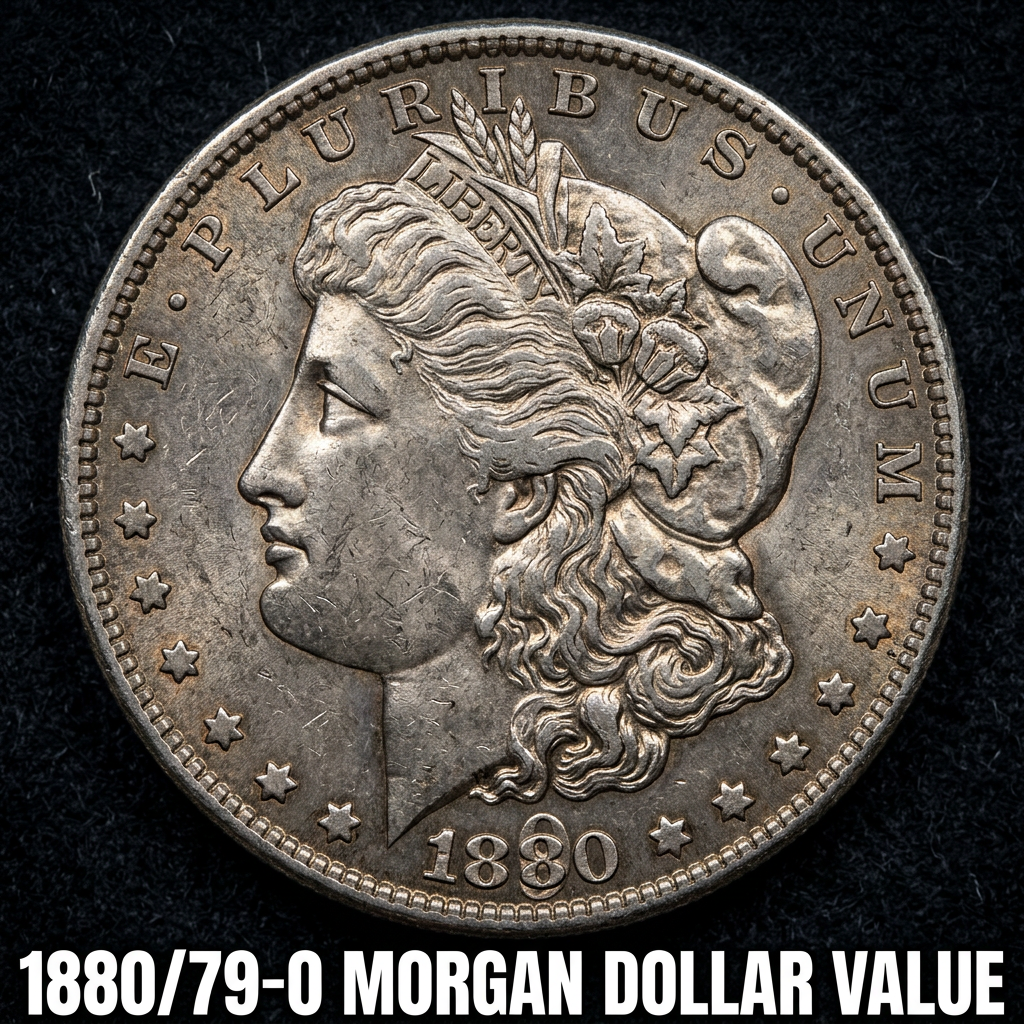
The 1880-O Morgan Dollar is worth anywhere from $30 in heavily worn condition to well over $200 in lightly circulated grades — and in pristine mint state, certified examples can fetch thousands of dollars. If you’ve come across one of these old silver dollars, you’re holding a genuine piece of American history, and it may be more valuable than you think.
What Is the 1880-O Morgan Dollar?
The 1880-O Morgan Dollar was struck at the New Orleans Mint, which is what the “O” mintmark stands for. You’ll find that mintmark on the reverse side of the coin, just above the “DO” in “DOLLAR.” The coin was designed by George T. Morgan and contains 90% silver — giving it real intrinsic metal value even if it’s heavily worn.
New Orleans produced a large number of Morgan Dollars during this era, which means the 1880-O isn’t considered a rare date in circulated grades. However, high-grade mint state examples — especially those graded MS-65 or above — become genuinely scarce and command serious premiums at auction.
If you’re not sure exactly what you have, using a coin identifier and value app is one of the easiest ways to get a quick read on your coin’s grade and approximate value without needing to visit a dealer first.
How Much Is the 1880-O Morgan Dollar Worth Today?
Value depends heavily on condition. A coin that’s been in someone’s pocket for decades looks very different from one that was saved in a collection since the day it was minted. Coin collectors grade coins on a scale from Poor (P-1) at the bottom to Mint State (MS-70) at the top.
For the 1880-O specifically, circulated coins in grades like Good (G-4) through Very Fine (VF-30) are relatively common and affordable. Once you get into Extremely Fine (EF-40) and above, prices start climbing more noticeably. Certified mint state examples graded MS-63 and better can bring hundreds of dollars from serious buyers.
Check out this detailed 1880 Morgan Dollar price data by grade to see how values break down across the full grading scale — it’s one of the most up-to-date references available for this series.
| Grade | Description | Estimated Value (1880-O) |
|---|---|---|
| G-4 (Good) | Heavy wear, major design visible | $30 – $40 |
| VG-8 (Very Good) | Moderate wear, some detail | $35 – $50 |
| F-12 (Fine) | Even wear, clearer features | $40 – $60 |
| VF-20/30 (Very Fine) | Light to moderate wear | $50 – $75 |
| EF-40/45 (Extremely Fine) | Light wear on high points | $80 – $130 |
| AU-50/58 (About Uncirculated) | Slight wear, near full luster | $140 – $200 |
| MS-63 (Mint State) | Uncirculated, some marks | $250 – $400 |
| MS-65 (Gem Mint State) | Sharp, near-perfect surfaces | $1,000+ |
The 1880/79-O Overdate — A Special Variety Worth Knowing
Here’s where things get interesting. There’s a well-known variety called the 1880/79-O, which refers to an overdate error where the last digit “0” was punched over a previously dated “9” die. This happened at the New Orleans Mint during the transition from 1879 to 1880 coinage, and it left a visible trace of the underlying “9” beneath the “0.”
This variety is collectible and does carry a modest premium over standard 1880-O coins, particularly in higher grades. Look closely at the last digit in the date with a magnifying glass — if you can see a faint “9” peeking through, you may have this desirable variety.
For a more complete breakdown of the 1880 silver dollar value including overdate varieties and mint marks, that resource covers the full picture in easy-to-read detail.
How to Check Your Coin’s Grade at Home
You don’t need to be an expert to get a rough sense of your coin’s grade. Start by looking at the highest points of the design — on the obverse, that’s Liberty’s hair above the ear and her cheek. On the reverse, it’s the eagle’s breast feathers. If those areas are smooth and flat, the coin has seen significant wear.
Lighting matters a lot. Hold the coin under a single light source and tilt it slowly — a coin with original mint luster will show a cartwheel-like shimmer as you rotate it. No shimmer usually means it’s circulated.
CoinHix is a great tool for this step — the app lets you scan your Morgan Dollar and get an instant grade estimate along with real market pricing data. It’s free to try and saves you a trip to the coin shop just to find out the basics.
Is It Worth Getting Your 1880-O Morgan Dollar Graded?
Professional grading through services like PCGS or NGC makes sense if your coin looks uncirculated or close to it. A certified MS-63 or better coin is far easier to sell at full value because buyers trust the grade.
If your coin is circulated, professional grading probably costs more than it’s worth for most common-date Morgan Dollars. In that case, knowing the approximate grade yourself — or using CoinHix to get a fast estimate — is usually enough to decide whether to sell, hold, or simply enjoy your piece of silver history.
Either way, the 1880-O Morgan Dollar is a beautiful, historically significant coin that’s always in demand among collectors. Even a well-worn example is worth real money thanks to its silver content alone.
—
Frequently Asked Questions
Q: How do I find the mintmark on my 1880 Morgan Dollar?
A: Flip the coin to the reverse side and look above the “DO” in “DOLLAR,” just below the eagle’s tail feathers. An “O” means it was minted in New Orleans. No mintmark means it came from Philadelphia.
Q: What makes the 1880/79-O overdate variety different from a regular 1880-O?
A: The 1880/79-O was made using a die that originally had the date 1879 punched into it. When workers repunched it for 1880, traces of the old “9” remained visible under the new “0.” With magnification, you can sometimes see the ghost of the “9” inside the final digit of the date.
Q: What’s the best way to find out exactly what my 1880-O Morgan Dollar is worth right now?
A: Check current auction results and price guides for your specific grade. Apps like CoinHix can give you a fast real-time estimate based on recent sales, which is often more accurate than printed price guides that go out of date quickly.