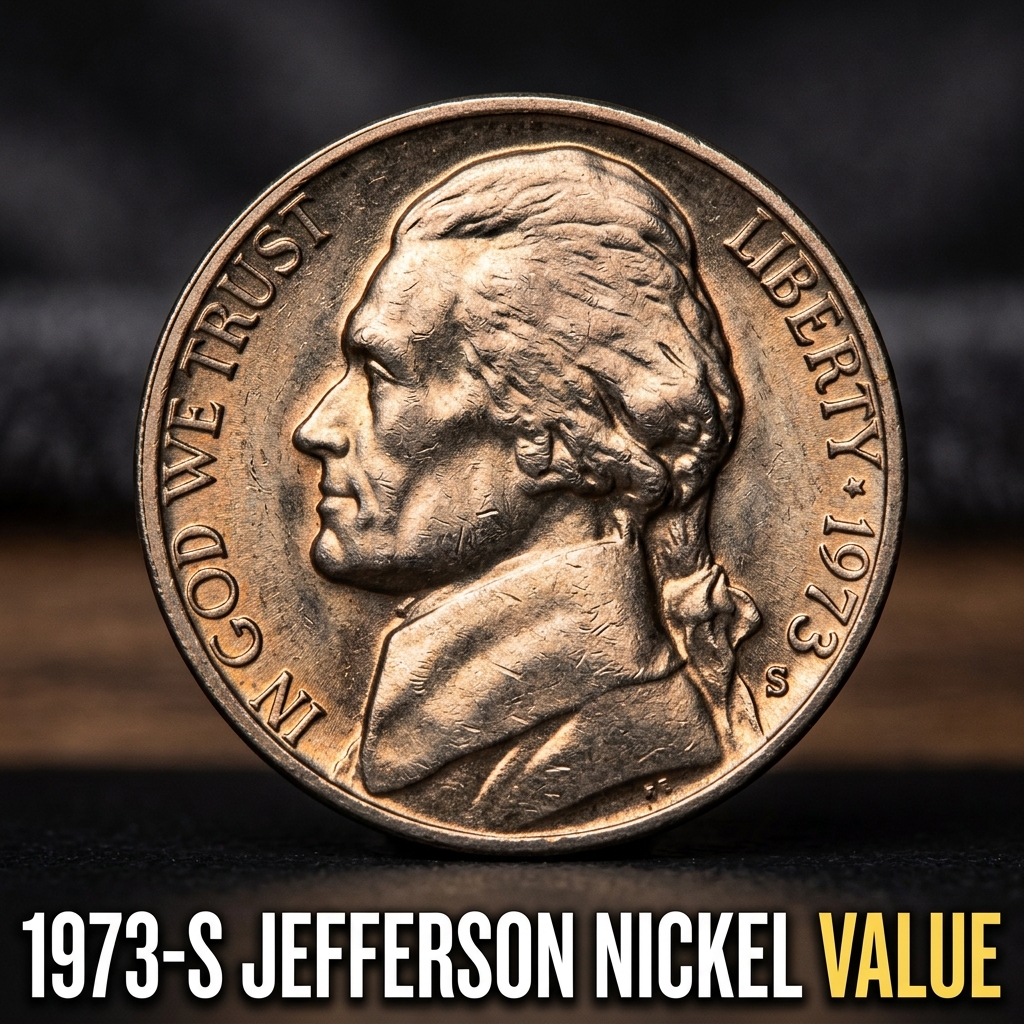
The 1973-S Jefferson Nickel is worth anywhere from 5 cents in heavily worn condition to over $15 or more in pristine mint state — and if you have a proof version, it could be worth even more. Whether you found one in a drawer, a jar of old change, or an inherited coin collection, you’re in the right place to find out what it’s really worth.
If you’re not sure what mint mark you’re looking at or want to quickly identify your coin, a coin identifier and value app can help you figure it out in seconds. It saves a lot of guesswork, especially when you’re dealing with coins from the early 1970s that can look similar at first glance.
What Makes the 1973-S Jefferson Nickel Different
The “S” in 1973-S stands for San Francisco, the mint where this coin was produced. In 1973, the San Francisco Mint was primarily striking proof coins — those specially made, mirror-finish coins intended for collectors rather than everyday pocket change.
That’s what makes the 1973-S Jefferson Nickel a little more interesting than your average nickel. Most of the 1973-S coins you’ll encounter are proof issues, meaning they were made with extra care, struck multiple times on polished planchets. These weren’t meant to circulate, so if you find one in nice condition, it probably came from a proof set.
The Philadelphia and Denver Mints handled the bulk of circulation strikes that year. So finding an “S” marked nickel usually means you’ve got something made for collectors.
1973-S Jefferson Nickel Value by Grade
Here’s a simple breakdown of what the 1973-S Jefferson Nickel is worth depending on its condition. Grades range from worn (lower grades) to perfect mint state or proof (higher grades).
| Condition / Grade | Estimated Value |
|---|---|
| Circulated (worn) | Face value (~$0.05) |
| Proof PR-65 | $3 – $6 |
| Proof PR-67 | $8 – $15 |
| Proof PR-68 or higher | $20 – $50+ |
| Cameo or Deep Cameo Proof | $25 – $100+ |
For the most current auction prices and graded coin sales, you can check out the 1973-S Jefferson Nickel price data on CoinHix, which tracks real-world market values regularly.
Proof Coins vs. Business Strikes — Which Do You Have?
Since the 1973-S was largely a proof coin issue, it’s worth knowing how to tell the difference between a proof and a regular circulation strike.
A proof coin will have sharp, well-defined details, shiny mirror-like fields (the flat parts of the coin), and frosted raised designs — especially on higher-grade cameo examples. A regular business strike looks more “normal,” with a slightly duller finish.
If your 1973-S nickel looks especially brilliant and crisp, there’s a good chance it’s a proof. Proofs are almost always more valuable than worn circulated coins, sometimes by quite a bit.
CoinHix is a great tool to use here — it lets you compare your coin’s appearance to graded examples so you can better understand what you’re working with before selling or having it professionally graded.
Should You Get It Graded?
For most 1973-S Jefferson Nickels, professional grading probably isn’t worth the cost unless you believe you have a high-grade cameo or deep cameo proof. Grading services like PCGS or NGC typically charge $20–$40 per coin, which can eat into your profit unless the coin grades PR-67 or higher.
That said, if you found a full proof set from 1973 in its original packaging, the set itself may be worth $5–$15 depending on condition.
You can also explore detailed 1973 nickel value information to better understand how different grades and mint marks affect pricing before you make any decisions.
If you’re unsure whether your coin is worth grading, try scanning it with CoinHix first. The app gives you an instant estimate so you know whether it makes financial sense to spend money on professional grading.
Where to Sell Your 1973-S Jefferson Nickel
If you decide to sell, you have a few solid options. eBay is the most popular marketplace for individual coins and tends to get competitive prices, especially for proof examples. Local coin shows and coin dealers are good if you have a full collection to sell.
For higher-grade pieces, submitting to PCGS or NGC first and then selling through a major auction house can maximize value. But for most everyday finds, an online listing with clear photos will do just fine.
—
Frequently Asked Questions
Q: Is a 1973-S Jefferson Nickel rare?
A: It’s not considered rare, but it is special because it was primarily made as a proof coin for collectors. Around 2.76 million proof nickels were struck in San Francisco in 1973. That’s not a tiny number, but proof coins in top condition are always more desirable than common circulation strikes.
Q: How do I know if my 1973-S nickel is a proof?
A: Look for a mirror-like, highly reflective surface on the flat parts of the coin, along with sharp, frosted details on Jefferson’s portrait and Monticello. Proof coins also tend to have very clean edges. If your coin looks dull or worn, it may be a circulation strike or a proof that’s been mishandled.
Q: Where is the mint mark on a 1973-S Jefferson Nickel?
A: On 1973 Jefferson Nickels, the mint mark is located on the obverse (front) of the coin, to the right of Jefferson’s portrait near the date. Look for a small “S” letter — you may need a magnifying glass to see it clearly.