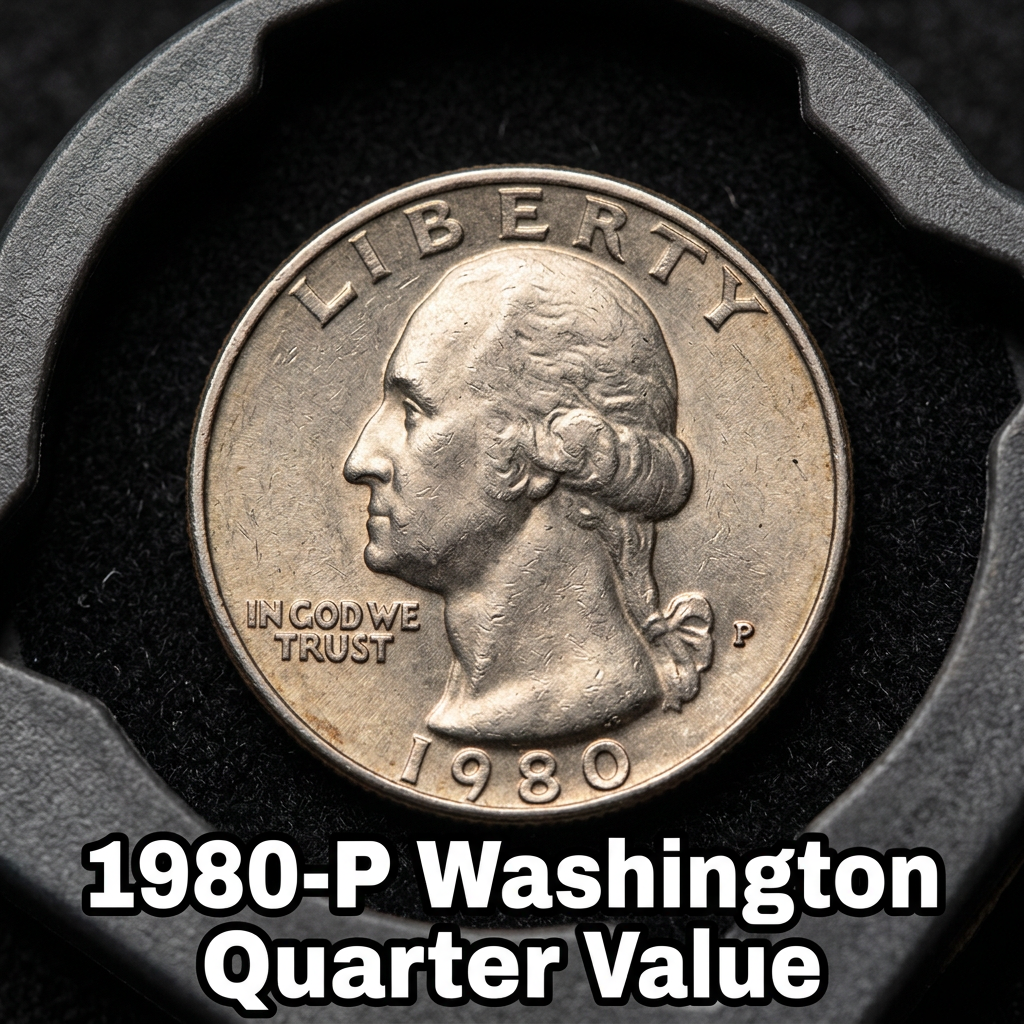
The 1980-P Washington Quarter is worth anywhere from face value (25 cents) in heavily worn condition to around $6 or more in pristine, uncirculated grades — and a few exceptional examples have sold for well over $100 at auction. If you found one in your change or an old coin jar, you’re in the right place to find out exactly what it’s worth.
What Is the 1980-P Washington Quarter?
The 1980-P Washington Quarter was struck at the Philadelphia Mint and is part of the long-running Washington Quarter series that began in 1932. The “P” mintmark — which appears on the obverse (front) of the coin — was actually a relatively new addition at the time, as Philadelphia began adding its mintmark to quarters starting in 1980.
These quarters were produced in massive numbers. The Philadelphia Mint struck over 635 million of them that year, which is a big reason why most circulated examples are only worth face value or a slight premium. Rarity is one of the key drivers of coin value, and with this many coins made, well-worn examples simply aren’t scarce.
That said, high-grade uncirculated coins are a different story. If you found a 1980-P quarter that has never been used in circulation — with sharp details, original luster, and no visible wear — it could be worth significantly more than a quarter. Use a coin identifier and value app to quickly get a sense of your coin’s grade and potential value before heading to a dealer.
1980-P Washington Quarter Value by Grade
Coin values are determined largely by condition, which is measured on the Sheldon scale from 1 to 70. Here’s a general breakdown of what a 1980-P Washington Quarter is worth at different grades:
| Grade | Condition Description | Estimated Value |
|---|---|---|
| Good (G-4) | Heavy wear, design visible | Face value ($0.25) |
| Fine (F-12) | Moderate wear, some detail | $0.25 – $0.50 |
| Extremely Fine (EF-40) | Light wear on high points | $0.50 – $1.00 |
| Mint State (MS-63) | Uncirculated, minor blemishes | $2 – $6 |
| Mint State (MS-65) | Gem uncirculated, strong luster | $6 – $20+ |
| MS-67 or Higher | Superb gem, near perfect | $100 – $400+ |
For the most up-to-date auction results and certified coin prices, you can check out the 1980-P Washington Quarter price data across multiple mint state grades to see what real collectors are paying right now.
Are There Any Valuable Error Coins to Watch For?
Most 1980-P Washington Quarters are standard circulation coins, but error coins from this year do exist and can be worth considerably more. Errors happen when something goes wrong during the minting process, and collectors actively seek them out.
Some errors to look for include:
– Doubled Die Obverse (DDO): Look for doubling in Washington’s eye, motto text, or date under magnification. These can sell for $50 or more depending on how dramatic the doubling is.
– Off-Center Strikes: If the design is noticeably shifted from the center of the coin, it’s an off-center error. A 10–20% off-center 1980-P quarter might fetch $20–$50. More extreme examples go higher.
– Die Cracks and Cuds: Raised lines or blobs on the coin’s surface caused by a cracked die can add a small premium for variety collectors.
Always examine your coins under a magnifying glass or loupe before assuming they’re ordinary. A coin that looks unremarkable at first glance might turn out to be a mint error worth hanging onto. CoinHix is a great resource for checking whether a specific variety or error has been documented and what it has sold for recently.
How to Know What Your 1980-P Quarter Is Really Worth
The real value of any coin comes down to three things: grade, eye appeal, and market demand. For a coin like the 1980-P Washington Quarter, condition is everything — the difference between a circulated example and a gem MS-67 can be hundreds of dollars.
If you believe your coin is uncirculated or nearly so, consider getting it professionally graded by PCGS or NGC. These third-party grading services encapsulate your coin in a tamper-evident holder with an official grade printed on it, which makes it much easier to sell and gives buyers confidence.
Not sure where to start? CoinHix offers an easy-to-use platform where you can browse graded examples, compare prices across grades, and understand what the market looks like before you sell or buy. You can also explore a detailed breakdown of what the 1980 quarter is worth in today’s market, with values organized by grade and condition.
Should You Spend It or Save It?
If your 1980-P Washington Quarter shows obvious wear from years in circulation, it’s probably only worth 25 cents in terms of collector value. There’s no shame in spending it — that’s what coins are made for!
But if it looks bright, shiny, and like it’s never been touched, or if you spot something unusual about it under magnification, it might be worth setting aside. Even a modest MS-65 example can be worth $10–$20, which is a nice return on a coin you found in a drawer.
The smart move is to evaluate before you decide. Apps like CoinHix make it fast and easy to look up a coin on your phone, check recent sale prices, and decide if it’s worth keeping or getting graded.
Frequently Asked Questions
Q: Is a 1980-P Washington Quarter rare?
A: No, the 1980-P Washington Quarter is not rare. Over 635 million were minted at the Philadelphia Mint, making it a very common coin. However, high-grade examples in MS-65 or above are much harder to find and can be worth a meaningful premium to collectors.
Q: Why does my 1980 quarter have a “P” on it?
A: The “P” stands for the Philadelphia Mint. Starting in 1980, the Philadelphia Mint began adding its mintmark to quarters for the first time. Before that year, Philadelphia quarters had no mintmark at all, which is why collectors consider 1980 a historically notable transition year for this coin series.
Q: How do I get my 1980-P Washington Quarter graded?
A: You can submit your coin to PCGS (Professional Coin Grading Service) or NGC (Numismatic Guaranty Company) for official grading. Both services accept submissions directly from the public or through authorized dealers. Grading fees vary, so it typically makes the most sense to submit coins you believe are in high uncirculated grades where the value increase justifies the cost.