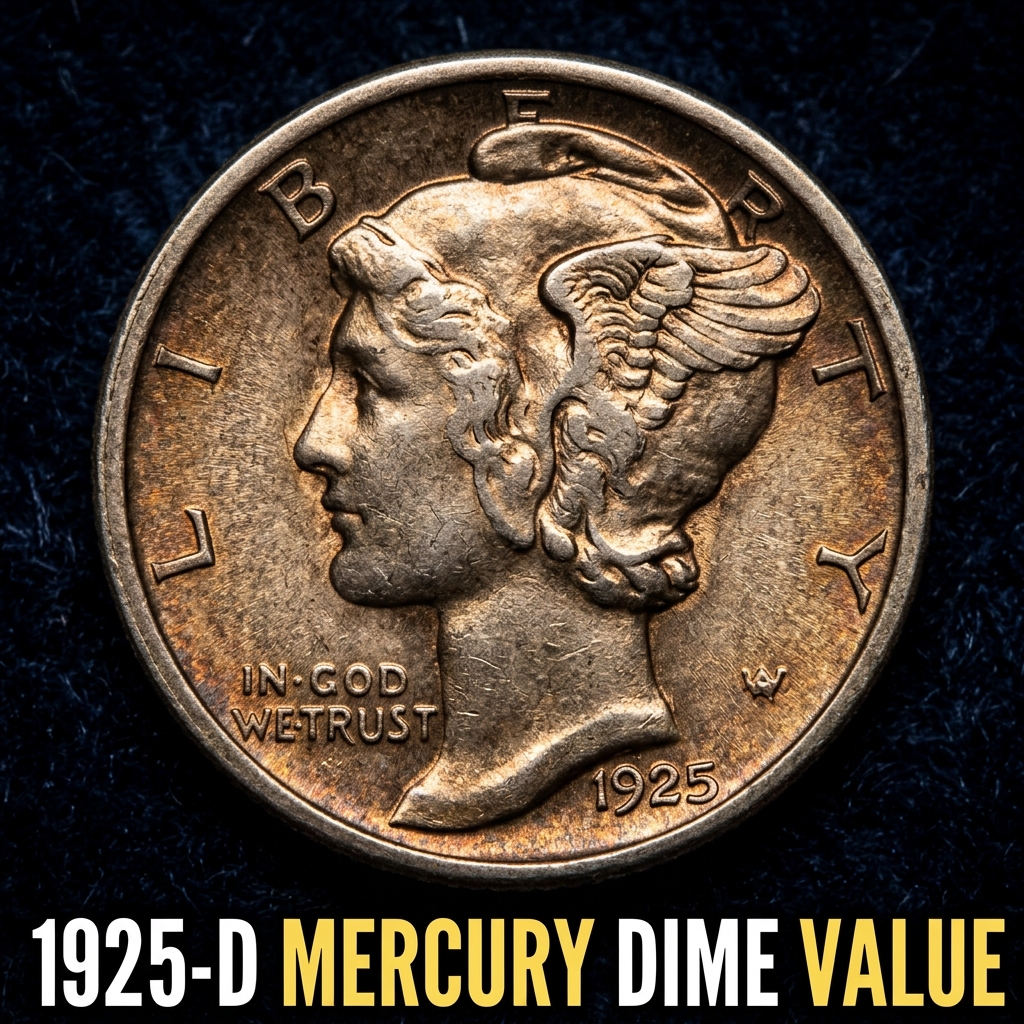
The 1925-D Mercury Dime is worth anywhere from $5 in heavily worn condition to over $500 or more in high-grade mint state, making it one of the more sought-after issues in the Mercury Dime series. If you just found one of these old silver dimes in a coin jar, a drawer, or your grandfather’s collection, you’re in the right place — let’s break down exactly what you have and what it might be worth.
What Makes the 1925-D Mercury Dime Special
The 1925-D Mercury Dime was struck at the Denver Mint, which is why you’ll see a small “D” mintmark on the reverse side of the coin, just to the left of the “ONE DIME” text. Denver produced 5,117,000 of these dimes in 1925 — a mintage that’s considered relatively low compared to many other years in the series.
Lower mintage generally means fewer coins survived in good condition, and that matters a lot when it comes to value. Collectors are always chasing well-preserved examples, and the 1925-D is no exception.
If you’re unsure whether what you have is actually a Denver-issue coin, a coin identifier and value app can help you quickly confirm the mintmark and get an instant value estimate right from your phone.
1925-D Mercury Dime Value by Grade
Coin grading might sound complicated, but it really just comes down to how much wear your coin shows. A coin fresh from the mint with no wear is called “mint state,” while coins that passed through everyday circulation show varying degrees of wear.
Here’s a general value breakdown for the 1925-D Mercury Dime based on condition:
| Grade | Description | Estimated Value |
|---|---|---|
| Good (G-4) | Heavy wear, outline visible | $5 – $8 |
| Fine (F-12) | Moderate wear, some detail remains | $12 – $20 |
| Extremely Fine (EF-40) | Light wear on high points | $40 – $70 |
| About Uncirculated (AU-55) | Slight wear, most luster intact | $90 – $150 |
| Mint State (MS-63) | No wear, minor contact marks | $200 – $350 |
| Mint State (MS-65+) | Gem quality, full luster | $500 and up |
For the most up-to-date pricing, you can check current 1925-D Mercury Dime prices across mint state grades to see what collectors are actually paying right now.
How to Check the Condition of Your 1925-D Dime
Grab a magnifying glass and look at Liberty’s face on the front of the coin. On a well-worn example, the facial features and hairlines will be flat and blended together. On a better-preserved coin, you’ll see sharp, distinct details in Liberty’s winged cap and facial profile.
On the reverse, look at the fasces (the bundle of rods with an axe) and the olive branch. If the diagonal bands running across the fasces are fully visible with clear separation, your coin is in at least Fine condition — and that’s a good sign.
The CoinHix app makes this process much easier for beginners. You can photograph your coin and get an instant grade estimate along with current market values, all without needing to visit a dealer first.
Silver Content and Melt Value
Even if your 1925-D Mercury Dime is heavily worn and not particularly collectible, it still has real value because of its silver content. Mercury Dimes are composed of 90% silver and 10% copper, with each coin containing about 0.07234 troy ounces of pure silver.
With silver prices fluctuating in the range of $28–$32 per troy ounce (as of recent market data), the melt value of a worn 1925-D Mercury Dime is roughly $2.00 to $2.30. That means even the most circulated examples are worth more than face value.
So no matter what condition your coin is in, it’s always worth more than 10 cents. You can also explore a detailed breakdown of 1925 dime values including silver melt estimates to get a clearer picture before you decide whether to sell or hold.
Should You Clean or Sell Your 1925-D Mercury Dime
Please don’t clean it. This is one of the most common mistakes coin beginners make. Cleaning a coin removes its natural patina and surface luster, which collectors value highly. A cleaned coin can lose 50% or more of its numismatic value instantly, even if it looks shinier afterward.
If you think your coin might be in especially good shape, consider having it professionally graded by PCGS or NGC. A graded and slabbed coin typically sells for significantly more than a raw (ungraded) example, especially for key dates and mintmarks like the 1925-D.
Before doing anything, use CoinHix to photograph and identify your coin — it’s free to get started and gives you a solid baseline value so you know what you’re working with before approaching a dealer.
FAQ
Q: How do I know if my dime is the 1925-D and not the Philadelphia or San Francisco issue?
A: Look at the reverse of the coin, just to the left of the text “ONE DIME.” If you see a small “D,” it was minted in Denver. No mintmark means Philadelphia, and an “S” means San Francisco.
Q: Is the 1925-D Mercury Dime a rare coin?
A: It’s not considered extremely rare, but its Denver mintage of just over 5 million is lower than many other years, which makes it a conditionally scarce coin in high grades. Gem mint state examples are genuinely hard to find and command strong premiums.
Q: Where is the best place to sell a 1925-D Mercury Dime?
A: eBay, coin shows, and reputable coin dealers are all solid options. If your coin grades MS-63 or higher, having it certified by PCGS or NGC before selling can significantly increase buyer confidence and final sale price. Apps like CoinHix can also help you gauge fair market value so you don’t leave money on the table.