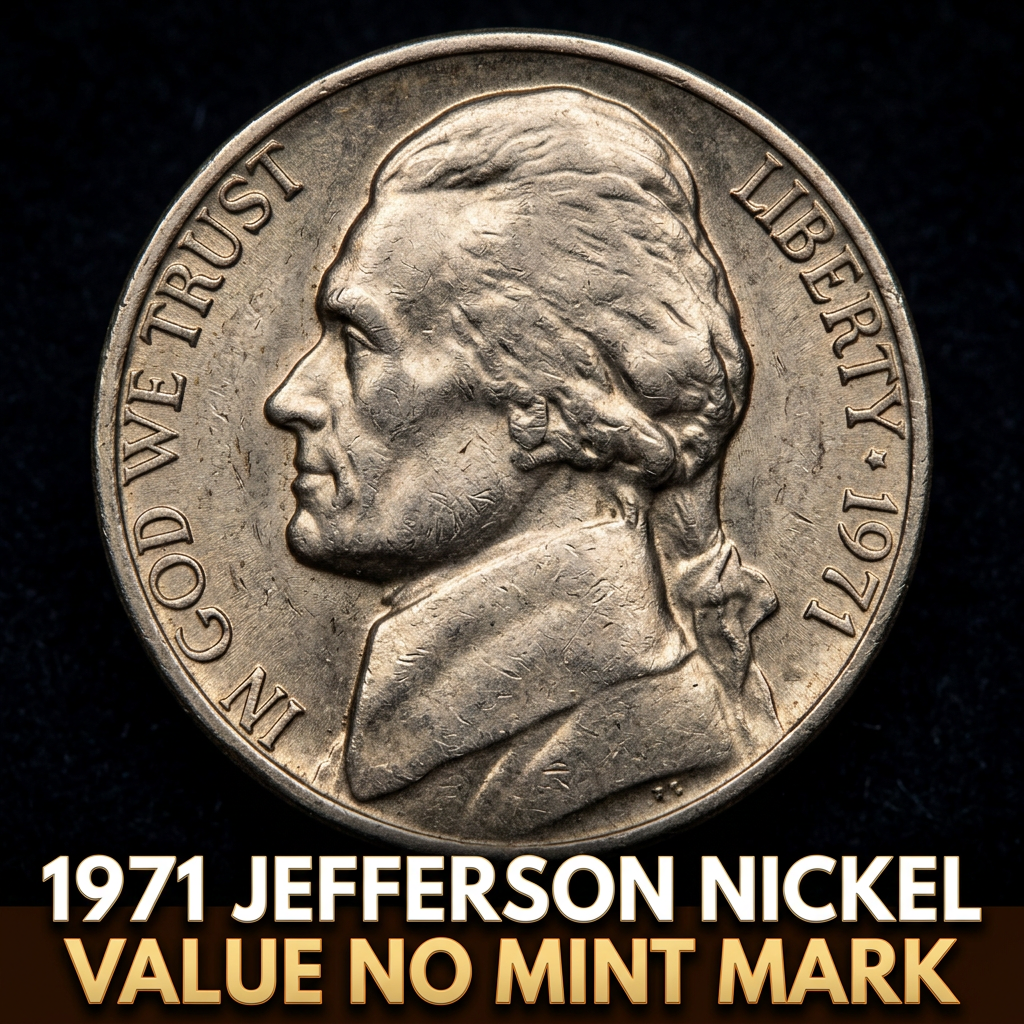
The 1971 Jefferson Nickel with no mint mark is worth anywhere from face value in heavily circulated condition to over $100 or more in pristine, uncirculated grades — and a few rare error coins can fetch even higher prices. If you found one of these coins in your pocket change or an old jar, you’re in the right place to find out exactly what you’ve got.
What Is the 1971 Jefferson Nickel No Mint Mark?
The 1971 Jefferson Nickel was produced at the Philadelphia Mint, which is why it carries no mint mark at all. That was standard practice for Philadelphia coins during this era — they simply didn’t stamp a “P” on the coin.
Over 106 million of these nickels were struck in 1971, making it a fairly common coin in circulated grades. But don’t let that discourage you. Even common coins can surprise you when they’re in exceptional condition.
The coin features the classic design by Felix Schlag — Thomas Jefferson’s portrait on the obverse and Monticello on the reverse. These design elements have made the Jefferson Nickel one of the most recognizable American coins since 1938.
If you want a quick and easy way to identify your coin and check its grade, try using a coin identifier and value app — it can save you a lot of guesswork right from your smartphone.
How Much Is the 1971 Jefferson Nickel Worth Today?
The value of a 1971 Jefferson Nickel with no mint mark depends almost entirely on its condition. A coin that has been circulated — meaning it’s been used as everyday money — is generally worth only face value or just a few cents over.
However, coins in uncirculated or mint state condition are where things get interesting. A nickel graded MS-65 can be worth $15 to $40, while a coin in MS-67 condition could fetch $100 or more at auction.
Here’s a quick value chart to break it down:
| Condition / Grade | Estimated Value |
|---|---|
| Good (G-4) | Face value ($0.05) |
| Fine (F-12) | $0.10 – $0.25 |
| Extremely Fine (EF-40) | $0.50 – $1.00 |
| Mint State (MS-63) | $5 – $12 |
| Mint State (MS-65) | $15 – $40 |
| Mint State (MS-67) | $100+ |
For more detailed and up-to-date pricing data, you can check out the 1971 Jefferson Nickel MS grade pricing on CoinHix — it’s a reliable resource with real market data broken down by grade.
Are There Any 1971 Nickel Errors Worth Looking For?
Yes, and this is where things can get really exciting. Error coins are always a hot topic among collectors, and the 1971 Jefferson Nickel is no exception.
One of the most notable errors to look for is a doubled die variety, where the design elements appear slightly doubled due to a misalignment during the die production process. These can show up on Jefferson’s portrait, the date, or Monticello.
Another error to watch for is an off-center strike, where the design is not centered on the coin blank. Depending on how far off-center it is, these coins can be worth anywhere from $20 to several hundred dollars.
If you suspect you have an error coin, it’s worth having it examined by a professional grader or running it through CoinHix to get a quick sense of what you might have.
Grading Your 1971 Jefferson Nickel
Grading is the process of assessing a coin’s physical condition, and it has a huge impact on value. The cleaner and sharper the coin, the higher the grade — and the higher the price.
For Jefferson Nickels, collectors pay close attention to the steps on Monticello. A coin with clearly defined steps — known as “Full Steps” — commands a significant premium. Even a common-date nickel like the 1971 can be worth several times more if it has Full Steps designation.
To check how your coin compares on the market, take a look at the 1971 Jefferson Nickel value breakdown by grade — it’s an easy-to-follow guide that shows exactly what collectors are paying right now.
If you’re not sure how to grade your coin yourself, CoinHix makes it simple with photo-based identification tools that can help you get a ballpark estimate from your phone.
Tips for Selling or Keeping Your 1971 Jefferson Nickel
If your coin is in circulated condition, it’s probably not worth selling — but it’s still fun to keep as a piece of American history. On the other hand, if you’ve pulled a sharply struck, uncirculated coin from an old roll or collection, you might be sitting on something worth real money.
Before selling, consider getting your coin professionally graded by PCGS or NGC. A certified grade adds credibility and can significantly increase what buyers are willing to pay.
Whether you’re a first-time finder or a seasoned collector, doing your research pays off. Use tools like the CoinHix app to stay current on coin values, compare grades, and make smarter decisions about your collection.
—
FAQ
Q: Is a 1971 Jefferson Nickel with no mint mark rare?
A: No, it’s not rare — over 106 million were struck at the Philadelphia Mint. However, high-grade examples and error coins can still be quite valuable to collectors.
Q: What does “no mint mark” mean on a 1971 nickel?
A: It means the coin was made at the Philadelphia Mint. During 1971, Philadelphia did not add a mint mark to its coins, so the absence of a letter is a normal characteristic, not a mistake.
Q: How can I tell if my 1971 nickel has Full Steps?
A: Look at the base of Monticello on the reverse side of the coin. If you can count five or six clearly separated, unbroken steps, your coin may qualify for the Full Steps designation — which can add a significant premium to its value.